
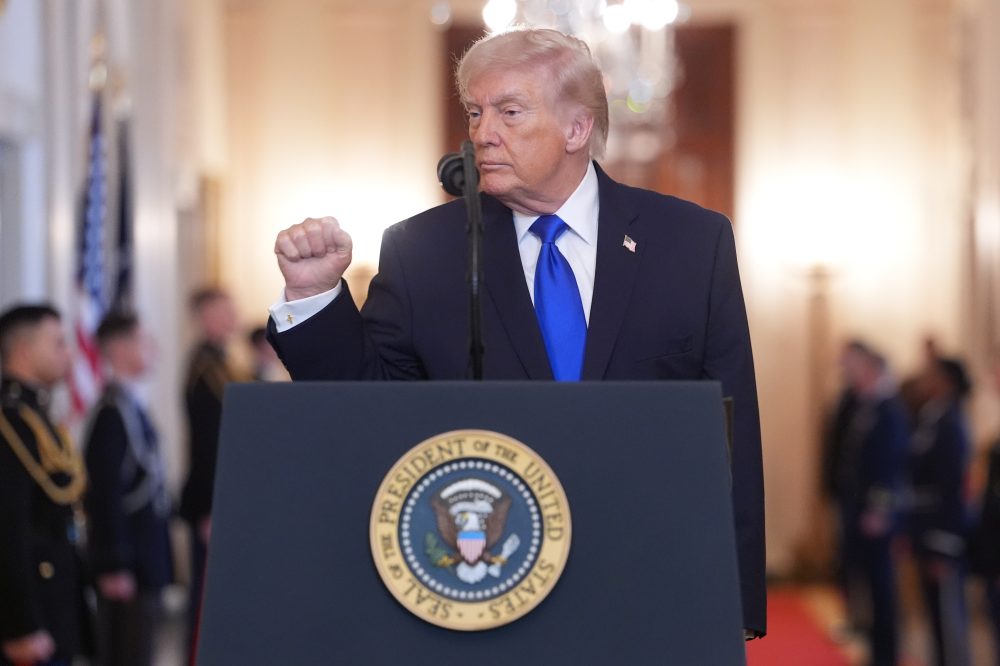
WASHINGTON (AP) — President Donald Trump says he has a lot to talk about tonight.
He’s returning to Congress to deliver a State of the Union address at a consequential moment in his presidency, with his approval ratings near an all-time low and restive supporters waiting for him to deliver more tangibly on their struggles with the cost of living.
On top of that, the Supreme Court just declared illegal the tariffs that have been central to his second term. And the foreign policy challenges he promised to fix easily now don’t look so simple with another potential military strike against Iran looming.
The narrow Republican majority in Congress that has done little to counter Trump’s expansive vision of power is at risk of falling away after this year’s midterm elections, when their respective self interests may collide.
Here are some questions we’re thinking about heading into the speech.
Trump did little to hide his rage last week when the Supreme Court struck down his far-reaching tariff policy. He didn’t just say that the justices who voted against one of his signature issues — including two who he appointed — were wrong in their legal reasoning. He said they were an “embarrassment to their families.”
Now many of those justices are likely to be seated at the front of the House chamber as Trump delivers his address.
Will Trump criticize the justices to their faces? Will he somehow show restraint in keeping his criticism limited to the decision itself?
Trump would not be the first president to use a State of the Union address as a chance to criticize the court. During his 2010 address, President Barack Obama said the Court’s Citizens United decision — which opened the way for millions of dollars in undisclosed political spending — would “open the floodgates for special interests,” prompting Justice Samuel Alito to shake his head and mouth “not true.”
Since then, attendance by Supreme Court justices has become more sporadic. Alito began skipping them after the 2010 speech, joining fellow conservative Justice Clarence Thomas, who has long argued the speeches are too partisan. By last year, when Trump delivered a special address to Congress, just four members of the Court — Chief Justice John Roberts along with Justices Elena Kagan, Brett Kavanaugh and Amy Coney Barrett — were in the House chamber.
At the time, Trump greeted the justices warmly, even telling Roberts “thank you again, I won’t forget it.” The comment was interpreted as Trump showing appreciation for the Court’s decision granting broad-based immunity to the presidency. But Trump said on social media he was merely thanking the chief justice for swearing him in.
Regardless, justices who don’t want a televised bashing from the president may decide to steer clear on Tuesday.
Democrats were still adjusting to Trump’s return to power when he last addressed Congress — and it showed.
During his 2025 joint address, Democrats entered the chamber with signs containing messages ranging from “Save Medicaid” and “Musk Steals” to simply “False.” Rep. Al Green, D-Texas, heckled Trump at one point, prompting his ejection from the chamber.
The signs were widely criticized as contrived and Green’s protest was something of a distraction. For voters who were outraged by Trump’s aggressive use of power during his opening months in office, the scene didn’t offer much confidence that Democrats were in a position to serve as an effective check on the White House.
Democrats are aiming to avoid a repeat of last year’s tumult. Expect fewer signs and possibly fewer Democrats in the chamber at all. Dozens of lawmakers have said they won’t attend the speech, with some planning to attend rival events in Washington.
That may help avoid some of last years theatrics. But it might do little to encourage frustrated voters that Democrats have a coherent, effective message a decade into Trump’s political rise.
And after Democratic governors boycotted a White House dinner with Trump over the weekend, skipping the State of the Union may only reinforce the sense that America’s two main political parties are charting fundamentally different courses.
Abigail Spanberger, Virginia’s newly inaugurated governor, will give the Democrats’ official response to Trump.
Trump will deliver his speech at the outset of a challenging election year for his fellow Republicans, who are holding on to a tenuous grip of Congress. Much of the GOP’s challenge has centered on a sense among voters that the party hasn’t done enough to bring down prices.
The White House insists it is aware of the economic anxiety among voters and is working to address it. But Trump consistently has trouble staying on message. During a trip to Georgia last week that was intended to focus on the economy, the president instead highlighted debunked claims of election fraud and pushed his proposal for voter identification requirements. When he addressed affordability, he said it was a problem created by Democrats that he has now “solved.”
Trump’s tone on immigration could also be notable. Republicans found themselves on defense after two U.S. citizens were killed in Minneapolis last month by federal agents who were conducting an aggressive immigration enforcement operation. While Trump has kept up his hardline rhetoric on undocumented immigrants, his administration has begun to draw down agents in Minneapolis. The president told New York Gov. Kathy Hochul last week that he would direct future immigration enforcement surges where they were wanted.
Trump promised a quick and easy end to conflicts across the globe when he was elected. A year later, Russia’s war in Ukraine continues to rage, there’s a fragile ceasefire in war-torn Gaza and Trump is threatening a major military strike against Iran just eight months after he claimed the U.S. had “obliterated” the nation’s nuclear facilities.
And let’s not forget about his military action in Venezuela less than two months ago in which U.S. forces snatched leader Nicolas Maduro. Trump has said repeatedly that he’s going to run the country.
Trump supporters may cheer his America First rhetoric, but the Republican president is showing far more globalist tendencies one year into his second term.
And the prospect of war with Iran is real. Trump has already built up the largest U.S. military presence in the Middle East in decades. Last week he warned the Iranian regime that “bad things will happen” soon if a nuclear deal is not reached.
Trump is rarely one to self edit. His speech last year — technically a joint address and not the State of the Union — clocked nearly one hour and 40 minutes. That was the longest speech to a joint session of Congress — and Trump may want to notch another record.
“It’s going to be a long speech because we have so much to talk about,” he said on Monday.
Brought to you by www.srnnews.com
 Calls grow for Texas Rep. Gonzales to resign over allegations of affair with ex-staffer
 Wisconsin schools, teachers file lawsuit against GOP-led Legislature seeking more funding
 The Latest: Trump will lay out his midterm agenda at the State of the Union
 New York City police investigating after officers were hit with snowballs during a snowball fight