
By Julie Steenhuysen
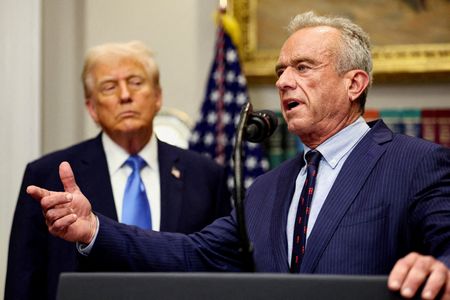
CHICAGO, March 17 (Reuters) – A federal court injunction on Monday put a check on Health Secretary Robert F. Kennedy Jr.’s rapid assault on U.S. vaccine recommendations, but months of turmoil and misinformation have sown doubt about vaccines that will be hard to reverse.
“The genie is out of the bottle. We’re going to have to live with that,” said Michael Osterholm, director of the University of Minnesota’s Center for Infectious Disease Research and Policy.
The decision, issued in a lawsuit brought by the American Academy of Pediatrics and others against Kennedy and the Health Department, reverses key parts of Kennedy’s moves to reshape U.S. vaccine policy, including reducing the number of shots routinely recommended for children.
It may also prove temporary if the government appeals the ruling.
The judge said Kennedy’s Advisory Committee on Immunization Practices was unlawfully reconstituted after Kennedy fired all 17 independent public health and infectious disease vaccine advisers.
When the firings became public, experts warned that the shake-up could destabilize the U.S. vaccine program and erode confidence. In Monday’s ruling, U.S. District Judge Brian Murphy said most of Kennedy’s 15 hand-picked panel members appear “distinctly unqualified.”
Richard Hughes IV, lead counsel for the American Academy of Pediatrics, acknowledged that despite the victory, damage has already been done. The dispute was necessary to “stop the continued destruction of science‑based policy for vaccines,” he said.
A spokesperson for the U.S. Department of Health and Human Services said: “HHS looks forward to this judge’s decision being overturned.”
KENNEDY NARROWS VACCINE SCHEDULE
Kennedy’s vaccine policy changes over the past year often circumvented the government’s traditional evidence-based recommendation process.
At the new panel’s September meeting, Kennedy’s advisers voted to remove a recommendation for routine COVID vaccines, recommending instead that people consult with their doctor – a process called shared clinical decision-making.
At its December meeting, the panel voted to abandon a longtime recommendation for universal newborn hepatitis B vaccination, a policy that had been shown to reduce hepatitis B infections in children by 99%, without scientific evidence to support making the change.
Kennedy in January narrowed the entire federal childhood vaccine schedule – without panel input or scientific evidence – moving four shots from routine recommendations to shared clinical decision-making. Ultimately, the Centers for Disease Control and Prevention recommended 11 shots broadly, down from 17.
Experts stressed that parents have always had the option of discussing vaccines with their physician, but shifting vaccines from a routine recommendation to shared decision-making raises suspicions about vaccine safety, the University of Minnesota’s Osterholm said.
“It creates doubt if you now have to discuss it with your doctor,” he said.
MANY STATES REJECT CDC VACCINE GUIDANCE
As a result of the changes, many states have rejected the CDC’s childhood vaccine guidelines.
As of March 10, some 30 states including the District of Columbia said they will not follow the new CDC recommendations for at least some childhood vaccines, according to a poll by the nonprofit health policy organization KFF. Of those, 27 said they will not rely on CDC guidance for any childhood vaccines.
Most of those have said they instead will follow the recommendations of the American Academy of Pediatrics, which has been issuing vaccine guidance since the 1930s, long before CDC’s advisory committee was formed in 1964.
Although AAP previously worked to harmonize its vaccine schedules with the federal government, the pediatric medical society broke with that tradition last year, saying that ACIP’s process was “no longer credible.”
Dr. Demetre Daskalakis, former CDC director of the National Center for Immunization and Respiratory Diseases, who left the agency in August along with three others in protest over Kennedy’s vaccine policies, said he was happy that they were able to raise the red flag.
“Now we need to repair the damage these HHS actions have caused and the disease that they have allowed to propagate,” he said.
POLICY SWINGS LEAVE PARENTS CONFUSED
Pediatricians say the policy swings have left parents with mixed messages and more questions, leading some to question even routine newborn treatments such as vitamin K.
Providers are hearing from parents who are confused about what to do, said Alison Barkoff, a health law and policy expert at George Washington University who joined an amicus brief supporting the AAP.
A KFF poll in February found that trust in the CDC for reliable vaccine information is at its lowest point since the start of the COVID-19 pandemic.
A court‑ordered reset cannot instantly unwind months of politicized debate, said Jen Kates, a senior analyst at KFF.
“It’s not like you can flip a switch and say, ‘OK, let’s go back to where we were,’” she said.
(Reporting by Julie Steenhuysen in Chicago; Editing by Caroline Humer and Matthew Lewis)
Brought to you by www.srnnews.com
 Iran’s internet blackout silences voices at home as diaspora creators fill the void
 Top counterterrorism official Kent resigns over Trump’s Iran war, says Iran posed no imminent threat
 US House transport committee head wants to collect EV fees for highway repairs