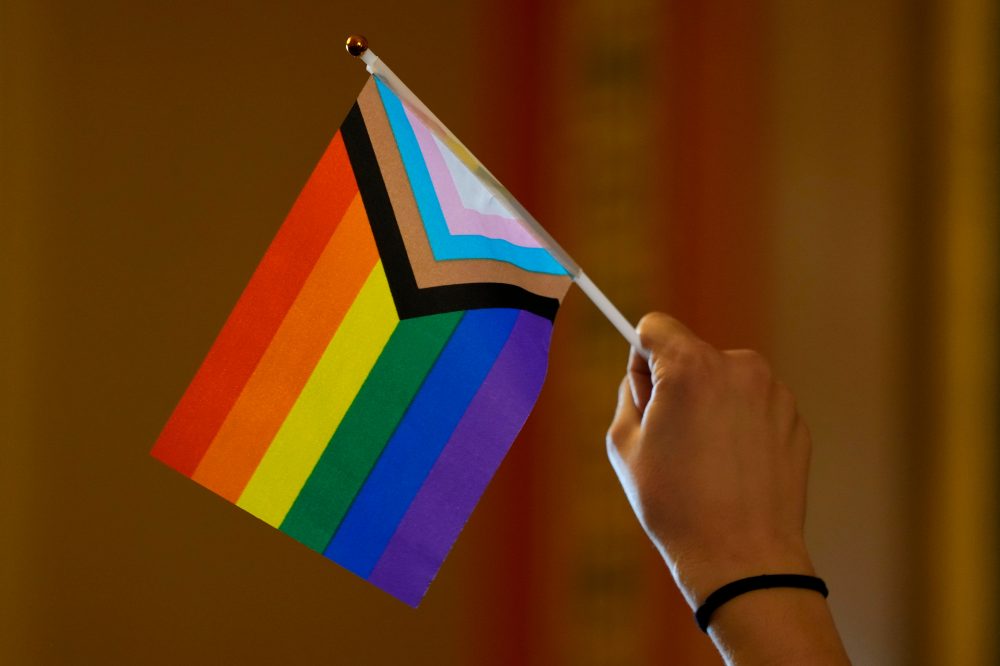
DES MOINES, Iowa (AP) — Iowa can enforce a law that restricts teachers from talking about LGBTQ+ topics with students in kindergarten through the sixth grade and bans some books in libraries and classrooms, an appellate court said Monday.
The decision for now vacates a lower court judge’s temporary blocks on the law.
The measure was first approved by Republican majorities in the Iowa House and Senate and GOP Gov. Kim Reynolds in 2023, which they said reinforced age-appropriate education in kindergarten through 12th grades. It’s been a back-and-forth battle in the courts in the three years since lawsuits were filed by the Iowa State Education Association, major publishing houses and bestselling authors, as well as an LGBTQ+ advocacy organization, Iowa Safe Schools.
The law was in effect for part of the 2024-2025 school year until last March, when a federal judge reissued a temporary block on the book ban provision, which prohibits books containing specific sex acts from appearing in school libraries or classrooms. In a separate decision in May, U.S. District Judge Stephen Locher said Iowa could restrict mandatory instruction on gender identity and sexual orientation in schools up through the sixth grade but could not enforce the restriction on any “program” or “promotion,” saying those terms were too broad.
Iowa asked the U.S. Eighth Circuit Court of Appeals to overturn both decisions, which a three-judge panel did Monday. The cases will continue in the district court while the law is in effect.
“This is a huge win for Iowa parents,” Iowa’s Republican Attorney General Brenna Bird said in a statement. “Parents should always know that school is a safe place for their children to learn, not be concerned they are being indoctrinated with inappropriate sexual materials and philosophies.”
Iowa’s measure was enacted in 2023 amid a wave of similar legislation around the country, driven by Republican lawmakers, to prohibit discussion of LGBTQ+ identities and restrict the use of restrooms in schools. Many of those laws prompted court challenges. The decision comes as Trump’s administration said Monday it has terminated agreements adopted under previous administrations that upheld rights and protections for transgender students.
The Iowa law states that K-12 school libraries cannot include materials with descriptions or visual depictions of six different sex acts. The state’s defense argued that the law outlines the restrictions explicitly and that the state, in its mission of advancing children’s education, has legitimate reason to ensure public school materials are appropriate.
But the teachers union, as well as publishers and authors, have maintained that the law is overly broad, reaching “far beyond obscenity to prohibit any book with any description of a sex act for any age,” their lawsuit stated. Plus, they argued, libraries are places of voluntary learning, not existing exclusively to advance the school’s educational mission.
The appeals court sided with the state, saying the restrictions are not amorphous and the books in a school library can be considered part of the school’s curriculum. For that reason, the court notes that the claims from the authors and publishers that the law infringes on First Amendment rights will likely not hold up.
The ruling also said: “The First Amendment does not guarantee students the right to access books of their choosing at taxpayer expense.”
The law also prohibits “any program, curriculum, test, survey, questionnaire, promotion, or instruction relating to gender identity or sexual orientation.” Attorneys for the state maintained that that text, as written, means mandatory school curriculum. Opponents argued the law is vague enough to limit any information accessed or activity engaged in at the school.
“Reading the plain language,” the appeals court decision said, “we cannot say the State’s assertion is wrong.”
Locher’s decision last May had granted a partial injunction, saying the state could restrict such topics when it comes to curriculum, tests, surveys, questionnaires or instruction but not any “program” or “promotion.”
Locher laid out specifically what that meant: “Students in grades six and below must be allowed to join Gender Sexuality Alliances (‘GSAs’) and other student groups relating to gender identity and/or sexual orientation.” And the district, teachers and students “must be permitted to advertise” those groups.
In vacating Locher’s partial block, the appeals court said Locher wrongly focused on the two words — program and promotion — in interpreting “an expansive view of the law’s scope.”
Because Iowa Safe Schools and the students asked the court to block the law on face value, not because of specific claims that it infringed on their rights, the appeals court said their complaint will likely fail on merits.
The appeals court also said the state could enforce a provision that requires school administrators to notify parents if a student makes a social transition, and wants to go by a different pronoun or name at school.
The decisions Monday are a setback but “not the end of the fight,” said Nathan Maxwell, senior attorney at Lambda Legal, one of the legal organizations representing Iowa Safe Schools.
It “is a cruel and unconstitutional law that silences LGBTQ+ children, erases their existence from classrooms, and forces educators to expose vulnerable students to potential harm at home,” Maxwell said. “We will continue to use every legal tool available to protect these young people.”
Brought to you by www.srnnews.com
 US soldier trying to halt wife’s deportation after she was detained on Louisiana military base
 Trump’s threatened destruction of Iran’s power plants could be considered a war crime, experts say
 Risky rescue of US crew downed in Iran relied on dozens of aircraft and subterfuge, Trump says
 Video brings new scrutiny to an ICE shooting in Minneapolis after charges against 2 men collapsed