
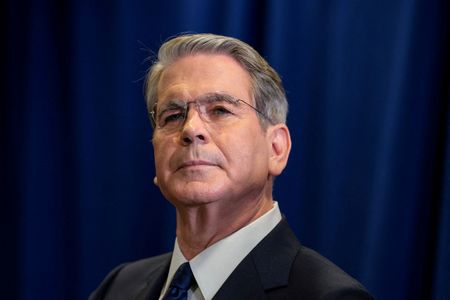
WASHINGTON, Nov 13 (Reuters) – US Treasury Secretary Scott Bessent said on Friday that the Federal Reserve should not hike rates because of inflation driven by an “energy supply shock” tied to the Iran war, comments made to CNBC and promptly contradicted on the network by Chicago Fed President Austan Goolsbee, who said price pressures were building far beyond what could be explained by high oil prices.
“I think the Fed should understand that this is an energy supply shock,” while the underlying US economy is very strong, Bessent said in an interview on CNBC. “So I think that to hike too much into an energy supply shock when it’s coming down, these are very noisy numbers…You know, the Fed’s supposed to look into the future, not look in the rearview mirror.”
Shortly afterwards, the network hosted Goolsbee, a regular guest on CNBC’s morning Squawk Box show, who said that inflation was not just due to energy, but had spread to the service sector and areas like medical care that are not usually responsive to the price of oil, and was also elevated through strong demand tied to the AI data center buildout.
“I respect the secretary and I am trying to figure out the same thing he is trying to figure out, which is how persistent is this inflation? The tariff inflation and oil price shock were supposed to have gone away by now and it hasn’t,” Goolsbee said. “One puzzle is why have those supply shocks been as persistent as they have been. A second thing is if demand is overheating and that is contributing to inflation, that is more worrisome… Services inflation, which is probably not coming from tariffs or oil, is one of the more troubling aspects of the inflation reports we have been getting.”
While not committing to a rate hike, he said the Fed “has definitely got work to do to continue to reestablish its credibility.”
The two interviews highlighted competing narratives about aspects of the US economy that figured heavily in midterm elections that centered on high inflation as well as the rapid pace of an AI buildout. The Trump administration has cheered the AI boom and focused on the likely upside, while being critical of communities reluctant to host the massive data centers needed for the technology.
Like other administration officials, Bessent focused on what he sees as the oil-driven roots of current inflation and criticized the Fed for responding to it.
“I’m not going to tell the Fed what to do. I am going to say they should have an open mind,” Bessent said, noting that the Fed had cut rates last year, “and now to reverse just based on an energy supply shock, a reversal in a dramatic way isn’t something that I would do if I were on the Fed. But I’m not on the Fed.”
Fed policymakers were open to the possibility they could “look through” supply-driven inflation at the start of the US war with Iran. But as inflation remained lodged above the Fed’s target, concern about it grew, as did support for rate hikes. Research meanwhile opened a different window on the relationship between oil prices and US inflation. Because the US is an energy exporter, higher global oil prices can filter through to the economy in the form of higher corporate profits and wages, providing a source of inflation beyond supply issues that can’t be easily ignored by the central bank.
Recent stronger-than-expected jobs and inflation reports have further bolstered the case for more Federal Reserve interest rate hikes, and even prompted some officials to discuss the need for a larger-than-typical half-percentage-point increase at the central bank’s coming December 8-9 meeting.
“We have had signs of trouble now for several months in a row if you look at how broad-based the inflation is,” Goolsbee said. “In categories that are not driven by oil prices and not driven by tariffs, you are still seeing stalled progress and in some cases going the wrong way … That is not going away no matter what happens to the price of oil.”
“Are we on a path back to 2%? My feeling right now is we are not and we’ve got to deal with that,” Goolsbee said. “Conventional wisdom says do everything you can to prevent demand overheating,” Goolsbee said, with coming data on inflation the key to whether the Fed needs a faster pace of rate increases.
(Reporting by Doina Chiacu, Katharine Jackson and Howard Schneider; Editing by Alex Richardson, Doina Chiacu and Andrea Ricci )
Brought to you by www.srnnews.com
 White House denies Hassett departing Trump administration
 US extends shipping law waiver 90 days, to allow freer movement of oil, commodities