
By David Hood-Nuño, Bianca Flowers and Disha Raychaudhuri
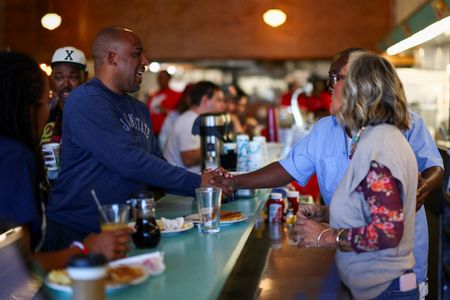
HATTIESBURG, Mississippi, Nov 24 (Reuters) – The sun rises every day over a memorial to civil rights leader Vernon Dahmer, murdered in 1966 by the Ku Klux Klan for paying poll taxes for fellow Black voters. Then at dusk, it sets on a 1910 Confederate monument, a symbol of racism to some, just yards away in Hattiesburg, Mississippi.
Melanie Sowell has renewed hope the dark legacy that has long hung over this Southern city will eventually lift.
“One day, if we continue this fight, the sun will set on the segregation, the racism and hatred that we live with every day and fight so hard to combat,” said Sowell, 57, chair of the Forrest County Democratic Party in Hattiesburg.
That hope came closer to reality when Scott Colom, a state district attorney, upset incumbent Republican US Senator Cindy Hyde-Smith in this month’s midterm elections, becoming the state’s first Black senator since Reconstruction, the period after the Civil War. Colom won Forrest County, which includes Hattiesburg, by 11 percentage points, though President Donald Trump carried it by 18 points in 2024.
As in Hattiesburg, Black voters across the South helped deliver upset victories for Democrats in proportions not seen in generations.
Black political leaders and organizers have argued for years that Democrats could build lasting political power in the region if the party invested in its large Black electorate rather than writing off Republican-dominated states.
Expanded Black voter mobilization efforts offer a potential blueprint for how Democrats can strengthen their position ahead of 2028 US elections, according to interviews with more than 15 grassroots organizers, political strategists and civil rights scholars.
The question now is whether Mississippi, home to the largest share of Black residents of any state, was an anomaly or an example of a broader phenomenon: a reservoir of Black political power and a growing multiracial coalition that Democrats have underestimated.
The will is there, according to interviews with 19 Mississippi voters. Many say there is palpable energy stemming from anger and frustration that voting rights, jobs and identities are under attack.
“We have done so much to try to get power back in the hands of the people,” said Gloria McCray-Watson, 63, an academic counselor at Jackson State University in Jackson, Mississippi. “And I feel like we got sick and tired.”
UNDERINVESTMENT
For decades, many Democratic strategists have centered national plans on a narrow map of battleground states, leaving much of the South with little sustained party infrastructure or campaign investment.
Marc Morial, president of the civil rights nonprofit National Urban League, said the shift occurred after former President Bill Clinton’s 1990s campaigns, which focused on winning Black votes while also appealing to moderate and conservative white voters. Since then, the Democratic Party has made a long-term retreat from grassroots organizing, candidate recruitment and voter registration, Morial said.
Stacey Abrams, former Georgia gubernatorial candidate, and Black-led organizations spent years restarting grassroots work to turn a once reliably Republican state into a swing state. Democrats won two statewide seats in Georgia, including the governor’s race, in which Keisha Lance Bottoms became the first Black woman elected state governor in US history.
“Black-led organizations never stopped investing where our people are,” said Melanie Campbell, president of the National Coalition on Black Civic Participation, a nonprofit that worked with the NAACP’s “All Roads Lead to the South” voter engagement campaign along with 160 other local organizations.
In Alabama, Democratic US Representative Shomari Figures won reelection despite a dramatic redrawing of his district to make it more favorable to Republicans. Trump had carried the new areas by about 14 points in 2024.
Tennessee State Representative Justin Pearson, a Democrat, ran in a Memphis-area district that Republicans also reshaped. They pushed through a new congressional map that split the Memphis-based district into three. He lost by roughly 1.1 points.
“The important lesson to be learned here is that the Democratic Party’s future flows through the South,” Morial said. “Many of us have been saying over the years that the underinvestment meant that you would have low Black voter turnout in presidential and Senate elections.”
The party, including the Democratic Senatorial Campaign Committee, defended its approach, saying Senate Democrats flipped nine seats in 2026, including seven in states that Trump carried by double digits in 2024. The committee said it remained focused on expanding the map and would “work to flip every seat we can in 2028.”
“In the face of a difficult map and being massively outspent across the country, Senate Democrats made history by flipping 9 Senate seats, including 7 states Donald Trump carried by double digits in 2024,” a DSCC spokesperson said in a statement.
Though Colom won his election, it came down to “affidavit ballots” — those set aside by poll workers from voters they cannot immediately verify and later counted by hand by officials in court. That process would have been unnecessary if the party invested earlier, widening its margin, according to a dozen party insiders and operatives in the state.
Canvassers in Forrest County such as Seija Hunter had to improvise with limited resources. The 39-year-old nursing assistant said she had only Colom’s name.
“When we started out, we didn’t even have any flyers, so we were going to people’s houses and people would ask us, ‘What does he look like?’” she said. “All we had was a sample ballot.”
REPUBLICANS CITE COST OF LIVING FRUSTRATION
High Black voter turnout is not the whole story, said Williamson County, Tennessee, Republican Party Chair Steve Hickey. Republican losses across the South were a culmination of voter frustration over the cost of living and failure of the party to sustain the economic message that helped Trump win a second term in 2024, he said.
NBC News exit polls show the cost of living weighed on Tennessee voters, with 82% calling it a crucial or major factor in their vote for Congress. Still, 51% said Republicans were better able to handle the economy, compared with 36% for Democrats.
Some Republican strategists caution against viewing Democratic gains as permanent. Diante Johnson, president of the Black Conservative Federation, said the Republican Party’s midterm defeat was driven by lower engagement from Make America Great Again supporters, diminished turnout among young men and lack of funding for conservative grassroots organizations.
“This is the first year since 2016 we did not do any door-knocking or grassroots on the ground. Grassroots has to be funded and it wasn’t funded this go around. A campaign is not a campaign without the coalitions,” Johnson said.
The coalition behind Colom extended beyond Black voters, about 97% of whom backed him, according to NBC exit poll data. About 27% of white voters backed Colom, as did about 9% of those who said they voted for Trump in 2024.
Turnout must remain high for Democrats to hold the ground they gained, said Deborah Delgado, 74, the first Black woman elected to Hattiesburg’s city council. She worries that Republicans, who hold the governorship and control both chambers of the state legislature, could enact more partisan electoral maps or tighter voting restrictions.
‘ACTIVATED’ BLACK VOTERS
Leaders say much of voters’ motivation came from the Trump administration’s own actions. Federal workforce cuts caused a cascade of job losses among Black voters, said CJ Rhodes, pastor of Mt. Helm Baptist Church in Jackson, Mississippi.
Coupled with the administration’s push to eliminate diversity, equity and inclusion programs and the Supreme Court’s decision to weaken the Voting Rights Act, Rhodes said Black voters across the state were “activated.”
Across Mississippi and South Carolina, nonpartisan voter registration group Registration Nation identified thousands of unregistered Black voters and sought to turn them into votes. It said sustained investment will be crucial.
“You can’t let people vote and then go away,” said Andrea Pringle, president of the organization.
(Reporting by David Hood-Nuño, Bianca Flowers and Disha Raychaudhuri; Editing by Kat Stafford and Rod Nickel)
Brought to you by www.srnnews.com
 US envoy ‘not certain’ military aid to Israel will end this year as Trump promised
 The Media Line: Former Mossad Chief Reveals Israeli Intelligence Helped Foil ISIS Plot Targeting Taylor Swift Concerts