
By Daniel Trotta, Georgina McCartney and Shariq Khan
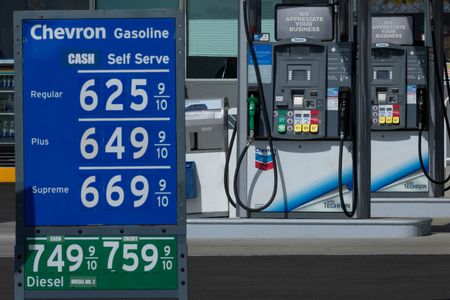
CARLSBAD, California, April 30 (Reuters) – Motorists commemorating the centennial of U.S. Route 66 – a celebrated symbol of carefree road trips – were paying $6 a gallon for gasoline in California on Thursday, the highest price in two years and a brewing political flashpoint as elections loom.
The Iran war has brought the worst-ever disruption to global oil supplies, driving up gasoline prices worldwide and posing particular hardships for California, the most populous U.S. state with the most cars on the road.
The Golden State also has some of the highest gasoline prices in the country because of stringent emissions standards, high taxes and its reliance on imported petroleum.
With California’s gubernatorial primary barely one month away, candidates sparred at a debate this week over whether to eliminate the state’s $0.61-per-gallon gas tax, the highest in the nation.
At the national level, high gas prices look certain to become a major political issue ahead of congressional midterm elections in November, when President Donald Trump’s Republicans will be struggling to retain control.
Three out of four Americans said the Trump administration bore responsibility for the recent rise in gas prices, according to an April Reuters/Ipsos poll, while a majority said they expect gas prices to get worse over the next year.
HIGHEST GAS PRICES IN THE U.S.
California’s average gasoline price hit $6.01 a gallon on Thursday, the highest in the country and the most that motorists in the state have had to pay since October 2023, GasBuddy data showed, while the U.S. national average climbed to $4.34 a gallon, the highest since July 2022.
The fuel price surge has pinched U.S. consumers, contributing in March to the biggest gain in annual inflation in nearly three years.
Analysts expect the pain to worsen as the Iran conflict – which has closed the Strait of Hormuz and bottled up nearly a fifth of global oil flows – stretches into the peak U.S. summer travel season, typically beginning around Memorial Day in late May and lasting through Labor Day in September.
California relies heavily on Asia for imports to meet its domestic fuel requirements, making it one of the U.S. states most affected by supply shortages due to the Iran war. Asian refiners have cut production and restricted exports as they struggle to find crude oil to replace barrels from the Middle East. That means they have less to export to California.
Fuel shortages have also pushed foreign importers to snap up crude and fuel supplies from the U.S. Gulf Coast, pushing benchmark oil prices higher – and with them fuel prices across the United States.
U.S. gasoline exports rose in March to 834,000 barrels per day, the highest since November, with at least two cargos sent to Asia, Kpler data showed.
Fuel stockpiles in California hit record lows in April. Gasoline imports to California dropped sharply after hitting a record 195,000 bpd in the week starting April 13, to less than 75,000 bpd last week, Kpler data showed.
“California is arguably the state most impacted by the Strait of Hormuz in the United States, which has been largely insulated from the events,” said Denton Cinquegrana, chief oil analyst at Dow Jones Energy.
SUMMER ROAD TRIPS FACE A SPEED BUMP
The rising fuel prices are fueling political controversy in California and nationwide.
California’s incumbent Governor Gavin Newsom, one of Trump’s most vocal critics, has blamed the war in Iran for soaring gas prices in his state and elsewhere.
“Every American who fills up their tank this week, buys groceries, or books a flight is paying Donald Trump’s Iran war tax,” Newsom said in a press release on Thursday.
Newsom has faced criticism from Trump after energy policies he has supported contributed to the closure of some California refineries, increasing the state’s reliance on imports.
The California Energy Commission last year sought to reassure motorists that the ability to import from Asia would protect against possible price spikes, after the closure of two refineries supplying about 20% of the state’s motor fuel requirements. That has, however, proved a vulnerability rather than a strength during the current energy crisis.
Miguel Angel Cruz, who owns a landscaping business, said he used to fill up his truck for $50 but now it costs $80. As he spoke, the pump display at the gasoline station in Carlsbad, California, shot past $80 to land at $85.75 for a little more than 13 gallons.
“I cannot drive any less,” Cruz said, citing the needs of his business. “Every time we get a new president in the White House, they say this year is gonna be better. But nothing’s changed. It’s the same story, except now it’s worse because of the war in Iran.”
The U.S. government’s Route 66 Centennial Commission and independent motorists have scheduled a series of events to celebrate the 100th anniversary of the 2,400-mile (3,860 km)Route 66 – often called “The Mother Road” – that stretches through eight states to connect Chicago with Los Angeles.
About 41% of Americans planned to visit at least parts of Route 66 during the 2026 centennial celebration, an AAA survey showed. The iconic route is a favorite road trip for motorists during summer holidays.
“I don’t believe gas in California should cost this much at all … I cannot afford this gas,” said Amanda Martinez, a video editor who recently moved to California from Texas. She added that if gas prices rise further, she would consider driving less.
She plans to ask her employer for more work from home or for a gas card, and is considering buying an electric vehicle as her office is about 20 miles away from her home.
(Reporting by Daniel Trotta in Oceanside and Carlsbad, California, Shariq Khan and Nicole Jao in New York, Nichola Groom in Los Angeles; Editing by Arathy Somasekhar, Nathan Crooks, Simon Webb, David Gregorio and Edmund Klamann)
Brought to you by www.srnnews.com
 Habitat for Humanity is developing a new Atlanta community with help from the Carters’ initiative
 Republicans say they will defer to Trump on Iran war despite arrival of 60-day deadline
 Disappearing before our eyes: One photographer’s passion project of capturing local newsrooms
 Florida Republicans slice and dice congressional districts: How a new map could cost Democrats seats