
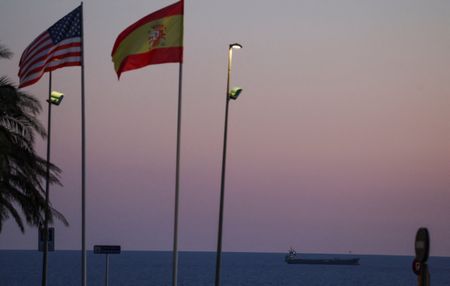
MADRID, July 8 (Reuters) – U.S. President Trump reiterated on Wednesday his desire to impose a trade embargo on Spain, ordering Treasury Secretary Scott Bessent to “cut off all trade… including visits” with the country, amid tensions over defence spending.
Below is an explainer on the key questions behind such a move.
WHAT POWERS DOES A U.S. PRESIDENT HAVE TO IMPOSE A TRADE EMBARGO?
Under the International Emergency Economic Powers Act (IEEPA), the president has sweeping powers to restrict or block economic dealings involving foreign countries.
However, such a move is only possible if the president can prove that the country in question presents an “unusual or extraordinary threat” to U.S. national security, foreign policy, or the economy and declare the situation a national emergency.
Peter Shane, a U.S. law professor at NYU, said it was “hard to see” how the U.S.-Spanish dispute over defence spending would qualify as such.
Also, European Union rules require trade negotiations to be conducted with it as a single bloc rather than with individual member states.
The IEEPA has previously been used on Iran in 1979, on Syria in 2004, on Iraq in 1990 and on Sudan in 1997.
The U.S. has in the past also imposed embargoes on countries including Cuba and North Korea via the “Trading with the Enemy Act” (TWEA), but its use is limited to periods of declared war.
WHAT OPTIONS ARE THERE BEYOND A FULL EMBARGO?
Scaling back from a full embargo, the U.S. president has a few other mechanisms to impose tariffs or other retaliatory trade measures.
Under Section 232 of the Trade Expansion Act of 1962, the president can impose tariffs on imports or set quotas for specific products or sectors if the Commerce Department deems them to pose a threat to national security.
Under Section 301 of the Trade Act of 1974, the president can impose trade penalties on a foreign country if its actions are determined to be discriminatory or unfair and burdensome to U.S. commerce.
Anti-dumping rules can also be applied. In Trump’s first administration, at the behest of Californian olive producers, a 30% anti-dumping tariff was imposed on Spanish black olives under the 1930 Tariff Act, with a separate Commerce investigation ruling that they benefited from unfair subsidies. The World Trade Organisation later ordered a partial rollback but Spain’s share of the U.S. black olive market plummeted from 49% in 2017 to 19% in 2024.
HASN’T TRUMP THREATENED SOMETHING SIMILAR BEFORE?
Yes. The first threat of trade punishment came in October 2025, when Trump said he “may” punish Spain with tariffs for refusing at a NATO summit in The Hague four months earlier to commit to raising defence spending to 5% of national output.
In March this year, he went further, ordering Bessent and Trade Representative Jamieson Greer to begin investigations to embargo all products from Spain.
To date, no such investigations have been disclosed on the Federal Register.
HOW SIGNIFICANT IS THE U.S.’ TRADE WITH SPAIN?
The U.S. sells more to Spain than it buys, exporting $26.6 billion in goods to the country in 2025 and importing $21.35 billion, according to the U.S. Census Bureau.
Spanish companies have invested €97.2 billion in the U.S., making it their largest investment destination worldwide, according to Eurostat data cited by the American Chamber of Commerce in Spain.
The U.S. is Spain’s largest foreign investor, with over €116 billion in productive capital investment employing around 200,000 people nationwide.
HOW MUCH DOES SPAIN CONTRIBUTE TO NATO?
Spanish core defence expenditure is expected to reach €35.41 billion in 2026, equivalent to 2% of its GDP, according to NATO’s latest estimates, up from €11.17 billion when Prime Minister Pedro Sanchez took office in 2018.
The country was NATO’s seventh-largest defence spender in absolute terms in 2025, according to Spanish government officials citing NATO data.
There are currently nearly 3,000 Spanish personnel deployed to NATO operations abroad, making it the alliance’s third-largest contributor of troops abroad in peace and security missions.
It has deployed over 125,000 troops in more than 22 missions, of which more than 100 were killed during NATO operations, Spanish government figures show.
It has mobilised a total of €3.795 billion in support for Ukraine since 2022.
(Reporting by Victoria Waldersee, David Latona, Emma Pinedo; Writing by Victoria Waldersee; Editing by Aislinn Laing and Gareth Jones)
Brought to you by www.srnnews.com
 Kentucky Gov. Andy Beshear asks Sen. Mitch McConnell to give a public update on his condition
 Some evacuation orders and street closures remain as work continues on a NYC high-rise that buckled
 Midtown Manhattan high-rise stable after columns buckled, officials say