
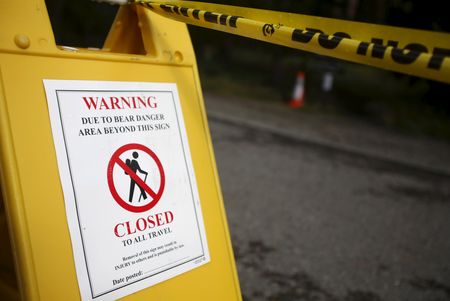
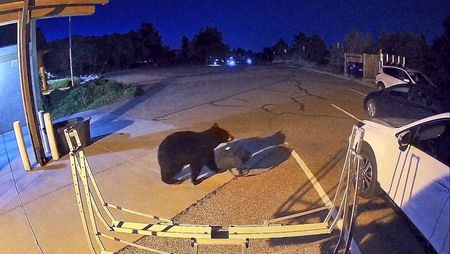
Aug 29 (Reuters) – A drought in the western U.S. has devastated wildlands, dried up food sources and sent bears wandering along city sidewalks and into homes and shops in search of food.
What should you do if you meet a bear? Reuters turned to BearWise, which bear biologists started in the southeastern United States in 2018 and that grew into a national program of the Association of Fish & Wildlife Agencies.
SHOULD PEOPLE FEAR BEARS?
Over millennia, humans have mythologized, vilified and attributed personalities to bears. Smart, strong and fast, bears can weigh hundreds of pounds and are feared predators in the wild. But they typically avoid people and rarely attack them, scientists say.
HOW CAN YOU TELL IF A BEAR FEELS THREATENED?
A bear that is huffing, moaning or clacking its jaws is showing it is feeling threatened and prepared to defend itself. BearWise advises standing your ground in the face of a defensive bear, even if it moves toward you. If it makes contact, play dead, protecting your head, until it goes away.
WHAT IF THE BEAR IS AGGRESSIVE?
While a defensive bear is noisy and obviously stressed, an aggressive or predatory bear is quiet and moves deliberately. In this situation, experts advise shouting, throwing rocks and using bear spray. If a predatory bear makes physical contact, fight back.
DOES IT MATTER WHETHER IT’S A BLACK OR GRIZZLY BEAR?
No, according to Nate Bowersock, a black bear biologist with the Missouri Department of Conservation and chair of the BearWise working group of the Association of Fish & Wildlife Agencies. The key is to respond to the bear’s behavior, not its species.
Bears can be hard to tell apart, especially if you are under pressure. Grizzlies, also known as brown bears, are distinguished in appearance by a shoulder hump. Individual black or grizzly bears vary from black to light brown and range in size.
WHERE ARE NORTH AMERICA’S BEARS?
Black bears are numerous and found across the U.S. and in Canada and Mexico. Most grizzlies, whose population has rebounded because of conservation efforts, live in Alaska and northern Canada, but also in Montana, Wyoming, Idaho and Washington state.
HOW CAN YOU AVOID TROUBLE?
If you spot a bear, do not approach. Do not gather to gawk if a bear shows up in your neighborhood.
If you find a bear in your home or business, leave and call in expert help, Bowersock said.
“Back away quietly,” he said.
Do not feed bears, and that includes not leaving pet food outside, keeping trash bins off the street until pickup morning and keeping barbecue grills clean.
IT’S A DROUGHT. SHOULDN’T I FEED THE BEARS?
Bowersock said people would be mistaken to think they are helping by feeding bears, and that it is even more important not to do so during a drought.
“If a bear finds food near people and starts to associate human areas with food, they will likely spend even more time in the future near people, even during non-drought times.”
(Reporting by Donna BrysonEditing by Rod Nickel)
Brought to you by www.srnnews.com
 Some US cities have begun rewarding careful drivers with fewer red lights
 As jurors deliberate in the Lindsay Clancy trial, here are key moments they may be considering
 Hungry bears wander into US West homes, shops in record numbers
 Was Dolly Parton a feminist? She wouldn’t say it, but fans heard it — in her life and her lyrics