
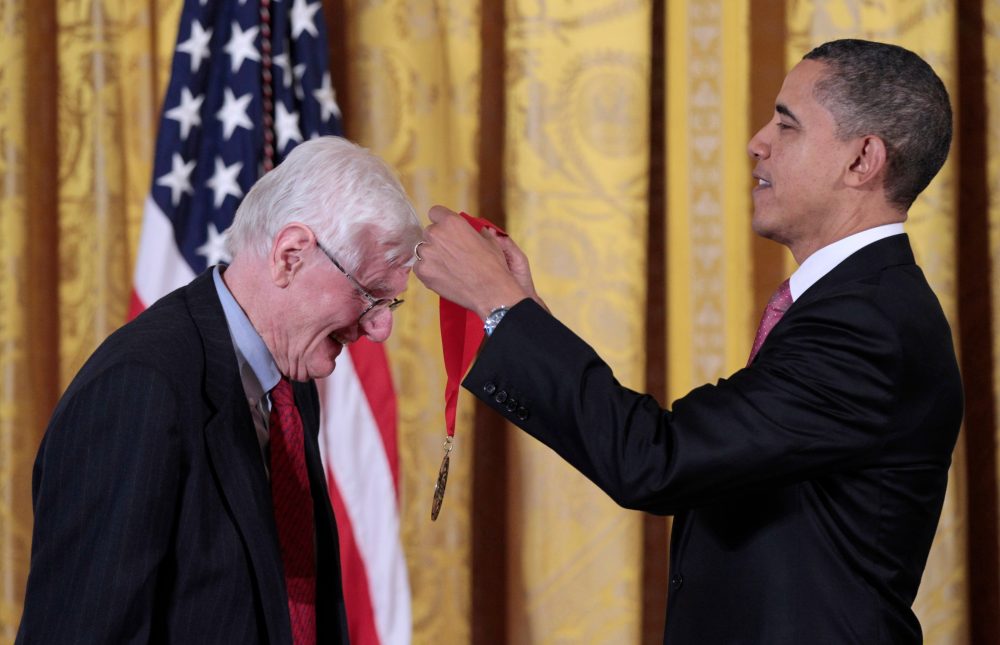
NEW YORK (AP) — Gordon S. Wood, the eminent and prolific scholar who forged a highly influential and sharply debated narrative of the country’s early years of independence through such prize-winning works as “The Creation of the American Republic” and “The Radicalism of the American Revolution,” has died. He was 92.
Wood, a professor emeritus at Brown University, died Sunday after being struck by a car in a supermarket parking lot in East Providence, Rhode Island, according to police.
Author of dozens of books and essays, Wood never gained the mass audience of historians like David McCullough and Doris Kearns Goodwin, but his findings became standard references for discussions about the formation of the U.S. and the legacy of the revolution. Many peers regarded the white-haired, mild-looking Wood as the embodiment of the learned, traditional historian, guided by facts rather than ideology.
In 2011, President Barack Obama presented him a National Humanities Medal “for scholarship that provides insight into the founding of the nation and the drafting of the U.S. Constitution.”
In recent years, younger academics increasingly alleged that Wood was too well-established, the epitome of the old-school historian who minimized the lives of slaves, women and Indigenous people. John L. Brooke, a history professor at Ohio State University, would fault him for “a distinct avoidance of interpretative paradox and complexity,” even as he cited Wood’s “scale and scholarly enterprise.”
His success was immediate and lasting. His first book, “The Creation of the American Republic,” won the Bancroft Prize in 1970 and lived on with generations of students who embraced and contended with Wood’s findings that the Constitution was unintentionally subversive, a document devised by elites that led to “the destruction of the very social world they had sought to maintain.”
His “The Radicalism of the American Revolution” won the Pulitzer in 1993 and the epic “Empire of Liberty” was a finalist in 2009.
Wood did welcome scholarly breakthroughs, notably Annette Gordon-Reed’s “persuasive contextual case” that the enslaved Sally Hemings bore some of Thomas Jefferson’s children. In “Empire of Liberty,” which covered the years 1789 to 1815, he included lengthy passages on slavery and called it a cancer “eating away at the message of liberty and equality.”
At other times, Wood angrily resisted new approaches. He was a prominent critic of The New York Times’ Pulitzer Prize winning 1619 Project and its contention — later amended — that maintaining slavery was a key motivation for the American Revolution. He alleged that the project encouraged a sense “victimhood” and feeling “aggrieved,” even as he acknowledged he hadn’t read most of it. He would counter that the founders, even such plantation owners as Jefferson and James Madison, believed — mistakenly — that slavery would die a natural death and the revolution itself energized the American abolitionist movement.
“We all want justice, but not at the expense of truth,” he wrote in 2019, adding, in a widely disputed statement, “I don’t know of any colonist who said that they wanted independence in order to preserve their slaves.”
Wood was born into history: His hometown, Concord, Massachusetts, had been the residence of Ralph Waldo Emerson, Henry David Thoreau and Louisa May Alcott, among others. But his passion for the subject he later mastered did not arise until college. Wood found his high school history education unbearable, suffering through classes in which the teacher simply read from a textbook.
Wood did admire his Latin instructor, who encouraged him to attend Tufts University, from which he graduated summa cum laude. He received a master’s and Ph.D. from Harvard University and studied under a celebrated Revolutionary War historian Bernard Bailyn, whose documentation of the intellectual forces behind independence in his landmark “The Ideological Origins of the American Revolution” Wood would build upon in “The Creation of the American Republic.”
In his introduction to “The Idea of America,” published in 2011, Wood looked back on his own work and the evolution of scholarship in his lifetime. He noted the many errors of the country’s founders but warned against scolding historical figures because of mistakes which seem obvious now, what he and others call “Presentism.”
“The drama, indeed the tragedy of history, comes from our understanding of the tension that existed between the conscious wills and intentions of the participants in the past and the underlying conditions that constrained their actions and shaped their future,” he wrote.
“If the study of history teaches anything, it teaches us the limitations of life. It ought to produce prudence and humility.”
___
Associated Press writer Michael Casey contributed to this report from Boston.
Brought to you by www.srnnews.com
 Ken Paxton’s attorney in his impeachment trial endorses James Talarico in US Senate race
 The Media Line: IDF Spokesperson Says US Helped Intercept Iranian Missiles, Iran Violated Ceasefire to ‘Buy Time’
 NYC imposes stringent security as Trump becomes 1st sitting US president to attend NBA Finals game
 Republican senators warn surveillance program may lapse after Trump intel pick backlash