
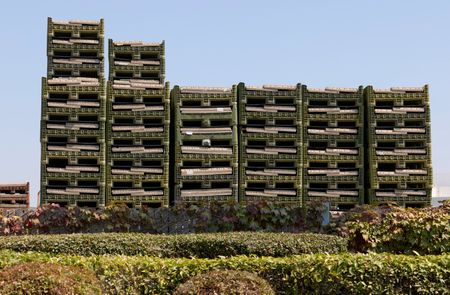
SALINAS, California, Aug 20 (Reuters) – Taylor Farms, the produce supplier at the center of the massive U.S. cyclosporiasis outbreak, changed the way that America eats after launching branded, prepackaged and washed chopped salads more than a decade ago.
With flavors ranging from Asiago Kale to Broccoli Crunch, the products are ubiquitous in Walmart, Kroger, Costco and other grocery stores, establishing Taylor Farms as North America’s leading salad producer. Its size and extensive network of growers also made it an indispensable supplier to some of the largest restaurant chains, including McDonald’s and Taco Bell.
Now, the company is changing the way America eats again, except this time it has driven consumers away from fresh produce after iceberg lettuce that Taylor Farms processed in central Mexico was tied to the U.S. outbreak of illness caused by the cyclospora parasite.
Cyclosporiasis, an intestinal infection that can give people explosive diarrhea for weeks, can be contracted by consuming food — typically raw fruits and vegetables — or water contaminated with feces that transmit the parasite. The CDC has confirmed more than 15,000 cases across 47 states and two deaths.
Taylor Farms said it is confident in its food and spends more than $200 million annually on food safety, including pathogen tests on leafy greens that exceed industry guidance or requirements.
The outbreak slashed demand for fresh produce, and wholesale lettuce prices plunged a record 73% in July. Though the outbreak was linked to lettuce from Mexico, not the United States, the decline quickly wiped out potential profits for the year for some farmers in California’s Salinas Valley, which is home to Taylor Farms and known as the world’s salad bowl.
Taylor Farms’ size is helping it weather the downturn, reflecting founder Bruce Taylor’s dominance in a food industry comprising few large players, local producers said. The company, built on business from major restaurant and food-service customers, is a $7 billion enterprise with more than 25,000 employees, according to the University of California, Berkeley, where Taylor studied business.
“He’s a super smart guy,” said Tim McAfee, owner of Visionary Vegetables, which produces cilantro and lettuce in Salinas, California. “He had a strategy to take over the produce industry, and it worked.”
RAZOR-THIN PROFIT MARGINS
Farmers, shippers and agricultural workers in the Salinas Valley have suffered financially because of the outbreak, with a major handler of leafy greens cutting employees’ hours in a processing plant because of lower demand.
Sabor Farms, which produces herbs, spinach, kale and other crops, plowed under some cilantro fields because demand sank by about 30%, said Jess Quinlan, founder and president. Operating on margins of around 2%, the losses ruined the potential for profits this year, he said.
“There’s nothing more devastating than to put all the work in and then not even be able to cut it,” Quinlan said.
Last week, farm workers swiftly harvested bunches of fragrant cilantro with sharp knives for Sabor Farms in Chualar, California, southeast of Salinas. Starting at 5 a.m., they placed the cilantro on a slow-moving machine, where the crop was sprayed with chlorinated water to clean it and then packed into boxes.
To prevent possible contamination, workers do not place harvested cilantro on the ground, Quinlan said.
Two farms that Reuters visited in the valley had portable toilets with outdoor handwashing stations on site while workers were harvesting crops. Driving around, it was easy to see trucks transporting such facilities among fields, which employees said were intended to reduce the risk for workers to contaminate crops.
FOOD SAFETY PROBLEMS
Taylor Farms has a history of food-safety issues, though it has also worked to improve protocols in the industry.
The U.S. Food and Drug Administration in July linked the cyclosporiasis outbreak to iceberg lettuce served at Taco Bell restaurants and sourced from Taylor Farms’ operations in Mexico. The United States is increasingly relying on Mexico’s produce to supplement domestic production.
Taylor Farms also recalled prepared foods containing jalapenos from retailers, including Walmart and Whole Foods, this month over potential salmonella contamination tied to peppers from Mexico. In 2024, slivered onions supplied by Taylor Farms and served on McDonald’s burgers were linked to an E. coli outbreak.
“Consumers often have no way of knowing when they are eating Taylor Farms products,” nonprofit group Farm Action said. “When so much of the food supply runs through a single company, a problem can quickly affect people across the country.”
Taylor Farms in 2007 co-founded California’s Center for Produce Safety, which funds research, and has donated more than $4 million to it since then, according to the nonprofit.
The company is also part of California’s Leafy Greens Marketing Agreement, under which produce shippers agree to follow a set of specific food-safety standards created after spinach contaminated with E. coli killed three people in 2006.
Taylor Farms said it went beyond what is required by law to implement processes allowing it to trace every salad component back to a specific harvest time and location.
CAPTIVE CUSTOMERS?
A third-generation lettuce producer, Bruce Taylor founded his company in 1995 after leaving Fresh Express, which he ran with his brother. He expanded the market for fresh produce and took market share from competitors, according to people who have worked with him.
He got ahead by focusing on food-service business, instead of retail sales, a strategy that allowed him to score big orders to cover overhead costs, a person familiar with his business said. Food service covers food prepared away from home, including products sold in restaurants and hotels.
In 2012, Taylor Farms entered the grocery store market with the first-ever branded, prepackaged chopped salads with dressings and condiments, UC Berkeley said in an article about Bruce Taylor this spring. The salads appealed to consumers increasingly looking for convenient, healthy foods.
Today, it is easy for food-service companies to buy from Taylor Farms because it can be a one-stop shop for multiple products, McAfee said.
“You go in and get whatever you need on one truck,” he said. “The convenience factor is huge.”
However, buyers can struggle to fully replace Taylor Farms when food safety issues arise because of the volume of products it handles, industry members said.
Top U.S. food distributor Sysco said it halted sales and distribution of Taylor Farms iceberg lettuce from Mexico in July.
“We’ve moved source of product away from them to the degree that we can,” CEO Kevin Hourican said this month. “Because they’re really big, you can’t just turn it off overnight.”
(Reporting by Tom Polansek in Salinas, California; Editing by Emily Schmall and Anna Driver)
Brought to you by www.srnnews.com
 US sends 20 deportees to Liberia, part of 1,200 migrants the country will receive under new deal
 US weekly jobless claims dip in latest week
 Why Taiwan and the South China Sea matter to the US and the world
 States pour taxpayer dollars into college sports as athlete pay, soaring costs squeeze budgets