
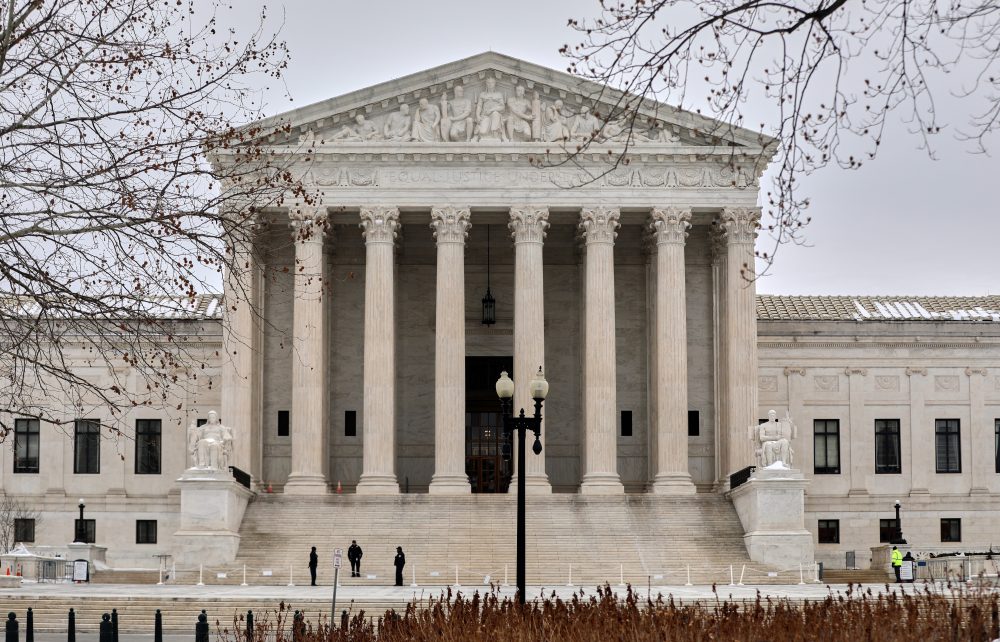
The Supreme Court is once again hearing arguments on whether President Donald Trump can deny citizenship to children born to parents who are in the United States illegally or temporarily.
The Wednesday case stems from an executive order Trump signed on the first day of his second term ending what’s known as birthright citizenship, which guarantees citizenship to nearly everyone born on U.S. soil.
While the concept has been part of U.S. law for well over a century, it is relatively rare around the world.
Birthright citizenship is based on the legal principle of jus soli, or “right of soil.”
In the U.S., the right was enshrined in the Constitution after the Civil War, in part to ensure that former slaves would be citizens.
“All persons born or naturalized in the United States and subject to the jurisdiction thereof, are citizens of the United States,” the 14th Amendment states.
In the late 1800s, birthright citizenship was legally expanded to the children of immigrants.
Wong Kim Ark, who was born in the U.S. to Chinese parents, sued after traveling overseas and being denied reentry into the U.S. The Supreme Court eventually ruled that the amendment gives citizenship to everyone born in the U.S., no matter their parents’ legal status.
Today there are only a handful of birthright exceptions, such as for children born in the U.S. to foreign diplomats.
Only about three dozen countries, nearly all of them in the Americas, guarantee citizenship to children born on their territory.
Most countries follow the principle of jus sanguinis, or “right of blood,” with a child’s citizenship based on the citizenship of their parents, no matter where they are born.
None of the 27 member states of the European Union, for example, grant automatic, unconditional citizenship to children born on their territories to foreign citizens. The situation is similar across much of Asia, the Middle East and Africa.
Some countries use a combination of principles, such as parenthood, residency and ethnicity, to decide a child’s citizenship.
Australia, for example, allowed birthright citizenship until 1986. But starting that August, children born there could only become citizens if at least one parent was an Australian citizen or a permanent resident.
Things shifted the other way in Germany, which changed its citizenship laws in 2024.
Until then, citizenship by birth required that at least one parent was German. Starting in 2024, though, children born in Germany to non-German parents are automatically granted German citizenship if one parent has been legally living in the country for more than five years with unlimited residency status.
Citizenship laws were liberalized because “studies have shown that the education prospects of children and teenagers with a migration background are better, the sooner they were granted German citizenship,” the government wrote at the time.
Supporters of birthright restrictions in the U.S. focus on a handful of words in the constitutional amendment: “subject to the jurisdiction thereof.”
That phrase, they argue, means the U.S. can deny citizenship to children born to women who are in the country illegally.
A series of judges have ruled against the administration and the order has been repeatedly put on hold by lower courts.
Wednesday’s case originated in New Hampshire, where a U.S. district judge ruled the order “likely violates” both the Constitution and federal law.
___
AP reporter Kirsten Grieshaber contributed to this story from Berlin.
Brought to you by www.srnnews.com
 Wisconsin judicial panel dismisses Democratic attempt to redraw congressional maps
 Judge blocks Trump order to end funding for National Public Radio and Public Broadcasting Service
 Ex-Arkansas medical board chair indicted over alleged drugging and abduction of patients
 Huge glass skyscraper envisioned for Trump presidential library in AI video