
March 7 (Reuters) – Since U.S. President Donald Trump returned to office last year, he and his allies have derided federal judges who ruled against his policies as “rogue,” “crooked,” “lunatic” and more, casting their actions not only as incorrect but illegitimate as well.
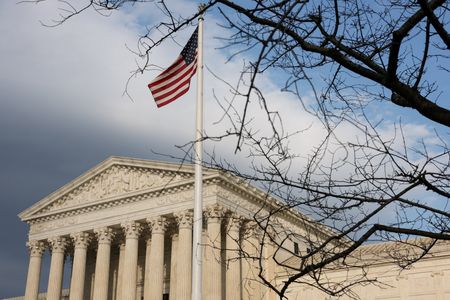
Beyond the Republican president’s vitriol in speeches and social media posts, his administration has launched a more systematic effort at the U.S. Supreme Court to diminish the power of the federal judiciary, a Reuters analysis shows.
The administration in the past year has raced to the Supreme Court with dozens of emergency requests to green-light policies impeded by lower-court judges who questioned their legality.
The administration includes in its written filings multiple legal arguments, but to a remarkable degree it has used these requests to question the very authority of the judges whose decisions are being challenged.
Of the 31 emergency requests Trump’s Justice Department has filed at the Supreme Court since February 2025, nearly all – 97% – claim the judge is improperly interfering with the president’s power under the U.S. Constitution and various laws, according to the analysis.
By contrast, in the 19 emergency requests filed by Trump’s Democratic predecessor Joe Biden’s administration over four years, just 26% suggested judicial interference with presidential authority.
‘MORE UNILATERAL POWER’
The Trump administration’s approach reflects a concerted effort to diminish the power of judges to restrain the president and his agenda, according to legal experts and former judges.
The arguments go beyond outlining why a judge reached what the administration considers an incorrect legal conclusion, according to Payvand Ahdout, an expert on presidential power and the federal courts at the University of Virginia School of Law.
“The administration is attacking the ability of federal judges to question or review the executive actions,” Ahdout said.
“As the administration seeks to assert more unilateral power, robust judicial review is a problem for them,” Ahdout added.
Trump has aggressively tested the limits of presidential powers during his second term in domestic affairs and foreign policy, drawing hundreds of legal challenges on numerous fronts.
The Supreme Court, whose 6-3 conservative majority includes three justices Trump appointed, has backed him in most of these emergency cases, letting him fire federal employees, take control of independent agencies, ban transgender people from the military and deport migrants to countries where they have no ties, among other actions. Unlike its usual work, the court typically handles emergency requests quickly, without extensive written briefing or oral arguments.
‘NO SURPRISE’
A Justice Department official with knowledge of the legal strategy, speaking on condition of anonymity, said any suggestion that its arguments are unusual is misleading.
Pointing to its high win rate at the Supreme Court, the official noted that many of the department’s requests involve areas where the justices traditionally have deferred to the president, such as immigration and the federal workforce.
“It should come as no surprise that this department is more forceful in defending Article II prerogatives,” the official said, referring to the constitutional provision vesting executive power in the president.
In addition to claiming judicial interference, Trump’s emergency requests challenge the power of judges in other ways.
Among these requests, 68% argue that the judge had no power to review Trump’s action or jurisdiction over the case, according to the analysis. Among Biden’s emergency requests, only 16% made such an argument.
And 71% of Trump’s requests argue the judge had no power to provide the relief – such as a court order freezing a policy – granted to the plaintiffs. Under Biden, that figure was 63%, reflecting frustration by presidents of both parties with judicial orders they consider overbroad.
The Justice Department under both Biden and Trump urged the Supreme Court to curtail so-called “universal” injunctions that blocked their policies nationwide. The court finally tackled that issue last June in a case brought by Trump, not Biden, handing him a landmark victory reining in judges.
Though that case involved Trump’s bid to restrict automatic birthright citizenship, the ruling did not involve the legality of that directive. The court will hear arguments on that question on April 1.
LITTLE EXPLANATION
The Supreme Court’s decisions in emergency cases often come with little explanation, making it hard to assess which of the administration’s arguments, if any, have carried the day.
For example, Trump sought Supreme Court intervention after judges at the district court level blocked his firings of multiple Democratic members of independent federal agencies, including two labor boards, a consumer-safety watchdog and the Federal Trade Commission. The Justice Department argued that those judicial actions intruded on the president’s power and that courts cannot review the firings or reinstate the officials.
The court’s conservative majority allowed the removals but provided little reasoning, briefly referencing in one of the cases its prior rulings endorsing a president’s authority to fire agency officers wielding executive power.
In three 5-4 decisions in which they provided a rationale, the justices lifted decisions by lower courts that blocked federal grant cuts and Trump’s use of an 18th-century law meant for use during wartime to speed deportations. In doing so, the justices appeared to agree with the administration that the judges lacked jurisdiction to review the dispute because it should have been before a different court.
The Justice Department’s bid to undermine the power of judges comes amid concerns by Trump’s critics and some judges that administration officials are sometimes defying district court orders, as well as continuing verbal attacks on the judiciary. Trump has even directed his ire at the Supreme Court, last month calling justices who ruled against his sweeping global tariffs “lapdogs” swayed by foreign interests.
“The administration’s position stated in briefs and argument is for a very narrow view of judicial review and judicial power. And that then manifests itself in the public square as: if judges move out of that more limited role, they’re crooks and corrupt,” said Barbara Lynn, a former federal judge in Texas who retired last year.
“That is a sad, inappropriate development, and runs the risk of there being, essentially, no checks and balances in this country if that view prevails,” said Lynn, an appointee of Democratic former President Bill Clinton.
‘POWER GRAB’
The administration’s claims of judicial interference variously describe judges as seizing, usurping or grabbing power rightfully belonging to the president.
For instance, in a case concerning Trump’s effort to fire thousands of federal employees, the Justice Department warned of an “ongoing assault on the constitutional structure,” telling the Supreme Court: “Only this court can end the interbranch power grab.”
When a judge blocked Trump’s bid to cut teacher-training grants as part of his campaign against diversity initiatives, the administration asked the Supreme Court to end judges’ “unconstitutional reign as self-appointed managers of executive branch funding.”
A judge’s moves restricting the administration’s plan to deport migrants to countries where they have no ties were “wreaking havoc” and “usurping the executive’s authority over immigration policy,” the Justice Department said.
Some legal experts said it is not surprising that Trump’s administration would seek to extend to novel disputes the kind of deference that the Supreme Court, led by Chief Justice John Roberts, has already given to presidents in areas such as immigration, foreign affairs and firings.
“They are trying to accelerate things that the Roberts court itself had already started, which is to narrow judicial involvement in … the president’s management of the executive branch,” said University of California, Berkeley law professor John Yoo, who worked as a Justice Department official during Republican George W. Bush’s presidency.
The administration’s arguments reflect a change in approach for the Justice Department, Georgia State University College of Law professor Eric Segall said.
“They make it sound like every case is a five-alarm fire that will destroy the presidency of the United States if judges get involved,” said Segall, who worked in the department during Republican George H.W. Bush’s presidency.
Philip Pro, a retired federal judge from Nevada, said the administration’s legal strategy appears to view judges as an obstruction.
“If I don’t agree with you as a member of the judiciary, then you’re an obstruction because I want to do what I want to do, whenever I want to do it, wherever I want to do it, and you can’t tell me otherwise,” said Pro, an appointee of Republican former President Ronald Reagan.
LISA COOK FIRING
In the case involving Trump’s attempt to fire Federal Reserve Governor Lisa Cook, the justices signaled the administration’s views on judges may go too far.
Despite protections provided by Congress for Fed officials, Trump has sought to remove Cook – an unprecedented move that threatens the independence of the world’s most important central bank – based on unproven mortgage fraud allegations that she denies. A federal judge blocked the firing. The Supreme Court scheduled a rare oral argument in January before it decides Trump’s emergency request to lift the judge’s order.
During the arguments, some justices balked at the administration’s contention that courts are limited in their ability to review Trump’s stated cause for the termination, or to reinstate her.
“If there is any level of cause … then you can’t be right about the idea that courts can’t order anybody who’s been removed to be reinstated,” Roberts told Solicitor General D. John Sauer, arguing for the administration.
A decision in the Cook case could come at any time.
(Reporting by Andrew Chung in New York; Editing by Amy Stevens and Will Dunham)
Brought to you by www.srnnews.com
 Thousands of Americans evacuated from Middle East on charter flights, State Department says
 Families with missing loved ones like Nancy Guthrie face ambiguous loss. It freezes grief
 Trump administration and Democrats at odds over risk to US weapons stockpiles from Iran war
 Trump will join grieving families for the return of soldiers killed in war in the Middle East