
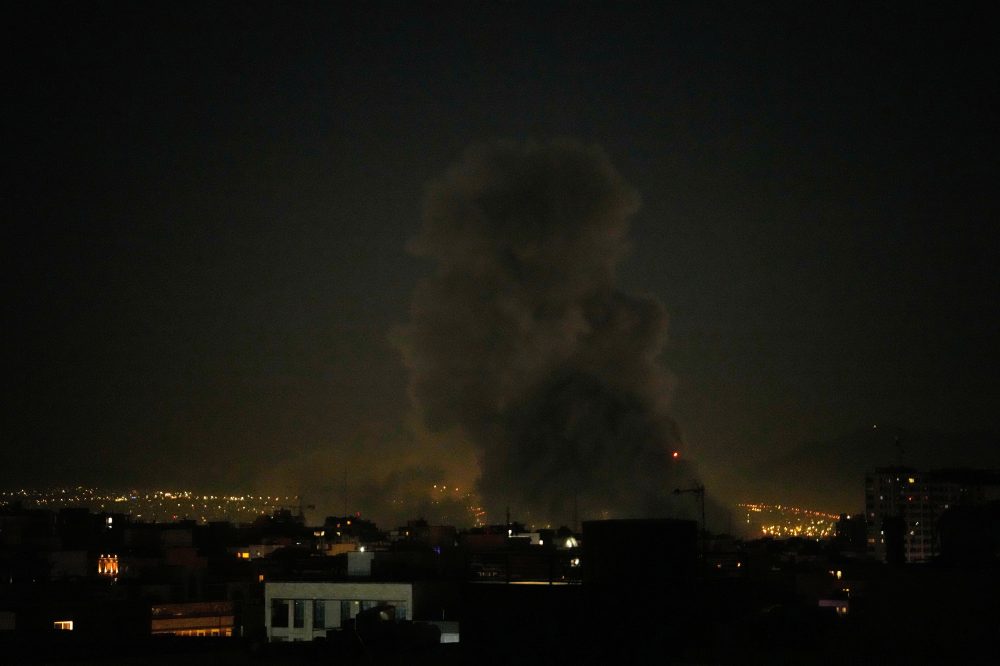
The Associated Press is using the word “war” to refer to the joint U.S.-Israeli strikes on Iran, and Iran’s retaliation. This reflects the scope and intensity of the fighting.
The United States and Israel attacked key military targets and killed Supreme Leader Ayatollah Ali Khamenei and other government leaders. Iran responded by launching missiles and drones at Israel and several Gulf Arab states that host U.S. armed forces, and remaining leaders have vowed revenge over Khamenei’s death. The strikes and counterattacks indicate that the killing of Khamenei, and U.S. President Donald Trump’s calls for the overthrow of the decades-old Islamic Republic, could lead to prolonged conflict that could envelop the Middle East.
The Merriam-Webster definition of war is quite broad: “A state of usually open and declared armed hostile conflict between states or nations,” or “a state of hostility, conflict, or antagonism.”
Even though none of the countries have officially declared war, the attacks by the United States and Israel, combined with Iran’s retaliation, meet those criteria. The decision by the Trump administration and Israeli leaders to attack and the subsequent destruction and casualties are enough to call the actions, and Iran’s response, a war. Trump himself has used the word war to describe the conflict.
It’s important to use the correct language to describe military action between sovereign nations.
Sometimes a one-sided attack occurs without further action, or a conflict starts but doesn’t escalate. Using “war” to describe those situations could diminish the word’s importance. Then, when actual war breaks out, people might not understand its significance.
The AP provided guidance on the attacks on Iran by Israel in June 2025, using the term “war” to describe the conflict in the days after the initial attacks and Iran’s retaliation. The war lasted 12 days, and Israeli and American strikes greatly weakened Iran’s air defenses, military leadership and nuclear program.
The AP also began using the term “war” to describe the conflicts between Russia and Ukraine and between Israel and Hamas in the days and weeks after fighting began.
In those cases, editors considered the number of casualties, the intensity of fighting, the involvement of each party, and what each country was calling the conflict.
AP capitalizes the word “war” only as part of a formal name, which as of now does not exist.
Decisions on how AP uses the term “war” happen in real time. AP’s news leaders and standards editors will continue to monitor developments to see whether changes are necessary.
At this point, the level of fighting constitutes the countries being at war, no matter what happens next. If fighting were to end soon, AP would continue saying the countries had been at war.
Brought to you by www.srnnews.com
 Dubai’s image as a safe, tax-free haven is rocked by blasts from Iranian airstrikes
 People line up for ice cream treats every March 1 at this Minnesota Dairy Queen. Why? It’s tradition
 OPEC+ boosts oil production after attacks on Iran and throughout region
 3 US troops killed and 5 are seriously wounded during Iran attacks, military says