
PHILADELPHIA (AP) — Ever since Democrat Kamala Harris lost the presidential election to Donald Trump two years ago, political strategist Khalil Thompson has been traveling the country to figure out why Black men inched toward a white Republican rather than a Black woman.
Although Black men vote overwhelmingly Democratic, even small shifts in their support can help swing razor-thin elections. They are often some of the most scrutinized but least understood voters, a blind spot that Thompson wants to fix.
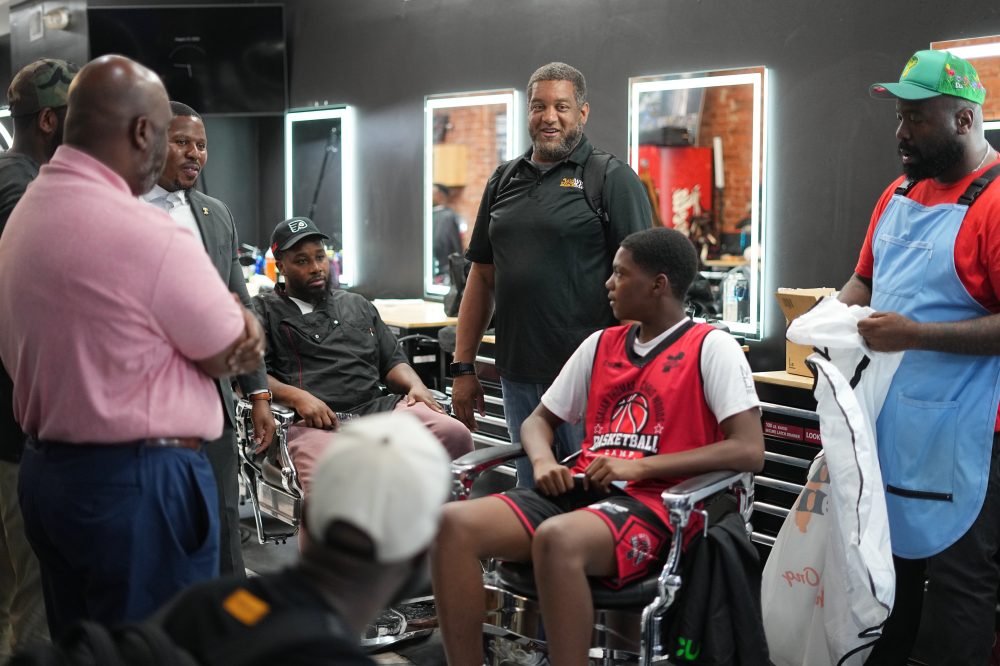
His mission led him to a Philadelphia barbershop one recent Friday night, where Thompson’s organization, Win With Black Men, organized a conversation that mixed with the sounds of buzzing clippers and a break to eat cheesesteaks.
“We know the shop is like our own country club that we come to, so we really just want to start having a conversation about what’s important to us in our community,” Thompson told the few dozen people who were getting their hair cut, sat in chairs lined up around the room or stood wherever they found extra space.
The two-plus hour discussion, which included local politicians, union leaders, lifelong residents, recent arrivals and a few high schoolers, had immense political stakes. While Philadelphia is a liberal stronghold and not at play in this year’s midterm elections, it is crucial in presidential elections. If Democrats cannot run up their numbers in the city, where Black residents are 40% of the population, it’s much harder for them to win Pennsylvania. Democrats face similar tests across the country.
“I am a middle-class Black man who lives in D.C. I have no idea what the various day-in-the-life needs would be of the brother who goes to the Bill Pickett rodeo in Houston, the brother that may work on a peanut farmer in Albany, Georgia, versus the brother that lives in Oakland or one who lives in Detroit and goes to work at a car factory plant,” Thompson later told The Associated Press. “When you’re polling, messaging, making TV decisions for Black men with one monolithic filter, you’re going to lose a broad swath.”
As the conversation got underway, Thompson raised the key question that he has been pondering: Why didn’t some Black men enthusiastically support Harris, the first Black woman nominated for president by a major political party?
One exchange reflected the raucous but familiar debates some Black men have had with each other since Trump’s return to the White House.
Stanley Thigpen, a civil engineer, had a theory about Black men and Trump, who he described as “Big T over in 1600,” a reference to the White House’s address at 1600 Pennsylvania Ave.
Thigpen said he is not a supporter, but “what we fail to realize is Trump has always been a prominent figure in Black culture,” he said. Groans, laughs and objections immediately followed.
“I gotta push back on that,” interjected Al Glay, a real estate agent.
“You can’t push back on that!” Thigpen retorted. “Rappers rapped about Trump.”
Glay recalled Trump’s statements about five Black and Latino teenagers, now sometimes known as the Exonerated Five, who were wrongly accused and convicted of the 1989 rape of a white jogger in New York’s Central Park.
“He was blatantly racist,” he said. “How can you support that?”
Another man brushed that off. “They’re all racist anyway.”
“You looked your mom in your face, you looked your aunt in the face,” Glay said. “You looked everybody in the face, and you saw Kamala, and you voted for the white man?”
The barbershop then briefly erupted.
Thompson got his start as an organizer for Democrat Barack Obama’s 2008 presidential campaign. Thompson co-founded Win With Black Men in 2023 to mobilize Black men and highlight their priorities.
The organization’s efforts were turbocharged after Harris entered the presidential race and concerns spread that Black men wouldn’t enthusiastically back the then-vice president.
Harris visited the same shop — Philly Cuts in West Philadelphia — during her campaign, nine days before she lost to Trump. She discussed ways to improve Black male representation in education, including increasing pay and reducing student loans with the local state representative.
The recent conversation was much more free-form.
Men debated how to provide role models and educational opportunities for Black youths, whether the city’s food deserts were the result of intentional policy and whether artificial intelligence posed greater risks or rewards for them in the labor market. But all agreed on greater government investment in their communities.
Thompson said he had found that Black men across regions, educational backgrounds and income levels are interested in policies that could help them serve as breadwinners and caregivers, build paths to independent wealth and obtain educational opportunities that boost financial independence and versatility.
Some shared feelings of disillusionment with politics that crossed party lines.
“For the longest time, we always have a reason to distrust government, because we know our history, right?” said Maurice Anderson, one of the barbers.
He remembered that Democratic President Bill Clinton signed legislation that boosted criminal penalties that disproportionately sent Black people to prison.
“What has happened,” he said, “is that we’re tapped out.” But even that was a trap, he added: “They want you to fall back.”
State Sen. Vincent Hughes, a Democrat, acknowledged the disillusionment.
“It’s always important that we’re having dialogue because we’ve got to turn that anger into action,” he said afterward.
John White Jr., 77, a former state representative and members of the Philadelphia City Council who led federal housing policy during the Clinton administration, said the men were having “the same types of conversations we were having back then.” He urged them to translate frustration into civic engagement.
Political strategists increasingly regard men of color as a crucial voting group as the political landscape undergoes a generational shift.
“Black men are not a monolith,” said Terrance Woodbury, a political pollster whose firm, HIT Strategies, consulted on the Harris campaign.
Black men age 18 and older — roughly 4.3% of the U.S. population, according to the latest census estimate — have unique historical experiences that make their voting patterns distinct from other groups. In July, Black men age 20 and older had an unemployment rate of 6.2%, nearly double the 3.5% unemployment rate for white men, according to federal data.
A Federal Reserve survey of 2022 data found that their families had a median wealth of $44,890 compared with the median white family wealth of $285,010. In 2023, Black men’s imprisonment rate was about 5.5 times the rate for white men, according to the latest figures from the Bureau of Justice Statistics.
About one-quarter of Black men supported Trump in 2024, according to AP VoteCast, a survey of more than 120,000 registered voters in all 50 states. That compares with 12% in 2020, when Trump lost to Democrat Joe Biden.
Thompson says he has heard from Black men of different backgrounds — urban and rural, high- and low-income — about how deeper realities such as trauma, mass incarceration, economic discrimination and cultural stereotypes make some Black men more skeptical of mainstream institutions and traditional campaign outreach efforts.
Woodbury, the pollster, said several potential Democratic presidential candidates have already begun consulting his firm on outreach to Black men.
“There is no one looking at 2028 who does not understand the disproportionate impact that Black men will play in South Carolina,” he said in reference to the first Democratic presidential primary state.
Thompson believes Black men are more likely to vote for candidates who offer an inspirational message rather than a pessimistic one. But just as Trump’s own dire messaging to Black communities resonated with some Black voters, Thompson said fears about the administration’s policies on policing civil rights, corporate diversity programs and how the nation’s history is taught, have also emerged as motivating issues for Black voters in the midterms, he said.
“We have the freedom today that countless ancestors prayed for, died for,” Thompson said. “And there are so many ways that we can use it. We just have to motivate and mobilize.”
Brought to you by www.srnnews.com
 Shelton aims to end an American drought and win his first major title in the US Open final vs Zverev
 Ahead of Fed meeting, Trump says US should have world’s lowest interest rate
 The secret ballot has been an article of faith in US elections. That’s being tested in Georgia
 GOP congressman from Wisconsin swims to safety after plane makes emergency landing in a lake