
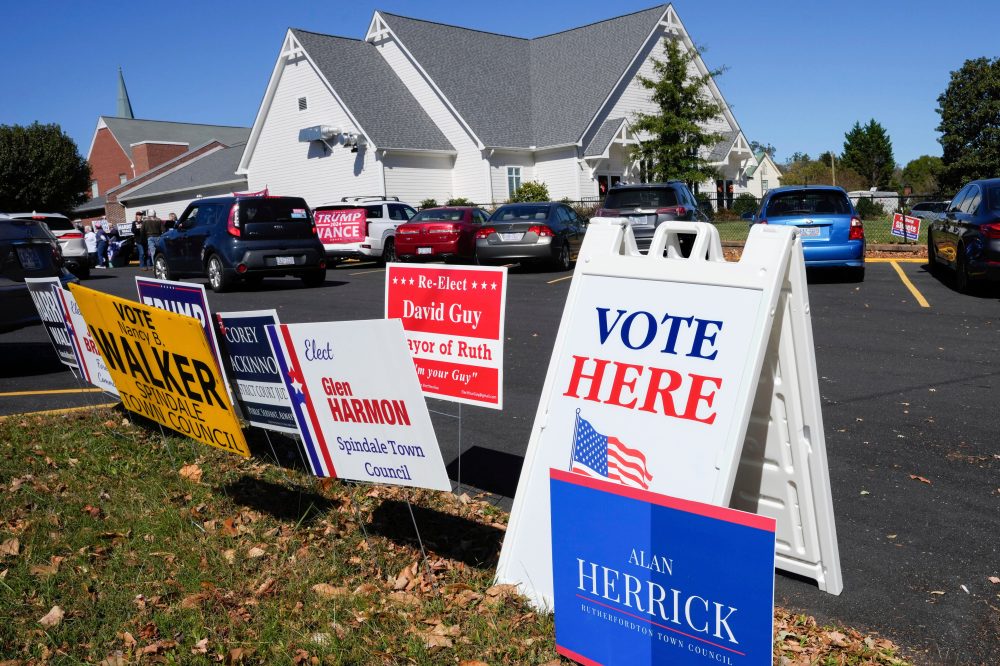
GREENSBORO, N.C. (AP) — A federal judge refused Sunday to help in attempts to open early voting sites at three public North Carolina universities, declining requests to overrule decisions by Republican-controlled elections boards leading up to the state’s upcoming primary.
U.S. District Judge William Osteen rejected arguments by the College Democrats of North Carolina and some students that they were likely to win a recent lawsuit because decisions by GOP board members placed undue burdens on the right to vote.
The decision by Osteen — nominated to the bench by President George W. Bush — to deny a preliminary injunction or a temporary restraining order can be appealed.
Early in-person voting for the March 3 primary begins this coming Thursday. It features nomination races for U.S. Senate and House, the legislature and local elections.
Osteen also wrote that formally backing efforts to open the sites so close to voting could risk confusion.
Osteen’s ruling marks a key decision on policy preferences by the State Board of Elections and elections boards in all 100 counties since a state lawrecently shifted them from having Democratic majorities to Republican majorities.
The College Democrats of North Carolina — an arm of the state party — and four voters sued in late January accusing the state board and boards in Jackson and Guilford counties of violating the U.S. Constitution.
The lawsuit involves votes by the state board and the two county boards to not include early voting sites at Western Carolina University, the University of North Carolina at Greensboro and North Carolina A&T State University, also in Greensboro. A&T is the largest historically Black university in the country.
An early voting site at Western Carolina has operated regularly since 2016. Sites at the Greensboro campuses have been offered in recent presidential-year elections but not in midterm elections.
Voting sites are offered at college campuses elsewhere in the state. Same-day registration is available at early voting sites.
Without the sites, the lawsuit says, students will be forced to travel off-campus to vote, imposing time and money upon those least familiar with voting.
Lawyers for the boards defended the panels’ actions, writing in legal briefs that there is no requirement boards must retain voting sites used in previous election cycles, and that site decisions were based on reasonable circumstances like parking access and past turnout.
Brought to you by www.srnnews.com
 Live Nation executives in talks with DOJ to avert trial, Semafor reports
 NFL-Trump absent from Super Bowl but wishes teams well
 ‘Take the vaccine, please,’ a top US health official says in an appeal as measles cases rise
 US Olympians speaking up about politics at home face online backlash — including from Trump