
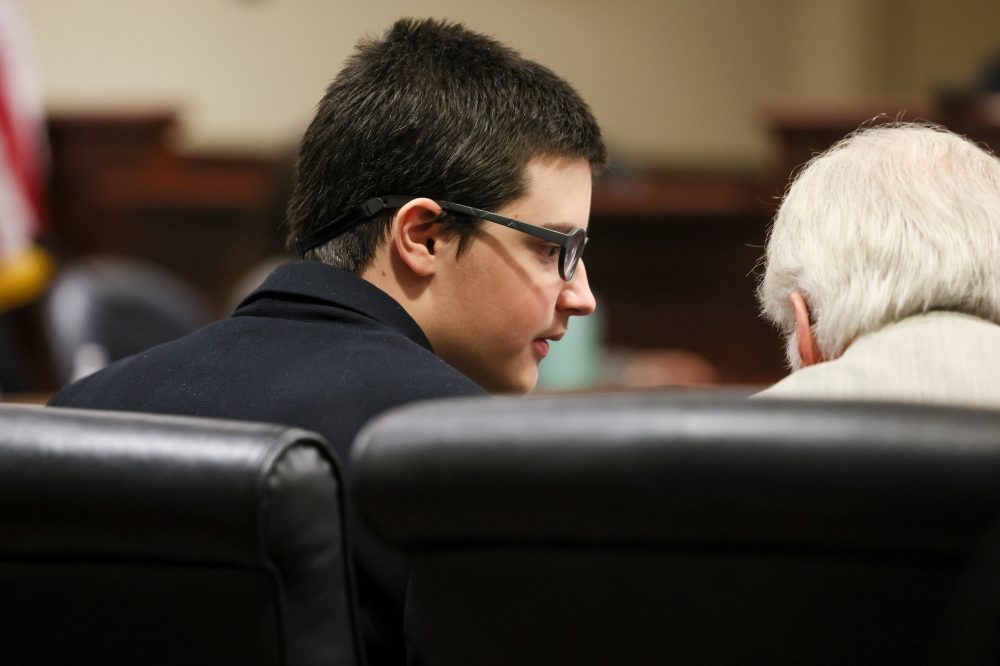
A prosecutor said that a teenager who killed two students and two teachers at Apalachee High School in Georgia carefully plotted the killing specifically to become famous, while a defense attorney argued that the terrible actions were those of a vulnerable and neglected child.
Colt Gray, 16, pleaded guilty last week to 55 counts, including murder, in the Sept. 4, 2024, shooting that also left several others wounded at the school about 45 miles (73 kilometers) northeast of Atlanta.
The minimum penalty for murder in Georgia is life with the possibility of parole. That leaves Barrow County Superior Court Judge Nicholas Primm trying to decide whether Gray should ever be eligible for parole.
District Attorney Brad Smith told the judge that Gray “cannot be in society.”
“We’ve seen no evidence he has any ability to develop a conscience or any ability ever to fully value human life,” Smith said.
Defense attorney W. Charlton Allen told the judge his client is “not irretrievably broken.” Giving him the possibility of parole would give him “an opportunity of hope,” Allen said, adding that without hope, “that takes away the ability for him to change.”
Teachers Richard “Ricky” Aspinwall, 39, and Cristina Irimie, 53, and students Mason Schermerhorn and Christian Angulo, both 14, died in the shooting. Another teacher and eight more students were wounded, seven of them hit by gunfire.
Victims of the shooting and family members of those killed conveyed their anger and grief to Primm on Friday, almost all of them asking him to impose a sentence of life without the possibility of parole.
Shayna Aspinwall, the wife of math teacher and football coach Richard Aspinwall, described “a life sentence of grief and trauma for those left behind.”
Investigators testified during the sentencing hearing that Gray idolized other mass shooters, talking about them online with other members of the “true crime community,” a group of young people online who are fascinated with such attacks.
Gray had chatted online about gaining notoriety through a school shooting and his admiration for previous mass shooters. There were aspects of his preparation and behavior before and after the Apalachee High School shooting that mimicked other mass shooters, an investigator testified.
Prosecutors played recordings of phone conversations Gray had with his mother, Marcee Gray, from a youth detention center in the months after the shooting. During those calls, he directed his mother to look up what people were saying about him online. When she described “fan art” drawings depicting him or comments people made about him, he asked her how much engagement those posts were getting and seemed excited when they were getting a lot.
“The shooting was not the culmination of the plan. The shooting was just one of the steps of the plan. The plan was ultimate and lifelong fame inside of the TCC,” Smith said, referencing the “true crime community.”
Gray’s maternal grandmother, Debbie Polhamus, testified that the teen had a troubled childhood and that his parents failed him. Her grandson had grown “highly agitated and aggressive” in the weeks before the shooting, she said, adding that she had urged his parents to get him some help but they didn’t follow through.
“I tried to help Colt because nobody else was helping him,” she said.
Polhamus said she visits her grandson once a week at a youth detention center and that he has improved enormously with treatment and medication.
“He’s so much better. Colt was in desperate need of a routine,” she said.
She said her grandson has been doing a lot of reading and wants to go to school and study to get his GED. She urged the judge to allow him a chance at parole.
“I’d like to see him have a chance at some point to prove himself,” Polhamus said.
Candice Broce, director of the state Division of Family & Children Services and commissioner of the Georgia Department of Human Services, was called to testify by Colt Gray’s attorney. She managed Gray’s case after he was put in foster care while in detention because he was a minor and his father was in prison. There were also concerns about his mother’s contact with him.
Broce testified that Gray appeared to show improvement while being treated. After Marcee Gray was barred from speaking with her son by a July 2025 no-contact order and he started taking medication, staff at the youth detention center later told Broce it “changed him essentially into a different child,” she said.
“Colt got less stability than he needed, which made him even more vulnerable,” Allen argued, arguing that his client got wrapped up in an online community where he found the acceptance he craved but wasn’t getting at home.
Brought to you by www.srnnews.com
 Loss of work authorization sows confusion for thousands of Haitian immigrants and their US employers
 Trump officials launch probe of 2 school districts over alleged testosterone vials, kissing exercise
 Seattle police say 15-year-old arrested in connection with festival shooting had a ghost gun
 Court panel declines to block Trump’s mail ballot order, but its status for midterms remains unclear