
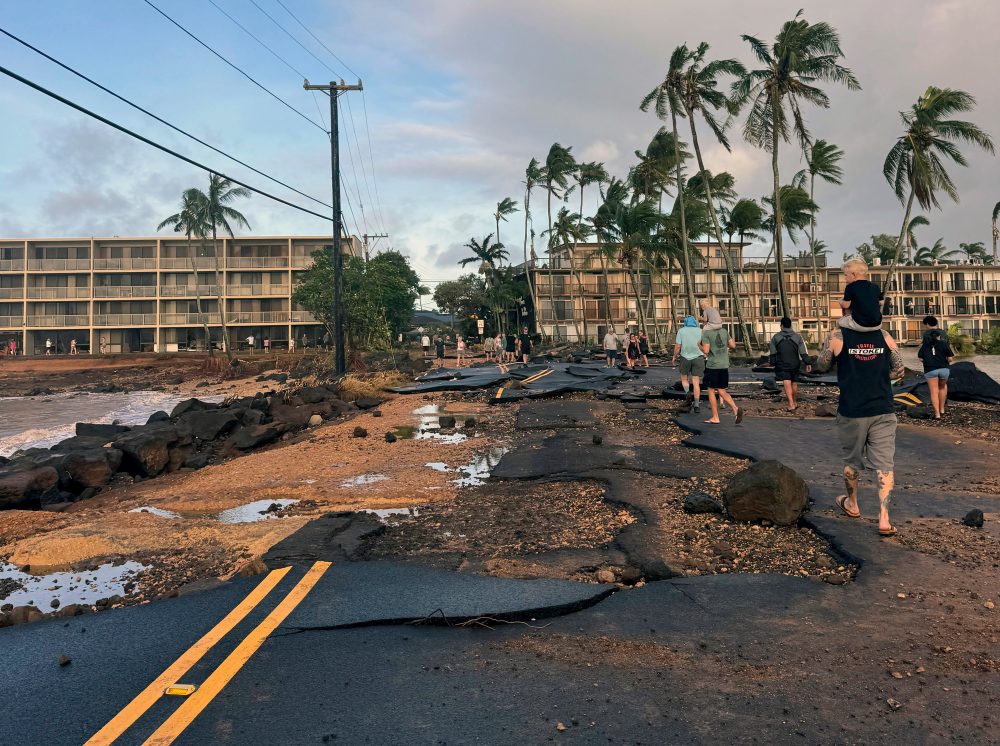
Watching her staff happily hand out free meals for hundreds of residents outside their Wailua commercial kitchen, food truck co-owner Kelly Kakalia felt fulfilled.
It was the day after Hurricane Lowell finished knocking out power, washing out roads and felling trees across Kauai, and Kakalia was focused on her community, not sales. The island where she was born and raised needed time to get back on its feet and put locals first.
About 10 days later, The Musubi Truck, Kakalia’s family-run business with three locations, has had to lay off half its staff of about 50 and shut down one truck. There is simply not enough demand for their poke bowls, spam musubi and bento boxes.
Kakalia is grateful would-be visitors heeded calls to give the island space to recover, work that continues since the Sept. 7 storm. But she and other small business owners across the island worry too long a pause will wreak economic havoc, forcing more layoffs and creating financial gaps too big to recover from.
“Now that power and water is being restored, we should start to switch the narrative before many of us go out of business,” said Kakalia, 36. “People are canceling their trips in November.”
When visitors should return is a familiar dilemma on Hawaii, where tourism injected $21.75 billion into the economy last year, according to state data. After disaster, crowds of sometimes less-than-conscientious tourists can be logistical and emotional barriers to recovery. At some point, however, they are key to jump-starting much of the economy.
That tension was especially pronounced on Maui, after wildfires wiped out the historic town of Lahaina in 2023, killing more than 100 people.
After Lowell, officials and some residents asked tourists to reconsider plans to visit Kauai, an island that can see over 28,000 visitors on a given day. Tourists might exhaust limited resources and clog roads needed for utility restoration and aid delivery, and some hotels and vacation rentals were badly damaged.
On Thursday, Kauai County Mayor Derek Kawakami said Kauai is now “welcoming visitors back,” while asking them to respect the ongoing recovery. “Come with patience, spend local, and help us recover,” he said.
More than 3,000 Kauai households and businesses still lack power nearly two weeks after Lowell, and some areas are still on water conservation notices. Some residents need generators, financial assistance, food, and help removing debris and mucking out property.
The community has led recovery efforts, donating supplies, setting up relief hubs, distributing gas and generators, and putting tools and vehicles to work to cut out and clean up damaged neighborhoods.
As the work progresses, some businesses felt ready to at least partially open to customers this week, but foot traffic was slow.
“It’s scary out there,” said Kristal Scott of Kauai Juice Co., the business she had run for 16 years. “Other businesses are already shutting their doors.”
Scott’s three juice bar locations and warehouse went dark after Lowell, and one store remains without power. Most of the fresh product spoiled, though Scott held on to her frozen goods by running a freezer off generators filled with pricey fuel.
All her shops sustained minor damage, but not enough for Scott, 41, to get a meaningful insurance payout despite paying for business interruption coverage.
With sales down 85%, Scott had to let go of half of her 45 employees, though she hopes they will return when things improve. “I beg them,” she said. “I’m like ‘Please, please, this is temporary.’ ”
The effects ripple beyond storefronts, spreading to farmers and fishermen who supply the hospitality industry along with the local food supply chain.
“It’s not just about the money, or me, it’s about all the fishermen we’re supporting and their families and their livelihoods,” said Cadena Ragsdale, owner of Kauai Fresh Fish, a seafood supplier that sources 100% Hawaii-caught fish from local fishermen to hotels and restaurants. “Without us, where are they going to sell fish?”
Ragsdale’s “heart sank” when she saw video of the terrible damage sustained at her largest client, a seaside restaurant on the south shore. Interrupted air cargo prevented her from shipping interisland. She laid off all but one of her eight-person team this week and is selling two vehicles to fill the gaps.
Even though the experience has been “eye-opening” for some small business owners about how much they rely on tourism, Ragsdale, 41, said the immediate focus is just staying afloat. If an area is closed, she said, “Don’t go there.” But, “Please come … be patient, have respect and aloha.”
Hawaii Gov. Josh Green requested an expedited major federal disaster declaration for Kauai and Maui counties in response to Lowell, the latest in a series of climate disruptions this year including major flooding, Hurricane Lala and Tropical Storm Moke.
A disaster declaration would unlock the opportunity for low-interest loans from the Small Business Administration, though President Donald Trump has not yet approved the request. The state made small business grant funding available for earlier disasters this year.
Mayor Kawakami said returning tourists should check with their accommodations and activity providers about possible interruptions, and cautioned that some beach parks, as well as communities on the far north shore, remain closed.
Those who do visit Kauai can help not just by spending locally, Kawakami said, but also signing up for volunteer opportunities listed on a county website.
Even those off island can find ways to help, like buying online gift cards from local shops.
The Musubi Truck already collected money online for its Feed Our Keiki program, which distributes free meals in the community. Now the program serves a double purpose. “It helps us feed the kids, but it also supports our business,” Kakalia said, “keeps us cooking.”
——
Associated Press coverage of philanthropy and nonprofits receives support through the AP’s collaboration with The Conversation US, with funding from Lilly Endowment Inc. The AP is solely responsible for this content. For all of AP’s philanthropy coverage, visit https://apnews.com/hub/philanthropy.
Brought to you by www.srnnews.com
 Trump refers to Black man from racially offensive 1988 campaign ad while stumping in North Carolina
 Early voting begins in US midterm elections that could flip control of Congress
 Asian shares mostly rise, cheered by a US rally and easing oil prices
 Judge strikes down Trump policy that cut millions in teacher-training money