
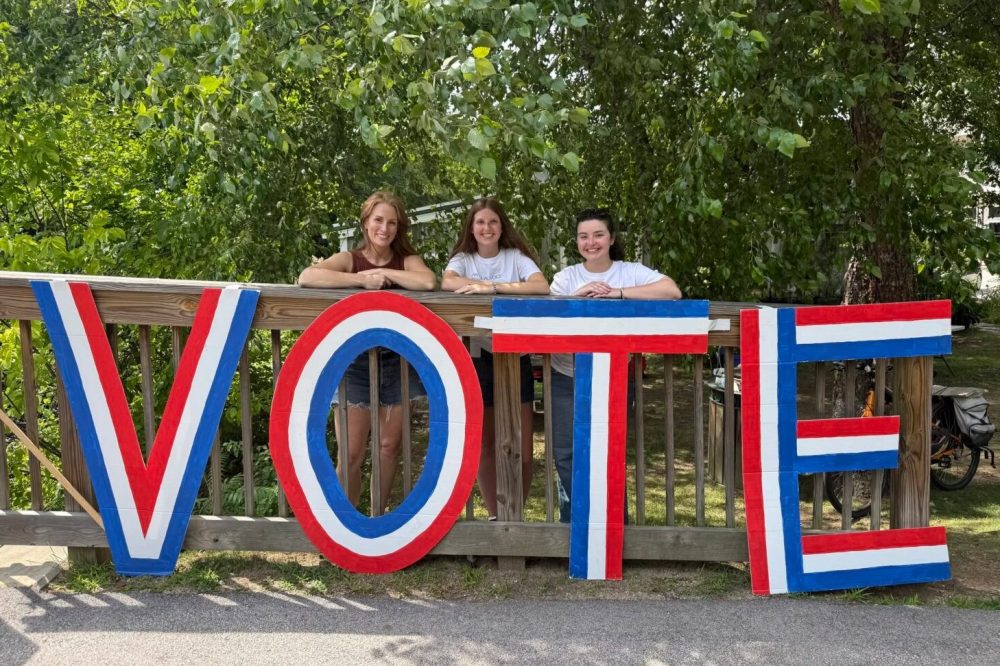
From court challenges on student IDs to new requirements for absentee ballots, voting in 2026 will bring a number of changes for Granite-staters for students and residents who have moved in-state or between states.
“The laws have changed a lot, so if you voted in 2025 or 2024, this year will be different,” said Olivia Zink, executive director of the Concord-based nonprofit voting rights group the Coalition for Open Democracy told InDepthNH. “They limited the amount of documents that can prove domicile, they’ve added requirements for absentee ballots. If you’re going to vote for the first time, remember ACID: Age, Citizenship, Identity, Domicile.”
On Tuesday, Zink’s group filed a lawsuit in U.S. District Court to preserve the use of high school and college-issued IDs for voting purposes. The suit is targeting House Bill (HB) 323, which was signed into law by Gov. Kelly Ayotte in June.
The Coalition for Open Democracy coordinates voter registration and outreach efforts across New Hampshire and filed suit to block the Secretary of State’s Office from impacting the voting rights of students.
“(The Coalition’s) work is directly impacted by HB 323, which takes away student IDs – whether those are high school IDs or college IDs — as a valid form of identification when obtaining a ballot,” Ben Horton, a legal counsel who’s working on the case explained.
Horton continued, saying Secretary of State David Scanlan’s April 23 directive — which barred student IDs when registering to vote, requesting an absentee ballot, or checking in at the polls — unlawfully extends HB 323 and that the law did not bar students from using IDs to register. A spokesperson from Scanlan’s office could not be reached for comment.
Horton said they had a meeting with a judge this morning, and they have a motion hearing scheduled for Aug. 31.
He added there’s a significant portion of young voters — people between the ages of 18-24 — who don’t have access to a driver’s license, which he said is the predominant way young voters would identify themselves after HB 323 passed and was signed into law. He said while other options such as passports or military IDs could still be used, the vast majority of voters will use drivers’ licenses.
Horton said this is going to negatively impact the youth vote right now, but that it will also only get more pronounced over time as the percentage of young people, who either wait to get their license or choose not to get one, increases.
“It’s adding this extra layer of bureaucracy with literally no actual difference in the amount of types of documents that are being required; it’s just adding another step. This does nothing to further election security… When you install these roadblocks the first time people are able to vote, you’re not just denying them the right to vote when they’re 18, you’re potentially creating a pattern of non-voting that is going to extend for years, or possibly decades,” Horton said.
Rep. John Sellers, R-Bristol, co-sponsored HB 323 and said he’d like to see a more secure government-issued ID that students can use for voting purposes rather than the school-issued IDs. He added he doesn’t see the lawsuit resulting in allowing student IDs to be used again, unless the legislature changed to be controlled by Democrats. “Right now, with Republican control, it’s not going to happen,” he said.
“It’s a simple change to not allowing student IDs as valid identification cards, because there’s maybe a potential for voter fraud, and we’re trying to cut down on fraud. We’re also trying to make sure people are not just residents but are also domiciled here in New Hampshire,” Sellers said.
No evidence of widespread voter fraud in New Hampshire has been presented.
House Democratic Leader Alexis Simpson, D-Exeter said, “For over ten years, young Granite Staters have been able to use a student ID to prove their identity when casting their ballots. Without a single case of fraud to point to, Republicans took that option away. Young adults deserve a real say in the decisions that shape their rent, their schools, and their futures.”
To register to vote you must be a U.S. citizen, at least 18 years of age and domiciled in the city or town where you plan to vote.
Durham Town Clerk Rachel Deane said students will not be able to use their high school, college or any other student IDs this year and most will likely need to get a driver’s license to prove their identity and age.
“A driver’s license can do three: domicile, identity and age if it’s a New Hampshire drivers license with a New Hampshire address,” Deane said. If the license is from another state, then a student would need to prove they are living in New Hampshire. “If you’re coming in to vote with the town clerks, it is typically 5 days before the election that we close the voter rolls down so the supervisor prints the checklist for the election. In the state of New Hampshire you can register to vote on the same day. If you have all the required proof, you can register to vote.”
At registration, you need to prove four things: Age, Citizenship, Identity and Domicile.
Identity and age: driver’s license, government-issued photo ID or passport. or passport card
U.S. citizenship: Birth certificate, passport, naturalization papers, proof you are currently or previously registered to vote in New Hampshire or a qualified voter affidavit sworn under penalty of voter fraud if you lack documents. Earlier in the year House Bill 1569 eliminated the option to use a qualified voter affidavit (QVA) to attest to citizenship, but the Coalition for Open Democracy challenged the law and a judge struck it down on May 29, restoring the right to use a QVA. The state is appealing the ruling, but for the Sept. 8 primary, the QVA will be available.
Domicile: New Hampshire driver’s license or non-driver ID with current address, New Hampshire vehicle registration, federal picture ID with current address, government-issued check, benefit statement, or tax document showing your current domicile address.
However, if you don’t have any of those, you can complete an attestation form saying you have none of those documents and bring one of these: a rental or lease agreement, a utility bill or other bill with your current address, a confirmation of domicile form signed by a property owner, manager or tenant or a homeless confirmation of domicile form.
The domicile attestation is different from the QAV, Schreiber emphasized. The attestation covers missing domicile documents; the QVA covers missing proof of citizenship.
If you are already registered in another New Hampshire town, you generally only need to prove identity and domicile to update your registration.
That does bring in another wrinkle. This year will be the first year that the NH Secretary of State will do annual purges of the voter list.
“We’ve got people getting letters saying they’ve been removed from the voter list, so I urge everyone to check,” Zink said. “Someone in a nursing home moved from one unit to another and was removed, another person put their home in a trust and the deed changed.”
___
This story was originally published by InDepthNH.org and distributed through a partnership with The Associated Press.
Brought to you by www.srnnews.com
 ICE pitches legal insurance to help shield local officers who make immigration arrests
 Teen lifeguard and boy he rescued are honored at White House after Trump saw dramatic viral video
 Board overseeing Washington Dulles airport to vote on $19.9 billion overhaul plan
 The Media Line: The Ceasefire Arsenal: Iran and Its Rivals Race To Reload