
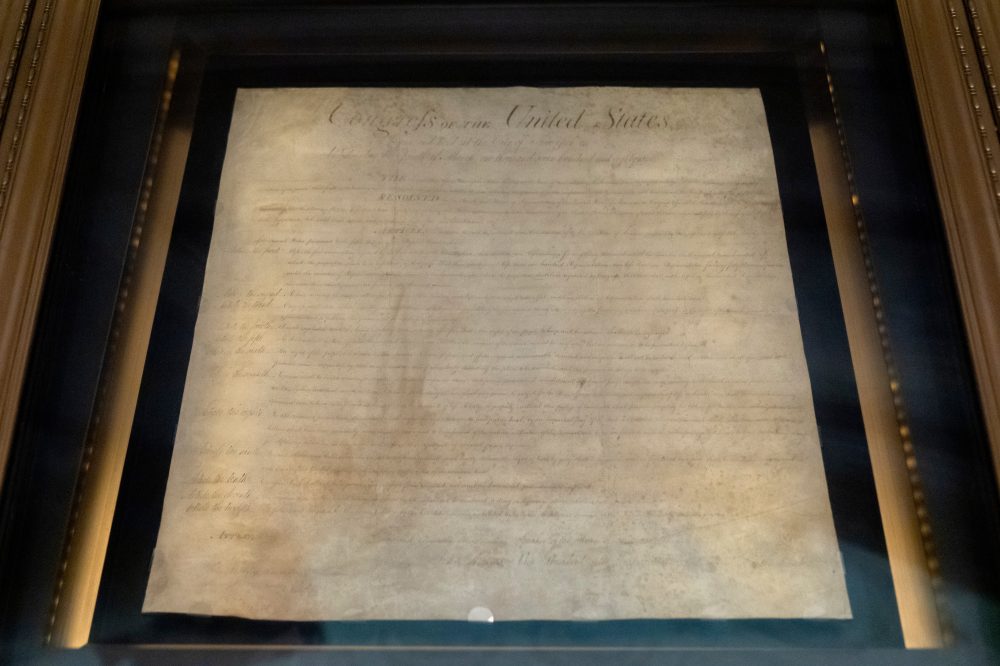
NEW YORK (AP) — It was important enough to the framers of the U.S. Constitution to be included in the first 10 amendments known as the Bill of Rights — that no person “shall be compelled in any criminal case to be a witness against himself.”
As part of the Fifth Amendment, the right against self-incrimination is well known to the general public thanks to years of legal and police procedural shows on television as well as instances of high-profile use in real life. The amendment also includes a right to due process and protects against being prosecuted twice for the same offense.
It has seeped into the culture, too. “Pleading the Fifth” has become an idiom in the United States, used jokingly in casual conversation as a way to get out of answering a possibly uncomfortable question.
The general principle is not a uniquely American one. Its roots include English common law dating back to the 17th century.
At the time the Constitution was being written, it was enshrined along with other amendments to put limits on the newly created federal government. The Fifth Amendment and a handful of others were focused on criminal justice issues, with other amendments including things like the right to a lawyer and a speedy jury trial, and a prohibition of cruel and unusual punishment.
One of the core tenets of the U.S. criminal justice system is that people are innocent until proven guilty, and that it’s up to the prosecuting power to prove guilt. Without a right to avoid self-incrimination, people could be put in the position of having to prove their own innocence rather than being shown as guilty.
Over the course of U.S. history, the Fifth Amendment has expanded beyond federal criminal cases to the state court level, and to civil cases as well. There’s a difference, though.
In criminal cases, if someone on trial invokes the amendment and refuses to testify, the jurors must be told that they can’t assume that silence equals guilt. In civil cases, drawing a negative inference from a refusal to testify can be allowed.
Of course, even in criminal cases, if jurors are told it doesn’t mean a defendant is guilty, they could still believe that not testifying correlates to having done what they are accused of. Witnesses can also plead the Fifth, but they can answer other questions — as opposed to defendants, for whom it’s all or nothing in regards to testifying.
The Fifth Amendment’s use has also shown up in hearings before Congress, when those who have been subpoenaed to testify under oath reference it out of concerns that something they say could then be used in some kind of criminal proceeding.
In a hearing before a Republican-led Senate committee about how he handled the COVID-19 pandemic, Dr. Anthony Fauci turned to the Fifth in declining to answer questions. It drew scorn from Republicans, while Democrats supported him.
In 2022, when he was out of the White House after his first term as president, Donald Trump used the Fifth repeatedly in a deposition for a civil case against the Trump Organization in New York.
In the 1950s, when Sen. Joe McCarthy held anticommunist hearings, some witnesses used the amendment when being questioned. Even though they had the right, McCarthy condemned them for it, and they faced consequences that included public censure and blacklisting.
Brought to you by www.srnnews.com
 Wisconsin judge says voters who have returned absentee ballot for state primary cannot get a new one
 Judge weighs bid to block or reverse transfers of transgender inmates into a segregated prison unit
 A Caribbean court rules that a US extradition process against Guyana’s opposition leader can resume
 Funerals for Iraq’s Popular Mobilization Forces fighters, in photos