
By Nate Raymond and Jan Wolfe
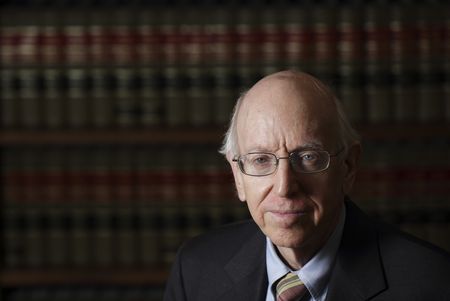
Nov 12 (Reuters) – Former US Circuit Judge Richard Posner, a prolific jurist who ranks as the country’s most-cited legal scholar of the last century and was viewed as one of the most influential judges outside the US Supreme Court, has died at 87.
Posner, who had served on the Chicago-based 7th US Circuit Court of Appeals for 36 years until retiring in 2017, died on Tuesday, according to the University of Chicago Law School, where he had long taught.
Posner was born in New York City to far-left Jewish parents he once described as “limousine radicals.” He enrolled at Yale College at 16 and was just 23 when he graduated first in his class from Harvard Law School.
Appointed to the appeals court in 1981 by Republican President Ronald Reagan, Posner authored more than 3,000 opinions during his judicial career.
He also wrote over 500 articles and 50 books, on topics including antitrust law, the 2000 presidential election recount, and constitutional issues arising after the attacks of September 11, 2001.
Posner was a pioneer in the field of law and economics, an area that examines legal rules through the lens of economic efficiency and incentives. In 1973, he published “Economic Analysis of Law,” a book that helped define the discipline.
Posner often called himself a pragmatist. He was known for focusing on the real-world impact of his decisions, rather than precedent and rigid legal doctrines. Judicial opinions, he once wrote, should be “characterized by brevity and candor and a quest for a sensible result.”
‘MAGNIFICENT DISGUISE’
Though long viewed as a conservative, Posner became a sharp critic of originalism, the dominant philosophy of the modern conservative legal movement, which seeks to interpret the US Constitution according to its original public meaning when it was drafted centuries ago.
In a 1990 article, he called originalism a “magnificent disguise” that allows the judge to “do the wildest things, all the while presenting himself as the passive agent of the sainted Founders.”
In 2012, he criticized the “incoherence” of conservative Supreme Court Justice Antonin Scalia, a leading proponent of originalism, accusing him of deviating from his own strict, text-based approach to interpreting law when he struck down a District of Columbia handgun ban in 2008 by considering the legislative history behind the law. According to Posner, Scalia’s methodology displayed “remarkable elasticity.”
“To say that I used legislative history is simply, to put it bluntly, a lie,” Scalia reacted in an interview with Reuters. Scalia died in 2016.
Posner in later years delivered rulings on topics including abortion and LGBTQ rights that were hailed by liberal advocates. He told NPR in 2012 that he had “become less conservative since the Republican Party started becoming goofy.”
In a 2014 ruling, Posner described arguments by the states of Wisconsin and Indiana in defense of their same-sex marriage bans as “totally implausible.”
“Heterosexuals get drunk and pregnant, producing unwanted children; their reward is to be allowed to marry. Homosexual couples do not produce unwanted children; their reward is to be denied the right to marry. Go figure,” Posner wrote.
The Supreme Court legalized same-sex marriage the following year.
Posner abruptly retired from the 7th Circuit in September 2017, telling the Chicago Daily Law Bulletin that he was not getting along with the other judges because he was concerned about how self-represented litigants were treated in court.
Lawyers for Posner later disclosed in a legal dispute that he was diagnosed with Alzheimer’s disease about six months after leaving the bench.
He is survived by his wife Charlene Horn and their two sons, Kenneth and Eric, who is himself a well-known law professor.
(Reporting by Nate Raymond in Boston and Jan Wolfe in Washington; Editing by Olivier Holmey)
Brought to you by www.srnnews.com
 The Media Line: President Trump Marks Veterans Day at Arlington; Monument Displays Names of 41 Million Past and Present Service Members
 US CDC confirms six measles-related deaths in 2026
 White House set to extend Jones Act shipping waiver, sources say
 USPS plans 11% fuel surcharge on package deliveries