
By Nicole Jao and Tom Polansek
NEW YORK/CHICAGO, June 9 (Reuters) – High energy costs are squeezing grain and soybean growers across the U.S. farm belt, as the Iran war chokes fuel supplies through the Strait of Hormuz and pushes diesel prices to record highs in key agricultural states.
Many farmers were already under pressure before the conflict and facing a fourth straight year of shrinking margins, battered by a resurgent drought, high input costs and fallout from U.S. President Donald Trump’s trade policies, which have weighed on crop prices.
The conflict drove diesel prices in several states across the Midwest, America’s primary corn and soybean-producing region, to new all-time highs in May, just as farmers ramped up plantings and other spring fieldwork. Wisconsin diesel hit $5.873 per gallon, while Indiana reached $6.167, and Illinois rose to $6.14 in mid-May. Ohio and Michigan also posted records, according to data from the motorists association AAA.
The national average diesel price has surged more than 40% since the Middle East conflict began. Global crude oil prices, which underpin diesel and gasoline, jumped about 30% since late February.
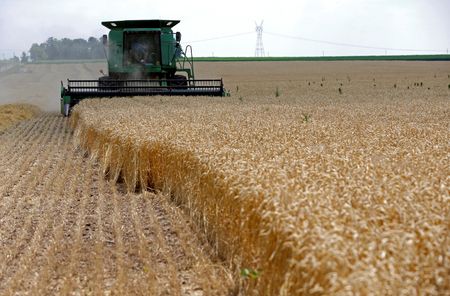
On farms across the U.S., diesel powers equipment needed for crucial field operations, from spraying pesticides and planting seeds to fertilizing fields and harvesting crops.
Unlike other sectors that can switch fuels, most U.S. farm machinery is designed to run on diesel, leaving farmers highly exposed to diesel price volatility.
“It’s a huge cost,” said Glenn Brunkow, who raises soybeans and cattle in Wamego, Kansas. “There’s just not much we can do about it, and we weren’t budgeting for it. It came out of nowhere and surprised us.”
Prior to the war, fuel-related expenses accounted for about 3% to 4% of an average Illinois row-crop farmer’s input costs, or roughly $16 to $23 per acre, said Ben Klieve, Benchmark Analyst, referencing estimates from the University of Illinois.
If diesel prices stay at their current level, fuel-related costs could rise to 5% to 6% of total input costs, or from a $20 per acre midpoint to $30 acre for row-crop farmers, Klieve said.
“It’s a very difficult environment for row-crop farmers today,” he said. “The prices of the grain that they’re producing have fallen sharply in recent weeks and are actually down relative to the pre-Iran war levels, while input costs like diesel and fertilizer remain significantly higher so their bottom lines are only getting weaker.”
FARMERS BRACE FOR LOSSES
Corn and soybean farmer Tom Murphy said he delayed plans to turn over soil in fields he recently rented in northwest Indiana because he did not want to use up precious fuel to operate his machinery.
Before prices spiked, Murphy intended to till five fields to make the ground level so that it would be easier to operate equipment for spraying and harvesting crops. However, he only tilled one of those as he tried to stretch out about 6,000 gallons of farm diesel he bought in December. He will still use the fields to grow crops, but the land will not be in the condition he wanted.
“We’re going to leave them a little rough this year and fix them next year, I guess,” said Murphy, who does not till most of his fields.
Murphy said in late May that he had about 2,500 gallons left in storage from December and would need to buy more to tend to crops during the important summer growing season.
Don Bloss, a grain and soybean grower in Pawnee City, Nebraska, said he was paying higher shipping rates to truckers to haul corn 80 miles to market.
“You just have to keep writing out the checks,” Bloss said. “We’re at everybody else’s mercy.”
MORE PAIN MAY BE ON THE WAY
Experts warned fuel prices may rise further if the Iran war continues to choke global fuel supplies.
Demand for U.S. petroleum products has remained high since the closure of the Strait of Hormuz, a critical passageway for nearly a fifth of global oil flows. If exports of gasoline and diesel remain near record levels heading into the summer, the domestic supply cushion that helps keep their prices in check could shrink further.
U.S. distillate fuel oil inventories fell to a 23-year low in May, according to the U.S. Energy Information Administration said. The country’s distillate stockpiles, which include diesel and heating oil, fell by 2.1 million barrels in the week ended May 22 to 100.8 million barrels, the lowest since May 2003.
The coast is anything but clear as uncertainty surrounding a potential deal between the U.S. and Iran persists, said Patrick De Haan, head of petroleum analysis at GasBuddy.
“Overall, any setback in negotiations could quickly reverse the recent decline in fuel prices” De Haan said.
(Reporting by Nicole Jao in New York and Tom Polansek in Chicago; Editing by Liz Hampton and Nick Zieminski)
Brought to you by www.srnnews.com
 What to know about the evolution of execution methods in the US
 Kalshi to collect employment info from customers trading in some high-risk markets
 Cuba’s top envoy to US calls Trump’s sanctions on Cuban leaders a ‘pretext’ for military action
 Musk’s xAI, SpaceX hit with class action over data center ‘nuisance’