
By Richard Cowan
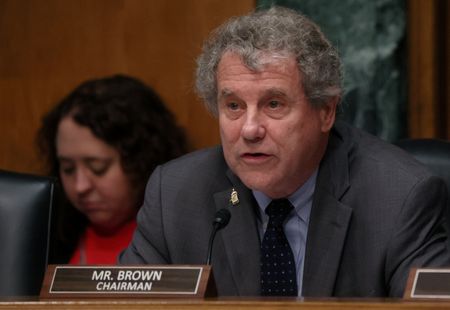
WASHINGTON, May 5 (Reuters) – Former Senator Sherrod Brown is favored to win the Ohio Democratic primary on Tuesday, as his party turns to a seasoned populist in its quest to topple Republicans’ U.S. Senate majority in November’s midterm elections.
Ohio has trended steadily Republican over the past decade, making Brown’s comeback bid – after a 2024 loss – a test of how far President Donald Trump’s declining popularity is reshaping the 2026 midterm map.
Democrats, who entered the 2026 midterm cycle facing long odds of retaking the Senate, now see an increasingly competitive landscape as voters sour on inflation, the war with Iran and other flashpoints of Trump’s presidency.
Brown, 73, lost his 2024 reelection bid to Republican Bernie Moreno, a former car dealer who capitalized on blue-collar workers fleeing the Democratic Party and was endorsed by Trump.
Brown’s prospective opponent, Senator Jon Husted, 58, was appointed to the seat in January 2025 when then-Senator JD Vance became vice president. He is running unopposed in the Republican primary.
The November special election will fill the remaining two years of Vance’s term.
The Husted-Brown race is seen as a toss-up by some analysts and a competitive race in recent opinion polls, in striking contrast to Trump’s 2024 romp in Ohio, where he beat Democratic presidential nominee Kamala Harris by 11 percentage points.
The Midwestern state, hit hard in recent decades by massive job losses in the steel and automotive industries, is one of four states Democrats plan to pour resources into for a shot at ending Republicans’ 53-47 seat control of the Senate.
DEMOCRATIC PATH TO FLIP THE SENATE
Recapturing the Senate will be an uphill climb for Democrats, who would have to both defend several competitive seats of their own and flip at least four Republican-held seats.
They think they have momentum nationally, however, as voters gauge Trump’s presidency nearly midway through his second term and are unsettled by rising prices of gasoline and other goods, the U.S. war with Iran and migrant deportations that some view as too extreme.
An April 24 to 27 Reuters/Ipsos poll found that Trump’s approval rating was 34%, down from 47% at the start of his second term. Only 21% of adults surveyed approved of his handling of inflation, a leading concern of voters.
Brown’s “economic populism may be uniquely suited to this moment when affordability concerns are paramount,” the non-partisan Cook Political Report said.
Even so, an April 7 to 14 Bowling Green State University poll found that 55% of respondents in Ohio said they considered themselves to be part of Trump’s MAGA movement, which has been embraced by Husted’s Republican Party.
Beyond Ohio, Democrats think they will have a chance of capturing North Carolina’s open Senate seat and a Maine seat held by longtime incumbent Senator Susan Collins, who is likely to face an upstart Democratic progressive with rising national attention.
In a surprise turn, Democrats also hope to be competitive in the heavily Republican state of Alaska, where Republican Senator Dan Sullivan is seen facing former at-large Democratic Representative Mary Peltola, a candidate with proven cross-party appeal.
Meanwhile, Democrats will have to dedicate campaign resources to Michigan, where Democratic Senator Gary Peters is retiring after narrowly winning reelection in 2020. Trump won Michigan in the 2016 and 2024 presidential elections.
Tight races could also develop over the next six months in Iowa, where Republican Senator Joni Ernst is retiring, and in Georgia, a swing state where Democratic Senator Jon Ossoff is defending his seat.
TURNOUT COULD REFLECT VOTER ENTHUSIASM
Political analysts will be closely monitoring voter turnout in Tuesday’s Ohio primary elections. A strong showing by Brown could hint at whether Democrats might score an upset victory in their battle for the Senate.
At the same time, three U.S. House of Representatives races in Ohio could also provide clues on Democrats’ more likely chances of winning control of that chamber, which Republicans now hold with a narrow majority.
Last year, Ohio approved a redistricting plan that Republicans drew up to gain an added edge in the November elections.
That has put Democratic Representative Marcy Kaptur’s four-decade House career in jeopardy. While she is expected to win her party primary, her northwest district in the Toledo area is now composed of significantly more Trump supporters, making her an underdog in the general election, according to analysts.
Similarly, Democratic Representative Greg Landsman’s Cincinnati district is now more Republican-friendly, although he is seen holding an edge against the likely winner of Tuesday’s Republican primary.
Meanwhile, Democratic Representative Emilia Sykes’ newly drawn district in the Akron area could boost her prospects in November in a somewhat competitive race with whichever candidate emerges from a crowded Republican primary field. Sykes is unopposed in the Democratic primary.
(Reporting by Richard Cowan; Editing by Edmund Klamann)
Brought to you by www.srnnews.com
 Former employee of Stefon Diggs to take the stand for a second day in NFL player’s assault trial
 US attempt to open the Strait of Hormuz tests Iran war’s fragile ceasefire
 USPS unveils Route 66 centennial stamps, born from a photographer’s 42 trips
 Exclusive-Canada-US oil pipeline close to reaching commitment requirement, sources say