By Maria Alejandra Cardona, Savyata Mishra and Ross Kerber
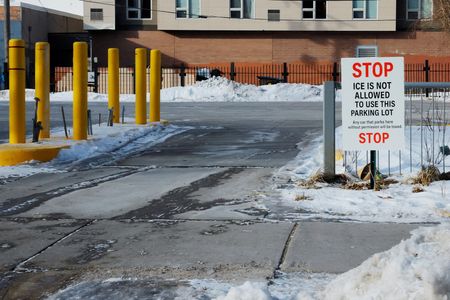
MINNEAPOLIS, Jan 16 (Reuters) – Up and down Lake Street in the heavily Latino area of south Minneapolis, numerous mom-and-pop restaurants have hung up signs that say “No ICE,” referring to U.S. Immigration and Customs Enforcement officials who have been conducting frequent raids in the area. The federal actions have also prompted thousands in the streets to protest after ICE agents killed 37-year-old Renee Good in her vehicle last week.
By contrast, large corporations in Minneapolis have been much less vocal about the effects of immigration enforcement on the city, known as both a bastion of progressive politics in the U.S. Midwest and a robust corporate employer. Seventeen Fortune 500 companies are based in Minnesota, including Target, UnitedHealth, and General Mills.
Reuters reached out to those companies, as well as Minnesota-based corporations Best Buy, Hormel, Land O’Lakes, agricultural giant Cargill, and industrial conglomerate 3M. None would speak on the record on the guidance they have given to employees. Their websites also have not addressed the current federal actions or unrest in the city.
It stands in contrast with how companies responded in 2020 after the police killing of George Floyd that spurred nationwide anger; many companies, including UnitedHealth and General Mills, spoke out in support of Floyd or his family after his death.
FEAR RESHAPING OPERATIONS
Their silence, according to Bill George, a Minneapolis-based former executive and current Harvard Business School fellow, is a mistake.
“A lot of them are very silent and I think it’s not a good time to be silent,” he told Reuters. He added he has spoken with numerous executives in the Minneapolis area who have expressed concerns about the toll on business, with many still in the process of formulating guidance to workers.
“It is disappointing to me that we don’t hear their voices. They’re charged with the safety, security and well-being of their employees,” he said.
Businesses have been much less outspoken about President Donald Trump’s policies in his second term, due to fear of retaliation or threats of boycotts. After a Hilton-owned Hampton Inn cancelled bookings for ICE members in early January, the company removed it from its network.
Many restaurants on Lake Street have reduced hours or closed. At Pineda Tacos, where a “No ICE” sign hangs in the front window and trash cans barricade the rear entrance, employees guard the door in an effort to prevent surprise raids, letting customers in one-by-one. Owner Luis Reyes Rojas said fear has reshaped daily operations.
“We have plan A, plan B and plan C,” Reyes Rojas said, describing plans to retreat to offices or basements in case agents appear. “We don’t know how much longer we can endure this.”
FEELING THE EFFECTS
Business associations say the $350 billion regional economy is feeling the effects, from sales declines at small businesses to falling attendance at large companies and agricultural operations. “There are impacts that roll up to Fortune 500 companies and all the way down to sole proprietors,” said Mike Logan, CEO of the Minneapolis Regional Chamber of Commerce.
The Trump administration has defended the operations, and has added more agents even as 69% of Americans in a recent Reuters poll say federal agents should minimize the harm to people during operations, even if arrests decline.
One high-profile ICE incident took place at a Target store in the suburb of Richfield, where a pair of workers – both U.S. citizens – were taken by ICE agents. One of those arrested was a 17-year-old Target employee, according to a source familiar with the situation. Target has not issued any public statement about the ICE raids; it declined to comment for this story.
Michael Howard, a Democratic state representative, whose district includes parts of Minneapolis and Richfield, said he has been trying to learn more about Target’s protocols related to ICE. He is urging them to “exert more clearly their private property rights and Fourth Amendment rights to request that if ICE is going into their public-private spaces that they present a judicial warrant.”
Jeff, 61, who owns a residential cleaning company in the Minneapolis suburbs, said he has told his all-Latino workforce not to work if they feel threatened. He declined to share his last name or business name out of fear of attracting ICE attention. He has been filling the tanks of company cars following reports that ICE has questioned people at gas stations.
“I’m not telling anyone they have to work,” he said. “If they want to, I will give them as safe a route as I can give them. If they don’t want to come in, I understand, and no one will get fired.”
(Reporting by Maria Alejandra Cardona in Minneapolis, Savyata Mishra in Bengaluru and Ross Kerber in Boston; additional reporting by PJ Huffstutter in Chicago, Siddharth Cavale, Jessica DiNapoli and David Gaffen in New York; Writing by David Gaffen; Editing by Aurora Ellis)
Brought to you by www.srnnews.com
 The Latest: Middle East allies urge Trump to hold off on Iran strikes, diplomat says
 Takeaways from the AP’s report on turmoil surrounding the FDA’s new fast-track drug program
 Legal questions swirl around FDA’s new expedited drug program, including who should sign off
 Sharks are famous for fearsome teeth, but ocean acidification could make them weaker