
By Lisa Baertlein
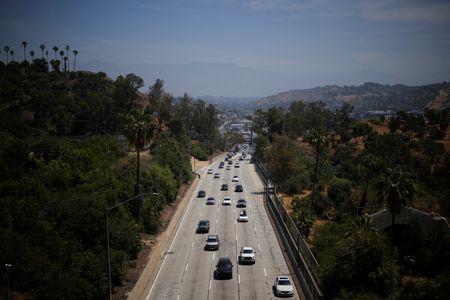
LOS ANGELES, June 2 (Reuters) – If you thought soaring pump prices since the onset of the Iran war might help clear the notoriously clogged highways of Los Angeles, think again. Drivers in the often-gridlocked city – where regular unleaded gasoline prices are well over $6 per gallon – appear accustomed to sticker shock, according to data provided to Reuters by government officials.
The California Department of Transportation (Caltrans), in an exclusive analysis for Reuters, found that major Los Angeles-area freeways overall showed no significant declines in vehicle miles traveled since the U.S. and Israeli attacks on Iran on February 28.
That analysis, covering roughly eight weeks ended April 23, examined traffic data from freeways including Interstates 405, 10 and 5. Those are some of the nation’s busiest, and part of the nation’s cultural fabric due to Hollywood films and viral national news events like O.J. Simpson’s slow-speed police chase in 1994.
While traffic on most major freeway sections moved only slightly up or down, some showed increases of nearly 9% or declines of almost 3% during the period analyzed.
“I think we’re immune,” said Los Angeles resident Marco Falcon, 44, who shrugged when told about the finding.
The data supports more than two decades of research showing that U.S. demand for gasoline is mostly inelastic – meaning drivers are either unwilling or unable to change their habits even when prices spike.
Indeed, a paper published by the National Bureau of Economic Research in 2006 found that drivers changed their habits much less during gasoline price surges in the 2000s than they did during the oil shock of the 1970s.
The average price for a gallon of regular gas in Los Angeles was $6.07 on Monday, up almost 28% from a year ago and 36% above the national average, according to data from automobile club AAA.
While nobody likes paying more for gas, Falcon said, Los Angeles drivers understand the nation’s highest gas prices are just part of living in car-obsessed California.
“You just gotta figure out what your priorities are,” said Falcon, who continues to drive because using lower-cost buses would take three to four times longer.
“Time is money for me.”
Total weekday bus and train ridership was up 1.6% year-on-year for the combined months of March and April, while passenger miles rose 0.8%, according to data from the Los Angeles County Metropolitan Transportation Authority (LA Metro).
While high gas prices may have contributed to the gains, the network also has added new stations and expanded to new areas, an agency spokesperson said.
“People don’t change their behavior much,” said Brian Taylor, a research fellow at the Institute of Transportation Studies at the University of California, Los Angeles.
If traffic sometimes seems lighter in Los Angeles, Taylor said, it is because small reductions in vehicles on the city’s near-capacity freeways create outsized changes in flow.
“A 10% drop in traffic can result in a 40% or 50% drop in delay,” Taylor said.
(Reporting by Lisa Baertlein; Editing by Andrea Ricci )
Brought to you by www.srnnews.com
 The Latest: Rubio will testify before Congress for the first time since the start of the Iran war
 Muhammad Ali’s family reflects on the champion boxer’s legacy 10 years after his death
 Iran’s inflation hits World War II levels, deepening economic pain
 Blanche is set to return to Capitol Hill as Trump reconsiders plans for his $1.8 billion fund