
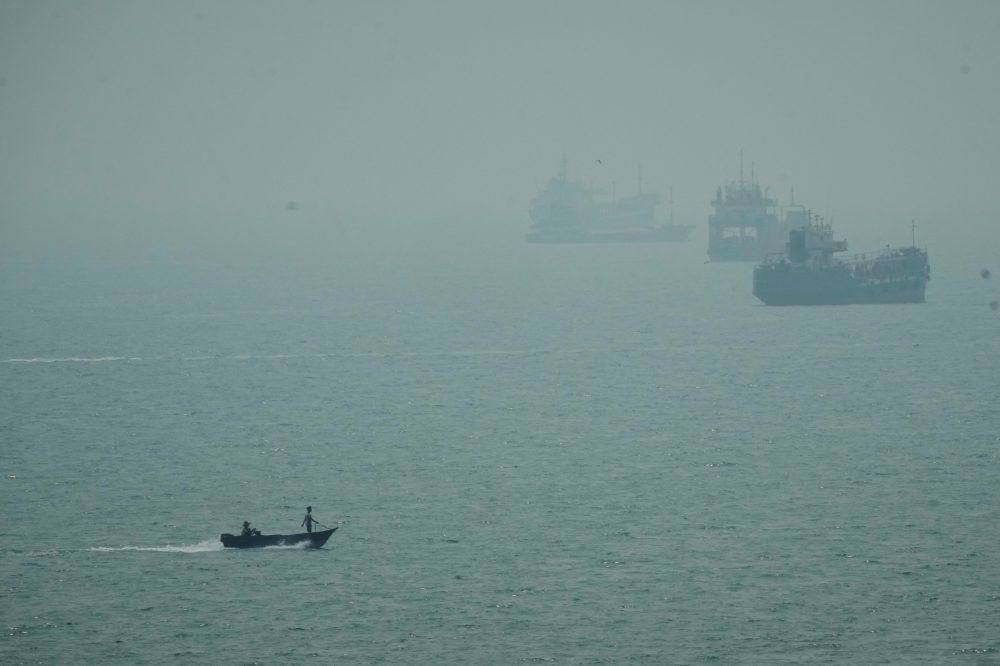
CAIRO (AP) — An Iranian cargo vessel was struck early Sunday off Qeshm Island in the Strait of Hormuz, Iranian state media said, a day before Tehran plans to brief countries in the region on its contested efforts to manage shipping traffic there.
The attack, which the reports said killed one and wounded four, drew attention back to the strait after threats to shipping in the region intensified last week when Iran-backed Houthi rebels captured an island on the Bab el-Mandeb Strait in the Red Sea.
Iran’s state-run IRNA news agency quoted the Qeshm governor as blaming a “terrorist enemy” for Sunday’s attack. There was no immediate comment by the U.S. military, which has struck Iranian-flagged vessels during its blockade of Iranian ports and faces a new threat from Iranian ballistic missiles launched at its warships.
The United Kingdom Maritime Trade Operations monitor said a vessel was hit by a projectile while transiting the strait, though it wasn’t clear if this was referring to the same attack. The monitor said a fire had broken out and that local authorities were evacuating those on board.
Qeshm Island, about 14 miles (22 kilometers) from the port city of Bandar Abbas, is key to Iran asserting control over the Strait of Hormuz.
Hours before the attack, Iran’s government remained defiant. “Our people can’t be bullied into submission. Iran won’t surrender,” President Masoud Pezeshkian said in a social media post.
Iran has said foreign ministers from regional countries will meet Monday in Oman to discuss efforts by Iran and Oman, located on the other side of the strait, to manage shipping on it.
The meeting returns regional focus to the Strait of Hormuz days after the Houthis swept down Yemen’s Red Sea coast to apply new pressure to a crucial alternative for global shipping. While the Houthis say they are targeting only neighboring Saudi Arabia, which backs Yemen’s internationally recognized government fighting the rebels, markets are wary and oil prices have risen again.
Commercial ship traffic remains low in the Strait of Hormuz as attacks continue on what was seen as an international waterway before the U.S. and Israel launched the war on Feb. 28. The U.S. has asserted that plenty of oil is getting out as its military helps to guide ships along Oman’s coast, at the risk of being struck.
Only Iraq has publicly confirmed its attendance, in a statement by the state-run Iraqi News Agency. It was not clear what other nations would be there. Bahrain has said it will not attend, citing a lack of diplomatic relations with Tehran.
Since early in the war, Iran has expressed interest in having ships pay fees for transit. It has said traffic into the Persian Gulf would pass through Iranian waters, while the outbound route would pass partly through Iranian waters and partly through Oman’s.
But Iran has said reaching an agreement with Oman on the strait doesn’t mean it will open for shipping. “The waterway would be opened up on the condition that the U.S. will terminate its blockade,” Iran’s president told broadcaster India Today TV on Saturday.
There was some optimism in the region about the meeting, with hope that Gulf nations might use it to assert a collective response to a war they had no part in starting. For months, they have faced Iranian attacks that Tehran has claimed target U.S. military assets on their lands.
“Oman is hoping that by presenting this agreement with a reasonable level of regional buy-in, the Trump administration will be forced to recognize that the future of the strait will be decided by regional countries,” Esfandyar Batmanghelidj, who heads the Bourse & Bazaar Foundation, a think tank focused on Iran’s economy, said on social media.
___
Anna reported from Jerusalem.
Brought to you by www.srnnews.com
 Shelton aims to end an American drought and win his first major title in the US Open final vs Zverev
 Ahead of Fed meeting, Trump says US should have world’s lowest interest rate
 The secret ballot has been an article of faith in US elections. That’s being tested in Georgia
 GOP congressman from Wisconsin swims to safety after plane makes emergency landing in a lake