
By Tim Reid and Bo Erickson
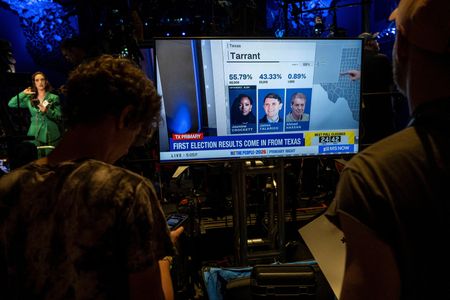
WASHINGTON, March 3 (Reuters) – America’s 2026 midterm congressional elections kicked off on Tuesday as voters cast their ballots in the first Republican and Democratic primaries in Texas, North Carolina and Arkansas.
There were marquee races, particularly in Texas, that offered the first glimpse of how the two parties are navigating President Donald Trump’s tumultuous second term, and ahead of November’s general election that will decide control of the U.S. Congress. Republicans hold razor-thin majorities in the U.S. Senate and the U.S. House of Representatives.
Here are some takeaways from Tuesday’s primaries:
DO DEMOCRATS WANT ANTI-TRUMP FIGHTERS OR PRAGMATISTS?
In Texas, the Democrats’ U.S. Senate primary pitted Representative Jasmine Crockett, 44 – an anti-Trump firebrand whose verbal broadsides against the president and Republicans have made her a prominent figure within her party – against state representative James Talarico, 36, a Presbyterian seminarian who emphasizes his Christian faith and preaches a political gospel of bridging divides.
Offering a fascinating contrast in style and tone, the race gave the first indication of whether Democratic voters want candidates like Crockett who fight Trump’s fire with fire, or contenders like Talarico who is more likely to appeal to moderates and independents and might have a better chance of winning November’s election.
Late on Tuesday, Talarico appeared to be heading for victory, after focusing on building a broad coalition of voters.
A Talarico win would mark the latest chapter in a meteoric political rise for the former middle-school teacher and comes amid a fight for the soul and direction of the Democratic Party as it seeks to rebuild after its bruising defeat to Trump in 2024.
It is a battle between those who believe elections are won by firing up the party’s core supporters and those who, like Talarico, say Democrats need to broaden their appeal to moderates to win back working-class and minority voters the party has lost to Republicans during the Trump era.
Still, Talarico pulled no punches in calling for the reform of the federal immigration agency and the impeachment of Department of Homeland Security Secretary Kristi Noem.
Democrats have not won a statewide race in Texas since 1994, but a messy Republican primary between four-term incumbent John Cornyn and Texas Attorney General Ken Paxton has given Democrats hope that they could pull off an upset. If the scandal-plagued Paxton emerges the victor in their runoff in May, he is viewed as potentially easier to beat in November. Democrats need a net gain of four seats to regain control of the Senate.
THE TRUMP FACTOR
The Texas Republican U.S. Senate primary boiled down to the three candidates fighting over who was most closely aligned with Trump, in a contest that was light on policy but heavy on loyalty to the president. Two of them, Cornyn and Paxton, were headed for a runoff.
The fact that Trump loomed so large over the race shows that he still exerts huge influence over the Republican Party, despite low approval ratings and some recent cracks in his Make America Great Again movement.
Cornyn, 74, who is seeking a fifth term, is a fixture of the Republican establishment, but has broken with Trump in the past, notably when the president tried to overthrow the 2020 election result.
His chief opponent, Paxton, 63, a self-styled MAGA warrior, filed legal challenges in Texas against Trump’s 2020 defeat and has been a fierce Trump loyalist for years.
The third candidate, Wesley Hunt, a U.S. congressman, had also sought to burnish his pro-Trump credentials. His candidacy meant neither Paxton nor Cornyn were able to surpass the 50% total needed to secure the nomination outright.
Trump said he likes all three candidates, but did not endorse any of them, despite their efforts to get his backing. Trump is perhaps keeping his powder dry until the runoff between Cornyn and Paxton in May.
Trump did endorse in North Carolina, giving the nod to ally Michael Whatley, who easily won the state’s Republican Senate primary. But two Whatley rivals who ran to his right, claiming to be more MAGA, garnered roughly a fifth of voters between them. Their strong showing suggests Trump’s MAGA base may not be as unified as it once was.
RUNNING ON – OR AWAY FROM – IRAN
The Iran conflict is only days old but it has already spilled into the midterm primaries.
Republican candidates on Tuesday’s ballot mostly cheered Trump’s military strikes in Iran, while Democrats opposed an attack they saw as ill-conceived and with no clear goals. It was not immediately clear how the conflict influenced people’s votes.
But, if gas prices continue to rise and U.S. casualties grow, Republicans could find themselves increasingly defending a conflict that lacks strong public support. A Reuters/Ipsos poll conducted at the weekend found just one in four Americans supported the strikes.
Critics pointed to potential risks for Republicans after the president campaigned in 2024 on a promise to focus on the economy and not start wars. Some MAGA voices are also questioning the Trump administration’s closeness with Israel.
Democrats went through a similar intra-party battle over Israel’s bombardment of Gaza during the 2024 election that cost Harris votes among Muslim Americans.
With U.S. forces at the forefront of the new conflict, Crockett emphasized the personal at a campaign stop in Texas on Sunday, saying military families were scared for their loved ones.
Talarico mourned both the deaths of U.S. troops and the reported deaths of scores of girls at a school on the first day of the U.S.-Israeli air strikes.
REDISTRICTING
At Trump’s urging, Texas Republicans last year redrew congressional districts outside of the normal process that occurs after the national census every 10 years.
For Tuesday’s primary, this led to unexpected contests pitting well-known Democrats against each other. Representative Al Green, who was cheered by Democrats after twice protesting at Trump’s annual address to Congress, faced off against Democratic Representative Christian Menefee, while Representative Julie Johnson was challenged by former Representative Colin Allred.
In southern Texas, the new district lines were intended to give Republicans a better chance of flipping two Democratic seats in heavily Hispanic areas. But polls suggest that Republicans may struggle to hold onto Trump’s gains among Hispanic voters, while Democrats hope a Latin Grammy winner, Bobby Pulido, can defeat Republican Representative Monica De La Cruz.
And even though Texas Republicans started this redrawing of lines, their goal of increasing the number of Republican-friendly elections may be undercut by other Democratic-majority states, like California, following suit.
(Reporting by Tim Reid and Bo Erickson, editing by Ross Colvin and Deepa Babington)
Brought to you by www.srnnews.com
 UK’s Metro Bank targets tripling of return on tangible equity in 18 months
 GOP challenger Steve Toth ousts Rep. Dan Crenshaw in Texas primary
 Congress taking first votes on Iran war as debate rages about US goals
 The Latest: Explosions heard in Tehran and Jerusalem on fifth day of war