
A U.S. delegation led by Vice President JD Vance arrived in Pakistan for talks with Iranian officials aimed at shoring up a shaky ceasefire and paving the way for a permanent end to the fighting. It marks the first such meeting since the war began more than a month ago.
The ceasefire brokered by Pakistan still faces hurdles in the talks beginning Saturday, as Israel and Hezbollah militants have been trading fire along the border of southern Lebanon and Iran has set conditions before negotiations can begin.
The Iranian delegation arrived early Saturday in Islamabad, led by Parliament Speaker Mohammad Bagher Qalibaf, who said on X that discussions will only take place if there is an Israeli ceasefire in Lebanon the release of blocked Iranian assets.
Hours earlier, President Donald Trump wished Vance good luck. “We’ll find out what’s going on. They’re militarily defeated.”
In Islamabad, the streets of a normally bustling capital were deserted Saturday as security forces sealed roads ahead of the talks.
Here is the latest:
The Saudi Defense Ministry said the Pakistani forces that include fighter and support aircraft arrived at a Saudi airbase on Saturday as part of a defense deal between the two countries.
The deployment came as officials from Iran and the U.S. are set to start talks Saturday in Islamabad that aim to end the war in the Middle East.
The ministry said the Pakistani force has been deployed at King Abdulaziz Air Base in the oil-rich eastern region which was repeatedly attacked with drones and missiles during the war.
The deployment aims at “enhancing joint military coordination … and supporting security and stability at both regional and international levels,” it said.
The pact was signed in September and defines any attack on either nation as an attack on both.
U.S. Vice President JD Vance met Saturday with Pakistani Prime Minister Shehbaz Sharif.
Both the White House and Sharif’s office announced the meeting, which comes as U.S. and Iranian officials are set to hold high-stakes talks later in the day.
Vance was accompanied by President Donald Trump’s special envoy, Steve Witkoff, and Jared Kushner.
Sharif’s office said the prime minister told the U.S. delegation that Pakistan looks forward to continuing its facilitation efforts to help both sides make progress toward sustainable peace.
Iran’s state-run television reported earlier that Iran’s negotiating team also met with Sharif.
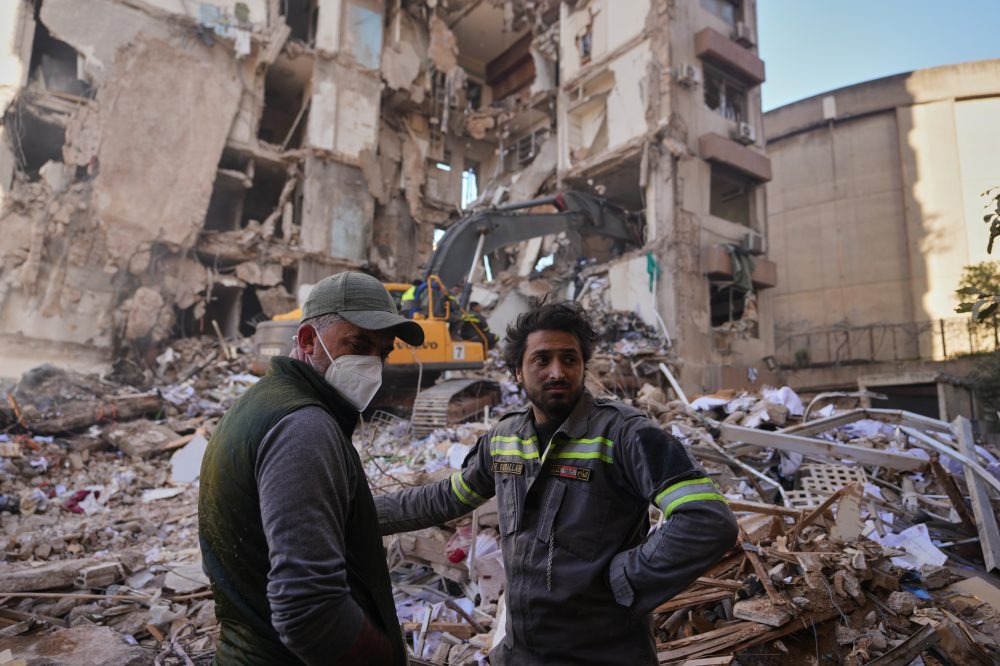
Civil defense crews used cranes on Saturday to search through partially collapsed apartments, three days after Israeli strikes hit a six-story building in Beirut’s seaside neighborhood of Caracas.
The Israeli military struck some 100 sites that it said were connected to Hezbollah in the capital and other parts of Lebanon Wednesday, killing more than 300 people, including more than 100 women and children.
Civil defense officials said six people were killed in the Caracas building and a missing teenager was believed to be buried under a collapsed roof.
Najib Merhi, the owner of a snack shop on the bottom floor, said the strike came as a shock because “this is a touristic area, a safe area, an area that is shared between all the social fabric of this country.”
Iran’s state-run television reported that Iran’s negotiating team chaired by parliament speaker Mahammad Bagher Qalibaf, met on Saturday with Pakistani Prime Minister Shehbaz Sharif.
Neither the Iranian delegation nor the prime minister’s office commented on the meeting in the Pakistani city city of Islamabad.
The meeting came as the U.S. and Iranian officials are set to start indirect high-stakes talks Saturday afternoon on ending the war in the Middle East.
People in Iran’s capital say they’re hopeful that a deal can be struck in peace talks that began Saturday.
They told the Associated Press that they base that guarded optimism on both sides realizing that no one would gain from more war.
People said they’ve been worn down by weeks of airstrikes and warn that even if a deal is reached, the road to recovery will be long.
Amir Razzai Far, 62, said a peace deal isn’t enough “because we’ve been hit very hard, there have been huge costs, and the people have to pay for that.”
Shahab Banitaba also questioned whether the U.S. could be trusted to uphold any agreement.
She said even if there’s something concrete on paper, “there is still a chance that the deal falls through.”
Officials from the region said on Saturday that Egyptian, Saudi, Chinese and Qatari officials are in Islamabad to indirectly facilitate the talks.
The officials were speaking on condition of anonymity to discuss the matter.
The head of Airports Council International-Europe, Olivier Jankovec, warned the European Union that a ″systemic jet fuel shortage’’ could come within three weeks because of the blockage of the Strait of Hormuz.
Jankovec said in a letter obtained by the Associated Press on Saturday that the crunch could impact the summer travel season and ″significantly harm the European economy.’′
He urged the EU to organize collective purchases of jet fuel for European countries, track stocks and identify alternative sources of jet fuel, among other measures.
The EU’s Energy Union Task Force which met Friday said there is ″no immediate risk to the EU’s security of oil and gas supply’’ from the Mideast conflicts and no need to release additional stocks.
But it warned of possible longer-term risks, and said ″jet fuel remains the primary concern’’ because of its reliance on imports.
Foreign Minister Abbas AraghchiIran said his country enters Saturday’s talks with the United States with “deep distrust” because the Islamic Republic was attacked twice during negotiations on its nuclear program.
Araghchi warned that his country would fight back if it was attacked, his office posted on Telegram.
The Iranian official, who spoke with German counterpart Johann Wadeful on Friday, also called for Israeli attacks on Lebanon to stop.
Retired army general and senior defense analyst Tariq Rashid Khan on Saturday said “I think there will be good news, big news this week as a result of the talks.”
Khan said Pakistan’s Army Chief Gen. Asim Munir had played an important role in bringing the two sides to the negotiating table.
He said Pakistan offered to mediate because any further escalation could spark a wider conflict.
Mohammad Reza Aref, Iran’s first vice president, said on Saturday U.S.-Iran peace talks could produce a deal if U.S. officials worked in the interest of their country in line with President Donald Trump’s “America First” doctrine.
“However, if we face representatives of ‘Israel First,’ there will be no deal,” Aref said in a social media post.
He warned that “the world will face greater costs,” if the talks failed and the U.S. and Israel resumed the war against Iran.
The Al-Aqsa Martyrs Hospital which received the casualties said the Israeli airstrike hit a security point in the urban refugee camp of Bureij around in the predawn hours Saturday.
The Israeli military told the Associated Press that it struck Hamas militants who allegedly came close to the so-called Yellow Line that separated the Israeli-controlled areas in Gaza from the rest of the strip.
The deaths were the latest among Palestinians in the territory since a ceasefire deal last October that aimed to halt a more than two-year war between Israel and Hamas in Gaza.
While the heaviest fighting has subsided, Israeli forces have carried out repeated airstrikes and frequently fire on Palestinians near military-held zones, killing more than 730 Palestinians, according to Gaza health officials.
The health ministry, which is part of the Hamas-led government, maintains detailed casualty records that are seen as generally reliable by U.N. agencies and independent experts. But it does not give a breakdown of civilians and militants.
Militants have carried out shooting attacks on troops, and Israel says its strikes are in response to that and other violations. Four Israeli soldiers have been killed since the ceasefire.
Pakistan’s Ministry of Foreign Affairs said Foreign Minister Ishaq Dar, Army Chief Field Marshal Asim Munir and Interior Minister Mohsin Naqvi on Saturday received the U.S. delegation lead by U.S. Vice President JD Vance.
The ministry said in a statement that Dar commended the U.S. commitment to achieving lasting regional and global peace and stability.
He expressed hope that the parties would engage constructively and reiterated Pakistan’s desire to continue facilitating efforts toward a lasting and durable resolution to the conflict.
The Lebanese National News Agency reported multiple Israeli strikes early Saturday in southern Lebanon, killing at least three people.
The three were killed when an airstrike hit and destroyed a residential building in Maifadoun town in the southern province of Nabatiyeh, according to the agency.
Hezbollah, meanwhile, said it fired a barrage of rockets that targeted a military facility in northern Israel.
Vance arrived in Islamabad at the head of a delegation that includes President Donald Trump’s special envoy Steve Witkoff and his son-in-law Jared Kushner.
The Iranian delegation, led by Parliament Speaker Mohammad Bagher Qalibaf, was already in Islamabad.
Before departing for Pakistan, Vance warned Iran not to “play” the U.S. Hours later, Qalibaf said discussions would only take place if there is an Israeli ceasefire in Lebanon and the release of blocked Iranian assets.
Pakistan’s government has set up a state-of-the-art media center to facilitate Pakistani and foreign journalists covering the talks between the United States and Iran, Information Minister Attaullah Tarar said.
Tarar told reporters the facility at the Jinnah Convention Center offers high-speed internet and a range of free services to support media coverage. Shuttle services have been arranged to transport journalists between the media center and a hotel in the city’s main shopping mall.
Pakistan has announced visa-on-arrival for journalists and official delegations traveling from the United States and Iran for the talks, which have been dubbed the “Islamabad talks.”
Inside the media center, rows of workstations equipped with laptops and charging points allow reporters to file stories. Large screens broadcast major domestic and international television channels. The facility also has designated areas for live stand-ups, press briefings and interviews.
The streets of Pakistan’s normally bustling capital were deserted Saturday as security forces sealed roads ahead of talks between high-level officials from Iran and the U.S. to end their nearly six-week war. Pakistani authorities urged Islamabad residents to stay inside, leading the city to look like it was under curfew.
U.S. Vice President JD Vance is leading the American delegation, which was expected to arrive before noon.
Iranian negotiators, headed by Parliament Speaker Mohammad Bagher Qalibaf, arrived late Friday.
Pakistan Prime Minister Shehbaz Sharif the conflict was entering a “difficult phase” as the sides try to shift from a temporary pause in fighting to a more lasting settlement. He said they were at a “make-or-break” moment.
Brought to you by www.srnnews.com
 UK puts Chagos Islands handover deal on hold after Trump withdraws support
 For aging US Supreme Court justices, the politics of retirement looms large
 From Boston to Denver, US drivers cut back as Iran war pushes fuel costs higher
 Americans weigh in on the Iran war, gas prices and their fears