
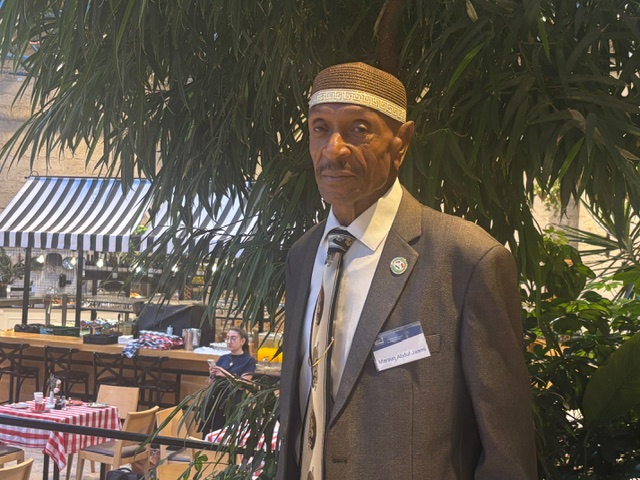
As Texas Turns Blue, Muslim Cleric Tells Jewish Community: ‘We Have Your Back’
After a Holocaust education visit to Israel, Imam Marzuq Jaami says interfaith alliances can help counter antisemitism and bridge political divisions
By Maayan Hoffman / The Media Line
After more than three decades of Republican dominance in Texas, Democrats scored a historic victory in last week’s midterm elections, raising questions about what the political shift could mean for the state’s Jewish community and its longstanding support for Israel.
At a time when parts of the Democratic Party have moved further to the left and become increasingly critical of Israel, the shift could make some Jewish Texans nervous about what lies ahead in a state where they have long felt comfortable, in part because of the strong support of the Christian Right.
Texas has been one of the most supportive states of Israel. In 2017, it passed legislation restricting state contracts and investments involving companies that boycott Israel. Texas officials have also regularly visited Israel and established trade and institutional ties, including agreements with the Samaria Regional Council in the West Bank.
But at least one Muslim cleric says Jews in Texas have nothing to worry about because support for the Jewish community is not about Democrats or Republicans, but about faith.
“We have your back,” Imam Marzuq Abdul Jaami, a member of the Thanks-Giving Square Interfaith Council and a founder of Friendship Among Faiths, told The Media Line.
Jaami, who lives in DeSoto, Texas, near Dallas, was in Israel last week on a mission organized by Sharaka, an organization that promotes relations between Israel and the Arab and Muslim worlds.
“We want to let you know we’re here for you. You’re not in this alone. We have to keep working together to strengthen the human spirit,” he said.
Jaami became involved with Sharaka several years ago after meeting current co-chairman, Dan Feferman. Since then, he has participated in several missions with the organization, including visits to Morocco and Israel. He also joined the March of the Living to visit former Nazi concentration camps.
Last week, he returned to Israel on another Sharaka mission, this time in collaboration with Yad Vashem, to deepen his understanding of the Holocaust.
Jaami said that no matter how much antisemitism rises in the United States and around the world, Muslim leaders like himself are determined to assure Jews that “this will never happen again, because now we have a bigger force to make sure that it don’t happen again, and I want them to know that in America too.”
He said his teacher had taught him that Jews, Christians and Muslims are all people of the book and that Muslims do not need to convert followers of other monotheistic faiths.
“Jews and Christians are your brothers and sisters in faith,” he recalled learning, adding that “Abraham, our father, he connects us, and we can never be disconnected.”
When he became involved with Sharaka, he said, he discovered how those teachings could be put into practice.
Alyssa Annis, Holocaust education program manager for Sharaka, told The Media Line that the organization had brought four Muslim leaders, two from Texas, one from the United Kingdom and another from Morocco, to participate in an interfaith seminar at Yad Vashem. She said the goal was to engage them in dialogue about the importance of Holocaust education and equip them to share what they learned with their communities.
The participants had taken part in previous Sharaka programs, Annis said. The seminar gave them an opportunity to deepen their knowledge, ask questions, and prepare to share what they learned when they return home. “We want them to take this knowledge on the Holocaust and really spread it to as many people as possible,” she said.
Amit Deri, co-founder and chairman of Sharaka, said the organization sees its work with Muslim leaders as an important way to build bridges between communities.
“Sharaka is proud to work alongside Muslim leaders from across the Western world to strengthen connections between Israel and the Arab and Muslim world. Through partnerships with influential voices such as Imam Marzuq Jaami, we can reach diverse communities and share the importance of the Abraham Accords, promoting dialogue, and people-to-people connections,” Deri told The Media Line.
For Jaami, the visit was eye-opening. He said he had wanted to better understand what caused the Nazis to hate Jews and how that hatred developed over time. After visiting Yad Vashem, he said, he had a clearer understanding of how the history unfolded and how antisemitic narratives evolved.
He plans to bring those lessons back to the interfaith council in Texas, where he has been working to strengthen relationships among religious communities. “The interfaith council makes Texas a kinder place,” Jaami told The Media Line.
He believes that when Jews, Muslims and Christians work together, they can teach their children to be kinder, helping to create a more compassionate next generation.
As an example, he pointed to Dallas Kindness Week, a celebration of unity, compassion, and community that he said grew out of the council’s work. During the event, children compete to see who can perform the most acts of kindness.
He said he was confident that people of different faiths would turn out to support the Jewish community if a synagogue were attacked.
“It’s easier for the Jewish community because now they got allies,” Jaami said. “At first, they didn’t have that many allies, but now they have allies.”
But can that spirit of cooperation survive in a country where the political Right and Left continue to move further apart and hatred spreads rapidly across social media?
Jaami believes it can.
He said interfaith cooperation would succeed as religious communities increasingly came together to demonstrate that their beliefs and their treatment of others could enable them to live in peace. “I don’t care what comes up now, after these midterms, we can fight it.”
For Jaami, the answer to political division and rising anti-Semitism is to continue building relationships across religious and political lines, regardless of who holds power.
He pointed to the Prophet Muhammad’s relationships with Jews and Christians as an example of the alliances he believes religious communities must preserve.
“The Prophet Muhammad … made allies with the Jewish community. He made allies with his Christian brothers and sisters. We need to keep together these allies … I want to remind you, we are all connected.”
Photo Credit: Imam Marzuq Abdul Jaami. (Maayan Hoffman / The Media line)
Brought to you by www.srnnews.com
 Congress Begins “Lame Duck” Session Monday
 Trump Touches On Midterms, Cabinet During 60 Mins Interview
 Factbox-Democratic attorney general wins could reshape US lawsuits on abortion, immigration and more