
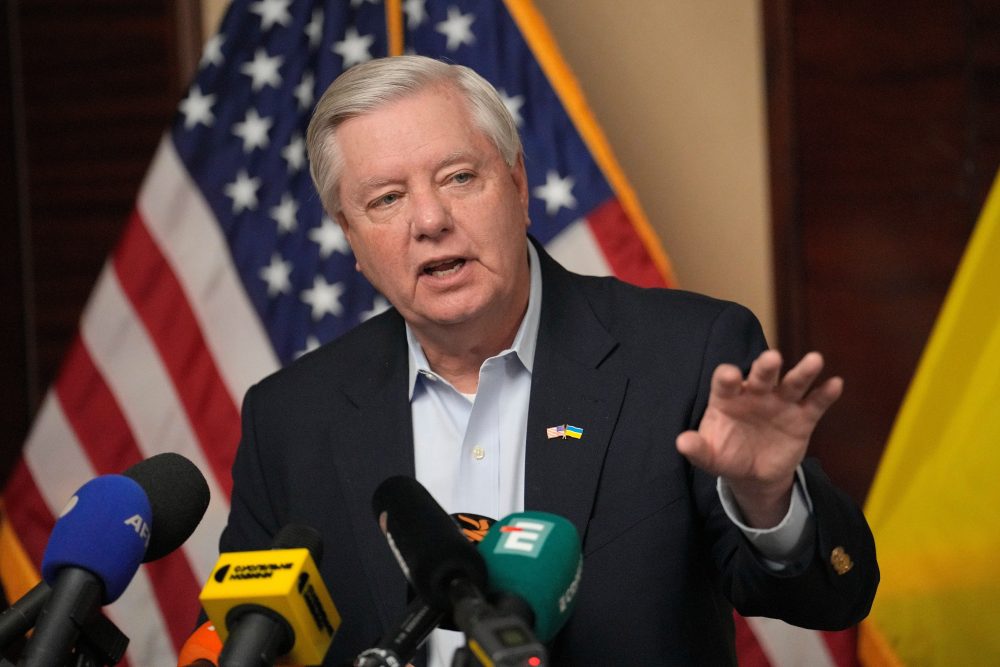
Lindsey Graham, US Senator and Influential Voice on Middle East Policy, Dies at 71
By The Media Line Staff
US Sen. Lindsey Graham, the South Carolina Republican whose three decades in Congress made him one of America’s most influential voices on national security, judicial affairs, and foreign policy—and one of Israel’s staunchest supporters—died Saturday after what his office described as a brief and sudden illness. He was 71. His family requested privacy and said funeral arrangements would be announced later.
A lawyer and former Air Force officer who retired from the Air Force Reserve as a colonel after 33 years of service, Graham was first elected to the US House of Representatives in 1994 before winning a Senate seat in 2002. Over the next two decades, he became a leading Republican on defense and intelligence matters, serving on the Senate Judiciary, Appropriations, and Budget committees. He chaired the Senate Judiciary Committee from 2019 to 2021 and, most recently, the Senate Budget Committee.
Known for his sharp wit, willingness at times to work across party lines, and later close alliance with President Donald Trump, Graham helped shape major debates over Supreme Court nominations, military policy, immigration, and US foreign affairs. Earlier in his congressional career, he served as one of the House managers in President Bill Clinton’s impeachment trial. As chairman of the Judiciary Committee, he presided over the confirmation of Justice Amy Coney Barrett and played a prominent role in several other Supreme Court nomination battles. He was also an unsuccessful candidate for the Republican presidential nomination in 2016.
Nowhere was Graham’s influence more evident than in the Middle East. He viewed the region through a national security lens, arguing that the United States had a strategic obligation to stand by its allies, confront Iran, and combat extremist organizations. Throughout his career, he became one of Congress’ most frequent visitors to Israel, meeting repeatedly with Israeli prime ministers, military leaders, and security officials.
Following Hamas’ October 7, 2023, attack on Israel, Graham emerged as one of the Senate’s most outspoken supporters of expanded US military assistance, tougher sanctions on Iran, and stronger action against Tehran’s regional proxies. He consistently argued that Israel’s security was inseparable from America’s own strategic interests.
His support extended beyond military aid. Graham championed the Abraham Accords and encouraged normalization between Israel and Saudi Arabia, believing broader Arab-Israeli cooperation could reshape the Middle East and counter Iranian influence. He also maintained close relationships with leaders across the Gulf, frequently traveling to the region and advocating stronger US partnerships with Arab allies.
Graham’s hawkish approach won him admirers and critics alike. He supported US military interventions in Afghanistan and Iraq, backed continued American engagement against the Islamic State, and repeatedly argued that diplomacy alone could not prevent Iran from acquiring nuclear weapons. Supporters praised his consistency and willingness to confront emerging threats, while opponents viewed him as one of Washington’s leading interventionists.
Beyond foreign policy, Graham was recognized as a skilled legislator and institutionalist who often bridged divides within his party. Although deeply conservative, he occasionally broke with Republican orthodoxy on issues such as immigration reform and criminal justice, particularly earlier in his Senate career. His political evolution—from close ally of Sen. John McCain to one of Trump’s most reliable congressional partners—made him one of the defining Republican figures of his generation.
Even in the final year of his life, Graham remained deeply engaged in Middle East diplomacy, describing the region as standing “on the verge of previously unimaginable change” and urging continued US leadership.
Whether remembered as a principled defender of America’s allies or criticized as an unapologetic interventionist, Lindsey Graham left an enduring mark on the Senate and on US foreign policy. Few members of Congress shaped the American debate over the Middle East as consistently—or as forcefully—as he did.
Brought to you by www.srnnews.com
 Michigan Sen. Gary Peters backs Democratic Rep. Haley Stevens in contentious race to succeed him
 White House to rally utilities, data centers over AI power costs
 Man who killed Dartmouth professors at 17 seeks reduced prison sentence
 Is there such a thing as being too old to execute? Aging death row inmates are set to die in Florida