
By Heather Schlitz
Cotulla, Texas, June 8 (Reuters) – Like many ranchers in South Texas, Susan Storey said nightmarish screwworm outbreaks were among her first childhood memories. Now 62, she still recalls seeing wriggling maggots as they burrowed into living livestock and smelling the burning carcasses of calves that were too far gone for her family to treat.
The U.S. Department of Agriculture this week confirmed two infestations of New World screwworm in Texas — the state’s first cases since the 1970s. However, local residents and ranchers remain split over whether to trust the agency’s response, with some saying it’s too slow or not far-reaching enough.
U.S. cattle ranchers have been bracing for a domestic screwworm case for over a year as the pest has advanced north through Mexico, with experts predicting that a widespread outbreak could cost the state $1.8 billion in economic damage and could be devastating for the state’s wildlife. For Storey and other ranchers who lived through the last outbreak, the news has further eroded their trust in the USDA and prompted them to search for their own solutions.
“We’re fighting for this so our grandchildren can keep what we have,” she said as her pickup truck bumped down a dirt road past grazing cattle, sprawling green pastures and migrating butterflies. “I don’t want my herd threatened.”
Screwworms are parasitic flies whose females lay eggs in wounds on any warm-blooded animal. Once the eggs hatch, hundreds of larvae use their sharp mouths to eat through living flesh, eventually killing their host if left untreated. They mostly spread through the movement of infested animals and pose no threat to food safety and rarely affect humans, experts said. The last time screwworm was endemic in the United States, it took the cattle industry 30 years to recover, according to Agriculture Secretary Brooke Rollins.
The USDA and Texas officials created a quarantine zone, and stepped up trapping and surveillance efforts, deployed response teams and continued releasing sterile flies, with Rollins saying the agency expects to contain the Texas cases and prevent the pest from becoming established in the United States.
“Well before the first U.S. detection of New World Screwworm, since February of 2025, USDA has worked around the clock with our state, local, industry, and ranchers on the ground. The secretary herself made four trips to South Texas, more than anywhere else in the country,” a USDA spokesperson told Reuters. “The idea that this department has not been transparent is absurd and does not match what ranchers are telling the department and our partners directly.”
Reuters reported last year that hundreds of veterinarians, support staff and lab workers at the animal health arm of the USDA had left after the Trump administration pushed for resignations, leaving fewer specialists to respond to animal disease outbreaks and adding to concerns about preparedness.
‘NO MORE COWBOYS’
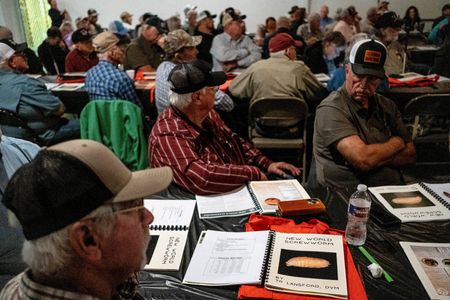
On Friday, about 100 ranchers in mud-splattered boots and cowboy hats packed a small high school cafeteria for a Texas Animal Health Commission briefing on screwworm, peppering officials with questions and venting frustration over what they saw as a slow federal response.
“As Texans, we’re not afraid to take this on,” said John Paul Schuster, a 55-year-old rancher and Kinney County judge, to applause and approving nods from the audience.
Some ranchers have proposed raising money to build a privately funded sterile fly production plant, at a startup cost of roughly $4 million. Screwworms were originally eradicated from the United States when researchers began releasing massive numbers of sterilized male screwworm flies that mate with wild female screwworms to produce infertile eggs. Current sterile fly production is far short of what is needed to suppress the outbreak, though two new plants are under construction.
After the meeting, Schuster lambasted what he saw as the slow pace of sterile fly plant construction, saying a wider infestation could endanger the ranching and hunting industries crucial to the economy for Kinney County’s 3,000 residents.
“If it’s not controlled in two years and eradicated in five years, my little county will be done,” Schuster said.
Though the USDA has detailed its strategy for containing screwworm, some ranchers have bristled at what they view as a lack of transparency, including the agency’s decision not to disclose exact coordinates where sterile flies are being released.
“We need to know what’s being done because it’s our financial investment. It’s our livelihood that’s on the line,” Storey said. “They’re not betting their herd – they’re betting ours.”
Other ranchers dismissed the USDA’s recommendations—including daily inspections and preventive treatments — as impractical for operations that span thousands of acres, face severe labor shortages, and lack skilled cowboys.
“It’s not really feasible. There’s no more cowboys anymore and there’s no good ranch horses,” said DJ Rubio, a 62-year-old rancher and Storey’s husband.
QUARANTINE ZONE
Monty Martin, a 61-year-old rancher who lives close to both positive screwworm cases in Zavala County, Texas, took a more measured tone and praised USDA and Texas Animal Health Commission teams that are on the ground.
“People need to stop politicizing this, stop finger pointing, it doesn’t do anyone any good,” he said. “Those people that are on the front lines have been tremendous, and I have the utmost respect and admiration for them.”
Every major road leading to the roughly 12-mile-wide infested zone around the initial detection site is marked with blinking orange signs urging vehicles carrying livestock to pull into a checkpoint staffed with state personnel charged with inspecting animals for screwworm, though they were gone by the early evening.
The responsibility of spotting new screwworm infestations, however, falls largely on ranchers themselves. Anthony Gallegos, a 43-year-old rancher in Zavala County, said the outbreak has made him even more vigilant about monitoring his cattle.
“Come on, girls,” he yelled, waving a bucket of treats as a herd of Black Angus cattle trotted toward him. “They just pretty much run to me like their dad’s here.”
Gallegos said the relationship he has with his cattle and the relatively small herd allows him to keep a close eye on them for worrying symptoms and vaccinate them with preventative medications like the USDA recommends.
Even with preventive measures, Gallegos worries about what would happen if screwworm became widespread.
“If it is widespread and it starts infecting animals, it’s going to hurt our bottom line,” he said. “Every time I see a buzzard, my heart sinks.”
(Reporting by Heather Schlitz in Cotulla, Texas; Editing by Emily Schmall and Aurora Ellis)
Brought to you by www.srnnews.com
 AP Decision Notes: What to expect in North Dakota’s state primary
 Israel and Iran trade strikes, threatening the region
 As America 250 approaches, fewer Americans see their country as exceptional, AP-NORC poll finds
 U.S. election betting boom to test prediction markets’ insider trading controls