
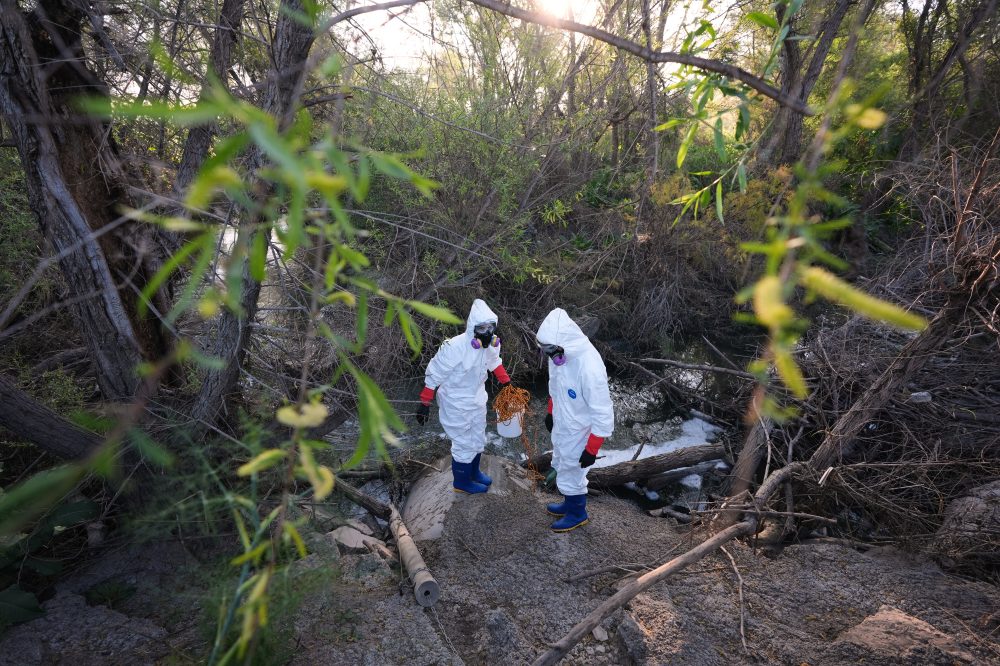
SAN DIEGO (AP) — The smell of rotten eggs permeates Steve Egger’s Southern California home, especially at night as the nearby Tijuana River foams up with sewage from Mexico before emptying into the Pacific Ocean.
Egger, 72, says he and his wife have frequent headaches and wake up congested and coughing up phlegm. Their home is outfitted with a hospital-grade filtration system that cycles the air every 15 minutes.
Despite those measures, “most nights we breathe in a horrible stench,” he said. “It’s awful.”
Since 2018, more than 100 billion gallons (378 billion liters) of raw sewage laden with industrial chemicals and trash have poured into the Tijuana River, according to the International Boundary and Water Commission. The river traverses land where three generations of the Egger family once raised dairy cows. The United States and Mexico signed an agreement last year to clean up the longstanding problem by upgrading wastewater plants to keep up with Tijuana’s population growth and industrial waste from factories, many owned by U.S. companies.
In the meantime, tens of thousands of people are being exposed to the sewage. Environmental Protection Agency Administrator Lee Zeldin said during a February visit to San Diego that it will take about two years to resolve one of the nation’s worst and longest-running environmental crises, which affects a largely poor, Latino population.
Raw sewage doesn’t just smell bad. It emits hydrogen sulfide, a toxic gas that can erode neurons in the nose and trigger asthma attacks. It can cause headaches, nausea, delirium, tremors, cough, shortness of breath, skin and eye irritation and even death, according to the Centers for Disease Control and Prevention. Its long-term health problems are only starting to be understood.
There is no federal safety standard for hydrogen sulfide except for workers at sites where the risk is extreme, such as wastewater treatment plants or manure pits. A few states set standards decades ago, but those are outdated. A California proposal would require the state’s 56-year-old standard reflect the health risks of the gas. In Texas, lawmakers are also considering updating its law.
“I think when you look back when the standard was first established and then it was reviewed, it was all about nuisance — basically it was all about odor,” said the California bill’s author, Democratic Sen. Steve Padilla, who represents the Tijuana River Valley. “I don’t think we had the understanding scientifically of what the health impacts were here, and now we do.”
Even if the bill passes, the new standard would likely not be developed until 2030.
A “Stop the Stink” sign is on Egger’s fence, part of a campaign that Citizens for Coastal Conservancy launched to demand officials clean up the cross-border sewage.
The 120-mile (195 km)-long river starts in the Mexican city of Tijuana, crosses into California and empties into the ocean. San Diego County beaches nearby have closed for years and Navy SEALs who train in the water have fallen ill.
Just since January, the Tijuana River has carried 10 billion gallons (38 billion liters) of mostly raw sewage and industrial waste across the U.S. border, according to International Water and Boundary Commission data. By comparison, a massive pipe that ruptured in January sent 244 million gallons (924 million liters) of untreated sewage into the Potomac River, affecting affluent, largely white communities. That spill prompted federal intervention within weeks.
In 2024, a sampling by San Diego County and the CDC representing the roughly 40,000 households close to the Tijuana River found 71% could smell sewage inside their homes and 69% had a member get sick from being exposed.
Even at low levels, “you’re going to feel like it’s in your sinuses. You can’t get rid of the smell. It’s going to be a constant irritation,” said Ryan Sinclair, an associate professor of environmental microbiology at Loma Linda University School of Public Health.
The EPA said it is working with local and state officials to find ways to mitigate the smell.
San Diego County this year distributed over 10,000 air filters to homes. But the air remains a threat. The river’s foam can now be seen from space.
In September 2024, Kimberly Prather, a chemistry professor at the University of California, San Diego, and a team of researchers installed air monitors in the neighborhood where Egger lives.
What they found stunned them: The hydrogen sulfide concentrations were 4,500 times higher than typical urban levels and 150 times higher than California’s air standards when river flows peaked at night.
Many residents, like Egger, felt vindicated.
“They’d been being more or less gaslit and told, ‘There’s gas. It’s a nuisance. It smells, but it’s not bad,’” Prather said.
She said her researchers have since detected thousands of other gases coming from the river that don’t smell “and many of them are more toxic.”
Egger said doctors have told him to move, though they have not given him a written diagnosis as suffering from hydrogen sulfide exposure.
But his family’s roots run deep. His wife grew up in Tijuana. His brother and his late-brother’s family live in the neighboring houses on what was Egger Dairy. Nearby are the dilapidated milk barn and rusting farm equipment.
“This is where I’ve lived all my life, with my family, my parents, my grandparents,” he said. “This is home.”
When Egger was a boy he swam in the river that ran only during the rainy season. Now mostly filled with sewage and industrial waste, it goes year-round. He says the river should be restored to its historical route, which is closer to the border and farther from most residences and schools. He believes then it would not pond, creating hot spots of hydrogen sulfide gas.
Less than half a mile from Egger’s home, the smell is overwhelming where the river shoots out of pipes after being forced briefly underground near Saturn Boulevard.
Scientists call it “the Saturn hot spot.” The stench permeates passing cars with the windows up, lingering inside for days.
Dr. Matthew Dickson and his wife, Dr. Kimberly Dickson, run a clinic about a mile from the hot spot. Many of their patients suffer from migraines, nausea, wheezing, eye infections and brain fog. Those with asthma say they use their inhalers more when the air reeks.
“They’d say, ‘You know, I feel better when it doesn’t smell outside,’” Dr. Kimberly Dickson said.
In August 2023, a tropical storm caused the river to overflow onto the streets. Within days, the doctors’ caseloads tripled.
Electronic health records confirmed what the doctors suspected. When the river flows have jumped, the number of patients they have treated for respiratory problems has increased by 130%, they said.
“Every day that this isn’t fixed,” Dr. Matthew Dickson said, “more people are getting sick.”
___
Pineda reported from Los Angeles.
___
The Associated Press receives support from the Walton Family Foundation for coverage of water and environmental policy. The AP is solely responsible for all content. For all of AP’s environmental coverage, visit https://apnews.com/hub/climate-and-environment
Brought to you by www.srnnews.com
 Younger adult colon cancer deaths are concentrated in people with less education, study says
 AI is a gold mine for spammers and scammers, but Google is using it as a tool to fight back
 Simple ways to make meetings work better for employees on the autism spectrum
 Over 10,000 US troops are enforcing the Iran blockade, but no ships boarded so far, military says