By Michael S. Derby
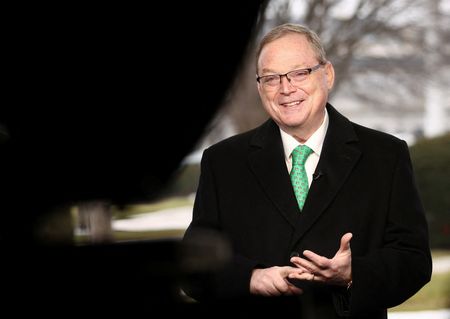
Feb 18 (Reuters) – Kevin Hassett, a top economic adviser to President Donald Trump, on Wednesday said those behind a New York Federal Reserve research paper that argued the costs of tariffs are borne mostly by Americans should be punished for what he described as shoddy scholarship.
“The paper is an embarrassment,” Hassett said in a CNBC interview. “It’s, I think, the worst paper I’ve ever seen in the history of the Federal Reserve System” and “the people associated with this paper should presumably be disciplined” for writing it, he said.
The paper argued that Trump’s large import tax increases are borne by those in the U.S., rather than by foreigners, as the administration has long argued. The findings in the New York Fed paper have been echoed elsewhere.
Hassett, the director of the White House’s National Economic Council, said the New York Fed researchers have “put out a conclusion which has created a lot of news that’s highly partisan based on analysis that wouldn’t be accepted in a first-semester econ class.”
The New York Fed declined to comment on Hassett’s statements.
The central bank research was published on Friday and argued that 90% of the taxes the president imposed on imports were in fact borne by those in the U.S. last year. Amid the shifting sands of the president’s trade agenda, the paper’s authors wrote that between January and August of last year Americans took 94% of the hit from Trump’s tariffs, ticking down to 92% between September and October, and settling at 86% in November.
The paper noted that the average tariff rate rose to 13% last year from 2.6%. The conclusions in the New York Fed research were not particularly controversial: The Congressional Budget Office also said in a new report that most of Trump’s import tax surge would be borne in the U.S., by way of a mix of smaller company profit margins and higher prices for consumers.
Fed officials have attributed much of the stickiness seen in inflation since Trump returned to office a little over a year ago to the tariffs. Those persistent price pressures have served as a limiting factor on the Fed’s ability to lower the cost of short-term borrowing in the U.S.
TARIFF TROUBLE
The Trump administration’s case for tariffs is that the taxes help bolster the government’s finances and create incentives for industry to return to the U.S. The tariffs have also been used as a tool to force compliance with various U.S. government demands.
Trump’s ability to set tariffs based on emergency powers is now being weighed by the Supreme Court and could be overturned.
Hassett was recently on a short list of potential successors to current Fed Chair Jerome Powell, but Trump ultimately selected former Fed Governor Kevin Warsh for the job.
Hassett argued in the interview that the authors behind the central bank research – three were from the New York Fed and one was from Columbia University – fundamentally misunderstood how tariffs affect the economy. He said the policy was successful at returning economic activity to the U.S.
“Prices have gone down. Inflation is down over time. Import prices dropped a lot in the first half of the year,” Hassett said. “Consumers were made better off by the tariffs,” he said.
Hassett’s contention that consumers are better off under Trump’s higher import taxes squares up against the most recent University of Michigan consumer sentiment report, which noted “concerns about the erosion of personal finances from high prices and elevated risk of job loss continue to be widespread.”
The central bank has been under sustained attack from the Trump administration over a range of issues.
Some of the flash points have surrounded the research activities of the 12 quasi-private regional Fed banks, which have in recent years looked at the economy expansively, and in the view of some critics, strayed well beyond the Fed’s core mission.
Fed officials have countered they’re trying to understand the economy to its fullest extent, and that doing so is essential to achieving the monetary policy goals laid out by Congress.
(Reporting by Michael S. Derby; Editing by Paul Simao and Andrea Ricci )
Brought to you by www.srnnews.com
 FCC chair denies censoring Colbert interview, confirms investigating ABC’s ‘The View’
 US House set to consider aviation safety legislation next week
 UN Security Council to hold high-level meeting on Gaza before Trump’s Board of Peace convenes
 Why Trump’s comment on discussing Taiwan arms sales with China has raised concerns