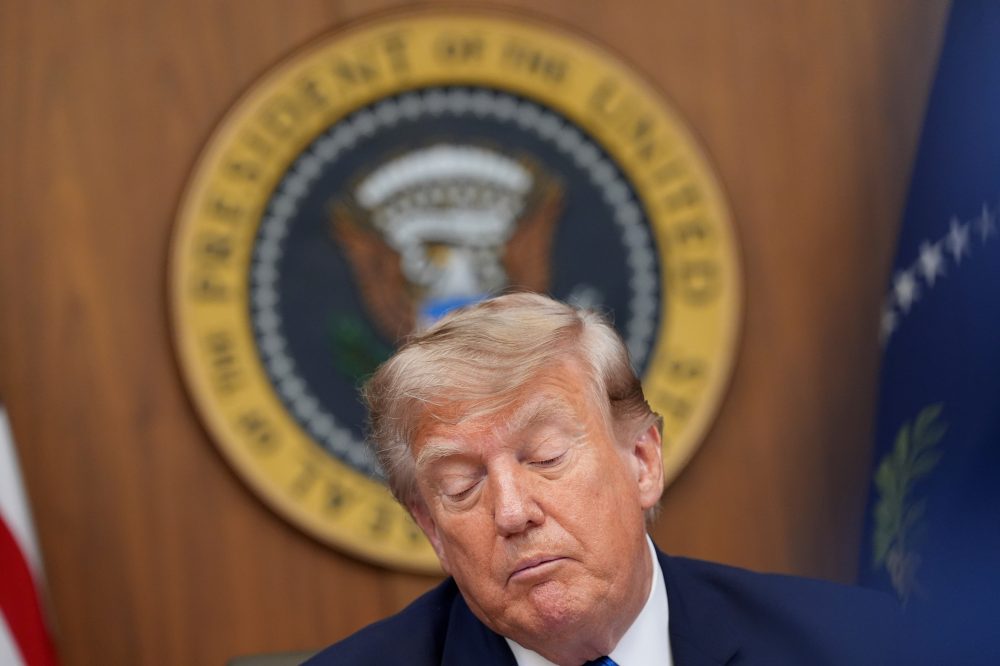
WASHINGTON (AP) — President Donald Trump has been losing his own battle to cut interest rates.
The president likes to vilify high rates as an affront to the size and strength of the U.S. economy, saying that America deserves the cheapest borrowing costs in the world. Trump for months publicly pressured the Federal Reserve to slash its benchmark rates, claiming it would be “Rocket Fuel!” for growth and make housing more affordable.
But since the war in Iran began at the end of February, borrowing money has become more expensive, meaning fewer families can afford mortgages or auto loans. The government is getting squeezed, too — as it has spent $827 billion so far this fiscal year to service the national debt, more than it has devoted to national defense.
The scope of the problem became clear this past week when Kevin Warsh, the Fed’s new chair picked by Trump, said in his second press conference on the job that inflation continues to run hot but offered no clear guidance on how to fix the problem.
Rates on 30-year U.S. Treasury bonds hit their highest levels in nearly two decades, the exact opposite of what Trump had pledged to voters. The 10-year U.S. Treasury note saw its interest rate shoot up above 4.7% on Friday, surpassing what the president inherited when he returned to the White House last year.
But Trump has largely ignored the jump in interest rates and has portrayed the economy as booming, even though the government recently reported that the annual growth rate for the prior three months was a sluggish 1.5%.
“We have the most successful environment that we’ve ever had,” Trump told his Cabinet on Friday. “There’s never been anything like it from the standpoint of investment into our country.”
Neither Trump nor his Treasury Secretary, Scott Bessent, discussed interest rates during the public portion of the meeting. But White House spokesman Kush Desai said the end of the Iran war would ultimately reduce energy costs and allow the Fed to reduce rates. “Oil prices — and thus overall inflation — will plummet again when President Trump forces a successful resolution with Iran, further paving the way for additional interest rate cuts by the Federal Reserve,” Desai said.
The prospect of higher borrowing costs has become troublesome for Republicans in the November elections, as Trump’s own policies helped drive the increase.
His tariffs that began last year caused rates to jump so quickly that he backed off and reformulated them. Trump has championed the construction of data centers for artificial intelligence, but the bonds financing those projects appear to have helped push up interest rates. And the war in Iran has fueled rising oil prices.
Republicans had hoped to show clear progress on affordability to voters ahead of the midterms. Trump can point to a low unemployment rate and solid consumer spending as proof that the economy remains stable, yet there are few signs that these arguments have connected with the public.
One possible reason why Trump’s economic messaging has struggled is that voters care more about whether their incomes are outpacing inflation, according to research released in June by Georgetown University’s Juan Felipe Riaño and the University of California, Berkeley’s Francesco Trebbi.
Trump and Republicans not only promised lower interest rates in the 2024 elections, but they indicated that prices could fall outright if their policies were in place. But over the last 12 months, inflation has nearly kept pace with hourly wage gains — and that understates the extent of the problem because debt service costs are not included in the consumer price index.
“It cut against Democrats in 2024, and if prices and borrowing costs keep outrunning wages into the fall, the same logic points at Republicans now,” Riaño, the Georgetown University economist, told the AP.
Earlier this year, the Trump administration directed Freddie Mac and Fannie Mae, the two mortgage firms under government conservatorship, to buy at least $200 billion in home loans to bring down mortgage rates.
Earlier this year, Republicans had hoped to campaign on falling rates and a bipartisan bill to increase home construction to help defend their House and Senate majorities. One GOP lawmaker, who spoke on condition of anonymity to discuss strategy, said the hope was that Trump would sign the bill as mortgage rates fell below 6%, which could improve housing affordability and public sentiment toward the overall economy.
However, Trump called the bill a “big yawn” and allowed it to become law without his signature. And the mortgage company Freddie Mac said Thursday that 30-year rates were averaging 6.66%, essentially unchanged from a year ago.
Warsh, the Fed chair since May, has said he has been content to let the financial markets do more to set the rates, rather than the central bank. Even though the Fed has held its benchmark rate steady this year, the markets on their own have chosen to charge a premium for holding U.S. government debt.
“Markets reflect the higher inflation, policy uncertainty,” said John Silvia, the CEO of Dynamic Economic Strategy. “They are the product of events.”
Warsh on Wednesday portrayed that as a positive, even if the result goes against what Trump expected from his new Fed chair.
“Market participants are learning to play the ball, not the referee — and market prices will continue to respond in the direction and magnitude they see fit,” Warsh said. “This is, in my view, a change for the better — and we are just getting started.”
But time might not be on Trump’s side for fixing high interest rates. The next Fed meeting on rates will conclude on Sept. 16. Markets currently expect Fed officials to vote to raise rates in order to reduce inflationary pressures, according to CME FedWatch.
Brought to you by www.srnnews.com
 Breakneck pace in immigration courts is driving up deportation orders
 Leave it: Dog trainers help pets avoid poisonous snakes
 US Senate Judiciary Committee to consider Blanche nomination for attorney general on Tuesday
 SEC, Big Ten add long-missing support to college sports bill and revive its chances in the Senate