
By Lucia Mutikani
WASHINGTON, Nov 10 (Reuters) – US consumer prices increased more than expected in October amid higher costs for food and accommodation, cementing expectations that the Federal Reserve will raise interest rates next month.
The Consumer Price Index report from the Labor Department on Tuesday also showed a strong buildup of underlying inflation pressures for a third straight month. It followed data last week showing the labor market regained momentum in October.
Inflation is being driven by the US-Israeli war with Iran, which has boosted oil prices, the Trump administration’s import tariffs, resilient consumer spending and aggressive business investment in artificial intelligence technology.
The rising cost of living contributed to the heavy losses suffered by President Donald Trump’s Republican Party in the midterm elections last week.
Fed Governor Christopher Waller said on Tuesday the US central bank should raise rates next month, adding that “a stronger policy move may be needed.” Waller also raised the prospect of an aggressive 50-basis-point hike.
“The Fed seems to be falling behind the curve on inflation, and the October hold is looking like a policy mistake,” said Stephen Juneau, an economist at Bank of America Securities. “We see a rising risk that the Fed will have to hike again in January, rather than March.”
The CPI increased 0.4% last month after advancing 0.6% in September, the department’s Bureau of Labor Statistics said. It was the third consecutive month of gains of 0.4% or more. Economists polled by Reuters had forecast the CPI would climb 0.3% over the month. The BLS did not publish year-over-year inflation readings because last year’s federal government shutdown prevented the collection of consumer price data in October 2025, leaving no comparison base.
Some economists used the average index for September and November 2025 to estimate the year-over-year rate of change for the October CPI. Others used interpolated levels from independent sources. Their estimates for the October year-over-year CPI ranged from a gain of 3.9% to 4.0%. Annual consumer inflation was 3.7% in September.
Shelter, which includes rents and hotel and motel rooms, accounted for more than 30% of the monthly increase in the CPI. Shelter costs rose 0.3% after climbing 0.4% in September.
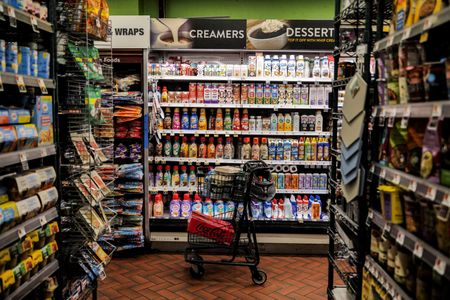
Food prices surged 0.5% after barely rising in the prior three months. Grocery store prices climbed 0.4%, boosted by a 0.9% jump in the cost of beef. Egg prices rose 0.6%, while fruits and vegetables were 0.6% more expensive. Prices for dairy products increased 0.6%. The cost of snacks surged 1.0%.
Rising prices at the supermarket could be an early sign that high diesel prices are filtering through to consumers. The cost of eating out also increased last month, with prices of food away from home rising 0.5% after a 0.2% gain in September. The cost of full-service meals jumped 0.7%.
“This may finally be the beginning of a pass-through of higher transportation costs to grocery prices,” said Stephen Stanley, chief US economist at Santander US Capital Markets. “If this is indeed happening, it could be a feature across a broad array of goods categories.”
Gasoline prices climbed 1.0% after soaring 9.1% in September. Consumers also paid more for electricity. Although diesel prices have eased off all-time highs, they remain on an upward trend, rising 2.7% in October after increasing 11.9% in September.
Consumers could get some relief at the pump, with oil prices down at least 10% so far this month, but the pressure is unlikely to ease elsewhere, economists warned.
Inflation-adjusted average weekly earnings fell again in October.
MORE RATE HIKES ANTICIPATED
The so-called core CPI, which excludes volatile food and energy items, increased 0.3% in October for the third straight month. The so-called core CPI was forecast to have climbed 0.2% in October. Economists estimated that year-over-year core CPI inflation gained 2.8% in October. Annual core CPI inflation rose 2.6% in September.
Financial markets are pricing in a roughly 89% chance of a 25-basis-point rate hike next month, and expect another increase in March, CME Group’s FedWatch tool showed. The Fed left its benchmark overnight interest rate in the 3.75%-4.00% range last month. Economists said only a substantial selloff in equity markets or widening credit spreads would prevent the Fed from tightening monetary policy in December.
Stocks on Wall Street were trading lower. They slumped last week after the Democrats’ sweeping victory fanned fears that new regulations could dent the durability of the AI trade, but rallied on Monday as oil prices fell. The dollar gained against a basket of currencies. US Treasury yields were mostly higher.
Underlying inflation last month was driven by a 0.3% rise in owners’ equivalent rent, a measure of the amount homeowners would pay to rent or earn from renting their property. Prices for hotel and motel rooms rose 0.6%. Airline fares increased 0.4%. The cost of recreation services climbed 0.9%, while that of motor vehicle insurance advanced 0.7%.
Doctor visits and hospital services also cost more. But the price of health insurance dropped 1.8%. The BLS updated the data used to calculate this component. Overall services prices excluding energy increased 0.3% after rising 0.4% in September.
Tariff effects were also evident in October. Prices of household furnishings and supplies rebounded 0.7% and the cost of toys increased 1.8%. There were more price gains for computers and peripherals, reflecting the AI spending boom. Prices for smartphones rose a record 1.4%.
There were also increases in the prices of new vehicles and medication. But used car and truck prices dropped 1.2%. Core goods prices increased 0.2% after climbing 0.3% in September.
The missing data from last year have no impact on the calculation of the Personal Consumption Expenditures Price Index readings that the Fed tracks to gauge progress toward its inflation target.
Based on last month’s data, economists estimated that core PCE inflation rose 0.4% after advancing 0.3% in September. In the 12 months through October, core PCE inflation is projected to have increased 3.3% after gaining 3.1% in the 12 months through September. These estimates could be impacted by producer price data for October that is due to be released on Friday.
“Inflation isn’t dead; it is very much alive and the cost-of-living crisis rages on,” said Christopher Rupkey, chief economist at FWDBONDS.
(Reporting by Lucia Mutikani; Editing by Chizu Nomiyama and Paul Simao)
Brought to you by www.srnnews.com
 US traffic deaths fall in first half of 2026, lowest rate since 2014
 India, US continuing talks to finalise first tranche of trade deal, official says
 Fed officials open door to a half-percentage-point rate hike as inflation worsens