
By Georgina McCartney and Tim McLaughlin
HOUSTON/BOSTON, Jan 23 (Reuters) – U.S. crude and natural gas production fell and spot power prices spiked as a winter storm with frigid temperatures started to sweep across the country on Friday.
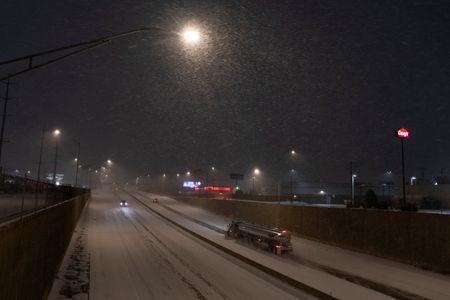
The storm system, named Fern by The Weather Channel, is expected to bring heavy snow, sleet and freezing rain to a broad swath of the U.S. – from the southern Rockies to New England – through Monday, according to the National Weather Service. Widespread travel disruptions, downed power lines and prolonged electricity outages are anticipated.
U.S. crude output is set to slip as the cold snap and stormy conditions push operators to shut in production in key basins, according to state regulators and analysts. That could lead to a total loss of around 300,000 barrels per day, said Energy Aspects, adding that the production outage could climb further.
The storm could cut 86 billion cubic feet of natural gas production over the next two weeks, Energy Aspects said, noting that the Appalachia region could lose 35 bcf of output.
Freezing temperatures are expected to reach the Permian Basin – which accounts for around half of total U.S. crude production – this weekend and could lead to a drop in 200,000 barrels a day from that oilfield alone, according to Energy Aspects. The area, which straddles Texas and New Mexico, is set to produce 6.63 million bpd of crude in January, according to the Energy Information Administration.
North Dakota crude output, meanwhile, is currently down by between 80,000 bpd and 110,000 bpd, accounting for around 5 to 10% of the state’s output, as operators shut production in due to cold weather, the state regulator said on Friday.
North Dakota is the third-largest oil-producing state, and output rose by 12,000 bpd to 1.189 million bpd in November, the latest monthly data from the state Industrial Commission showed.
The state’s well-head associated gas output was currently down by 0.24 billion cubic feet per day to 0.33 bcfd.
POWER GRID OPERATORS PREPARE
U.S. Secretary of Energy Chris Wright on Thursday asked the nation’s power grid operators to be prepared to make backup generation resources at data centers – which are sensitive to even minor disruptions – and other major facilities available as needed.
The Department of Energy estimates that more than 35 GW of unused backup generation remains available nationwide. That could help mitigate blackouts and reduce costs for potentially hundreds of millions of Americans during the winter storm.
The Southwest Power Pool, a regional grid operator that spans 14 states stretching from North Dakota to Louisiana, reported real-time spot wholesale prices that soared above $200 per megawatt-hour from congestion on high-voltage power lines bringing electricity from the south to the upper Midwest and Great Plains.
By contrast, an abundance of wind generation as the storm rips through parts of New Mexico and Oklahoma has caused wholesale prices to be negative, with wind generators forced to pay the grid to take their excess electricity and avoid shutting down their own generation.
The largest U.S. power grid, PJM, warned that, depending on temperatures, it could set a new all-time winter peak load on Tuesday, January 27, and is taking additional precautions with its generation and transmission owners to prepare. U.S. utilities CenterPoint Energy and Duke Energy on Friday issued a statement telling consumers they were rolling out preparation plans to minimize impact on power availability.
FUEL MARKETS BRACE FOR COLD BLAST
Traders expect gasoline demand to take a major hit as people stay indoors through the cold blast, but diesel prices have been rising as the fuel is often used in heating and power generation.
“There is the potential for a surge in distillate demand where scores of trucks load fuel that needs to be used while natural gas is unavailable,” said Tom Kloza, veteran oil analyst.
Potential disruptions to refining operations also helped lift U.S. ultra-low-sulfur diesel futures to their highest since November during Friday’s session. ULSD futures were last up 3% to $2.44 a gallon.
Major fuel delivery hubs of the Colonial Pipeline, the largest U.S. fuel conduit, are expected to be blanketed in ice and snow for days, U.S. fuel distributor TACenergy said on Friday.
That has pushed prices for shipping gasoline on Colonial’s Line 1 into negative territory, with demand at those delivery hubs expected to take a hit. Most of the major refinery origin points are currently expected to be spared by the worst of the storm, TACenergy said.
(Reporting by Georgina McCartney and Arathy Somasekhar in Houston, Shariq Khan and Nicole Jao in New York, Tim McLaughlin in Boston and Tim Gardner in Washington; Editing by Nathan Crooks and Rosalba O’Brien)
Brought to you by www.srnnews.com
 Man shot during Minneapolis immigration crackdown has died, hospital record shows
 Trump will not attend Super Bowl because it’s ‘too far away,’ he tells NY Post
 Crockett and Talarico ready for Senate debate as Democrats hope for breakthrough in GOP-heavy Texas
 Trump threatens Canada with a 100% tariff over its China trade deal and escalates feud with Carney