
By Lucia Mutikani
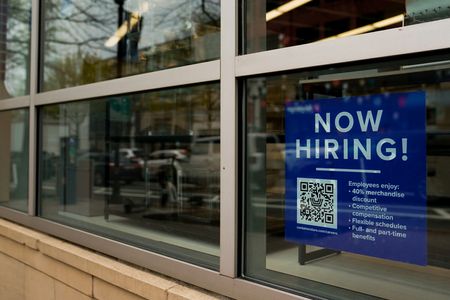
WASHINGTON, May 7 (Reuters) – The number of Americans filing claims for unemployment benefits rose moderately last week amid low layoffs, underscoring labor market stability and strengthening financial market expectations that the Federal Reserve will not cut interest rates this year.
The weekly jobless claims report from the Labor Department on Thursday, the most timely data on the economy’s health, continued to show no clear signs of labor market stress from an oil price shock triggered by the U.S.-Israel war with Iran.
Fewer people were collecting unemployment checks towards the end of April, though that drop could be the result of some people exhausting their eligibility, which is limited to 26 weeks in most states. Low levels of layoffs are anchoring the labor market. Economists remain wary of downside risks because of the war’s disruption of oil shipments through the Strait of Hormuz.
“Fed officials cut interest rates last year because of worries over joblessness and a higher unemployment rate, but right now, there is no reason to consider interest rate cuts whatsoever because the labor market is steady as a rock,” said Christopher Rupkey, chief economist at FWDBONDS.
Initial claims for state unemployment benefits rose 10,000 to a seasonally adjusted 200,000 for the week ended May 2, the Labor Department said. Economists polled by Reuters had forecast 205,000 claims for the latest week. The increase partially unwound the prior week’s decline, which had pushed claims to a level last seen in 1969.
Government data on Tuesday showed there were 0.95 job openings for every unemployed person in March versus 0.91 in February, consistent with a stable labor market.
Despite a raft of layoff announcements by big technology firms related to the adoption of artificial intelligence for some job roles, claims have remained below the 230,000 level this year. Economists speculate that laid-off technology workers are most likely receiving generous severance packages.
A report from global outplacement firm Challenger, Gray and Christmas on Thursday showed U.S.-based employers announced 83,387 job cuts in April, up 38% from March. The tally was, however, down 21% from last year.
LAYOFFS TRENDING LOWER
Employers have so far this year announced 300,749 job cuts, down 50% from the same period in 2025. Technology companies have accounted for the bulk of the layoffs, with AI often cited as the reason.
The U.S. central bank last week left its benchmark overnight interest rate in the 3.50%-3.75% range, citing inflation worries. Financial markets expect the Fed to keep rates steady into 2027.
U.S. stocks were largely flat in early trading. The dollar slipped against a basket of currencies. U.S. Treasury yields fell.
The number of people receiving unemployment benefits after an initial week of aid, a proxy for hiring, decreased 10,000 to a seasonally adjusted 1.766 million during the week ended April 25, the lowest level since January 2024, the claims report showed. The data have no bearing on the employment report for April, which is due to be released on Friday.
Nonfarm payrolls likely increased by 62,000 jobs last month after rebounding by 178,000 in March, a Reuters survey of economists predicted. The anticipated slowdown will reflect the fading boost from warmer weather and the return of striking health workers.
The expected pace of job growth would be above what economists say is now needed to keep up with growth in the working-age population. Estimates for the so-called break-even rate are between zero and 50,000 jobs per month.
The unemployment rate is forecast to have been unchanged at 4.3% in April, with a possibility of being rounded down to 4.2%. The Chicago Fed is forecasting the jobless rate to be 4.23%, which would round down to 4.2%.
A separate report from the Labor Department’s Bureau of Labor Statistics showed nonfarm productivity, which measures hourly output per worker, increased at a 0.8% annualized rate in the first quarter after rising at a 1.6% rate in the October-December quarter. Worker productivity, however, increased at a 2.9% pace from a year ago. Heavy spending on AI has ignited a debate over its impact on productivity.
“The question is whether productivity has accelerated because of AI and/or other technological advances, which would be expected to continue, or because firms were simply holding off on hiring last year due to policy-related uncertainty and making do with lower headcounts, which also shows up as a productivity acceleration but is not sustainable long-term,” said Stephen Stanley, chief U.S. economist at Santander U.S. Capital Markets.
(Reporting by Lucia Mutikani; Editing by Chizu Nomiyama and Paul Simao)
Brought to you by www.srnnews.com
 One Tech Tip: Why digital devices and online accounts need spring cleaning
 West Point military competition tests future soldiers, in photos
 FDA’s new playbook: Lots of media announcements but not much rulemaking
 The Latest: Rubio meets with Pope Leo XIV at the Vatican after Trump’s criticism over Iran