
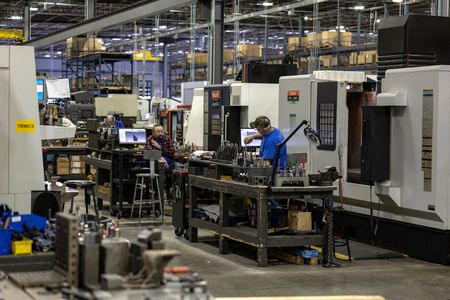
WASHINGTON, Nov 2 (Reuters) – US manufacturing activity picked up in October amid solid domestic demand, keeping inflation at the factory gate elevated.
The Institute for Supply Management said on Monday its manufacturing PMI increased to 55.5 last month from 54.5 in September. Economists polled by Reuters had forecast the PMI would stay at 54.5. The PMI has stayed above the 50 threshold this year, indicating growth in manufacturing, which accounts for about 9.4% of the economy.
Activity is being driven by robust consumer spending and business spending in AI. The government reported last week that domestic demand surged at its strongest pace in more than five years in the third quarter. The overall economy grew at a 3.4% annualized rate last quarter after expanding at a 2.2% pace in the April-June period, even as the ongoing US-Israeli war with Iran is stoking inflation.
The ISM survey’s new orders measure edged up to 55.5 from 55.3 in September, with exports also rising. Factory inventories also increased. The government’s advance GDP report showed business inventories rebounded last quarter after being drawn down for five straight quarters.
Suppliers are, however, struggling to cope with the strong demand. The survey’s supplier deliveries index inched up to 59.1 from 59.0 in September. A reading above 50 indicates slower deliveries. That meant factories continued to pay more for inputs.
The survey’s gauge of prices paid for inputs eased to a still-high 75.2 from 77.9 in September, supporting economists’ views that inflation will continue to run above the Federal Reserve’s 2% target into 2027. Economists had forecast the prices paid index would ease to 77.5. The government last week reported that the Personal Consumption Expenditures price index shot up 3.6% year-on-year in September. It is one of the inflation measures monitored by the US central bank for monetary policy.
The Fed last Wednesday left its benchmark overnight interest rate in the 3.75%-4.00% range while acknowledging that inflation “remains elevated.” Economists expect the central bank to raise borrowing costs in December.
Factory employment continued to grow last month, though the pace slowed a bit from September. A measure of factory employment edged down to 52.4 from 52.7 in September, slightly above economists’ forecast of 52.0.
(Reporting By Lucia Mutikani; Editing by Chizu Nomiyama)
Brought to you by www.srnnews.com
 Sectors bracing for a pivot as US midterm elections loom
 Major automakers urge US Congress to pass permanent ban on Chinese vehicles