
By Lucia Mutikani
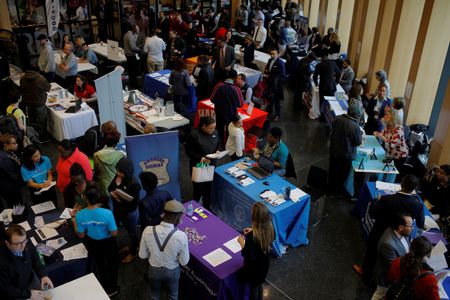
WASHINGTON, Jan 22 (Reuters) – The number of Americans filing new applications for unemployment benefits increased marginally last week, suggesting the labor market likely maintained a steady pace of job growth in January.
The Labor Department’s weekly jobless claims reports have in recent weeks been clouded by challenges adjusting the data for seasonal fluctuations around the year-end holiday season and turn of the year. Through the volatility, however, the labor market has remained in what economists and policymakers call a “low-hiring, low-firing” state.
The economy is experiencing jobless growth, with other data on Thursday showing gross domestic product increased at a slightly more robust pace in the third quarter than initially estimated amid strong consumer and business investment in artificial intelligence as well as a smaller trade deficit.
“The United States is experiencing a jobless boom where strong growth is powered by AI investments and consumption by wealthier families, but there is almost no hiring,” said Heather Long, chief economist at Navy Federal Credit Union. “It’s an uneasy situation for many middle-class families. One of the big questions for 2026 is whether the middle class will start to feel the uplift from the boom.”
Initial claims for state unemployment benefits rose 1,000 to a seasonally adjusted 200,000 for the week ended January 17, the Labor Department said. Economists polled by Reuters had forecast 210,000 claims for the latest week.
Economists say President Donald Trump’s aggressive trade and immigration policies have reduced both the demand for and supply of workers. Businesses are also unsure of their staffing needs as they invest heavily in AI, limiting hiring.
The claims data covered the period during which the government surveyed employers for the nonfarm payrolls component of January’s employment report. Nonfarm payrolls increased by 50,000 jobs in December, roughly in line with the monthly average for 2025.
The Bureau of Labor Statistics’ annual payrolls benchmark revision, to be published with January’s employment report next month, is likely to show the loss of momentum started in 2024. The BLS has estimated about 911,000 fewer jobs were created in the 12 months through March 2025 than previously reported.
The overcounting has been blamed on the birth-death model that BLS uses to estimate how many jobs were gained or lost because of companies opening or closing in a given month. Starting with the January report, the BLS will change that model by incorporating current sample information each month.
The number of people receiving unemployment benefits after an initial week of aid, a proxy for hiring, fell 26,000 to a seasonally adjusted 1.849 million during the week ended January 10, the claims report showed.
Part of the decline in the so-called continuing claims is also likely due to seasonal adjustment difficulties as well as some people exhausting their eligibility for benefits, limited to 26 weeks in most states. Those who are laid off are finding it difficult to land new jobs, a trend that is evident in surveys of consumers.
U.S. stocks opened higher. The dollar fell against a basket of currencies. U.S. Treasury yields were mostly lower.
THIRD-QUARTER GROWTH WAS ROBUST
A separate report from the Commerce Department’s Bureau of Economic Analysis showed GDP increased at an upwardly revised 4.4% annualized rate, the fastest pace since the third quarter of 2023. The economy was initially estimated to have grown at a 4.3% rate in the July-September quarter. It grew at a 3.8% pace in the second quarter.
The slight upward revision to growth in the third quarter reflected upgrades to exports and business investment. Imports, which subtract from the calculation of GDP, were revised up. Consumer spending and a smaller trade deficit were the key drivers of GDP growth in the third quarter.
Consumer spending, which accounts for more than two-thirds of U.S. economic activity, grew at a 3.5% rate in the third quarter, though outlays of goods were revised slightly down.
Economists said activity has assumed what they termed a K-shaped pattern, with higher-income households and big corporations doing the heavy lifting, mainly because of tariffs that have raised prices.
A stock market boom and still-high home prices have cushioned upper-income households against inflation while lower- and middle-income households face a limited ability to substitute purchases, economists said.
Similarly, large companies have sufficient resources to offset the rising costs from import duties, they added. In contrast, small businesses are barely staying above water, and are also struggling with a reduction in low-cost labor supply amid an immigration crackdown, economists said. Profits from current production increased at a $175.6 billion rate in the third quarter, an upward revision of $9.5 billion.
Inflation heated up in the third quarter. The price index for gross domestic purchases, a key measure of inflation in the U.S. economy, increased at an unrevised 3.4% rate. That was the fastest pace since the first quarter of 2023 and followed a 2.0% rate of increase in the April-June quarter.
The Personal Consumption Expenditures Price Index, excluding the volatile food and energy components, rose at an unrevised 2.9% rate. It is one of the inflation measures tracked by the Federal Reserve for its 2% target. The U.S. central bank is expected to leave interest rates unchanged next week.
(Reporting by Lucia Mutikani; Editing by Chizu Nomiyama and Paul Simao)
Brought to you by www.srnnews.com
 Largest US electric grid expects all-time record winter demand
 Freezing temps, heavy snow expected for millions of people in central and eastern US this weekend
 Georgia Republican Burt Jones uses legislature to attack his opponent over 2020 election
 Guinea-Bissau suspends Trump-backed hepatitis B vaccine study for ethical review