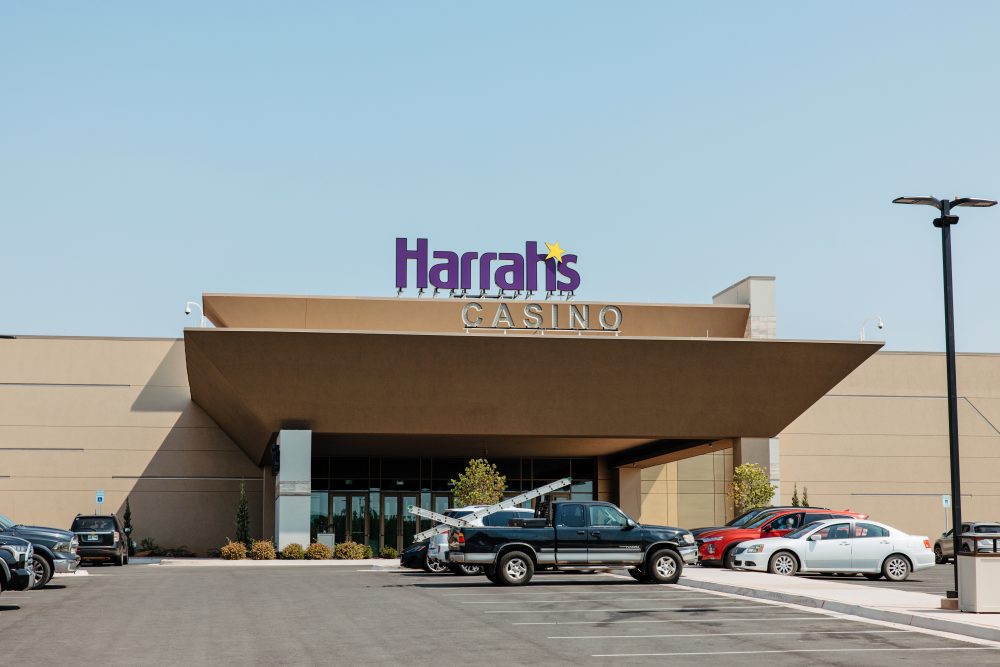
ALBUQUERQUE, N.M. (AP) — On opening day at the Iowa Tribe of Oklahoma’s new Harrah’s-branded casino, the tribe’s chairman watched customers pack the gambling floor while a queue of cars spilled out of the parking lot.
“We couldn’t let them in because we were so full,” Chairman Jacob Keyes said. “That’s a direct impact from the Harrah’s name.”
But a vacancy in Washington is preventing the tribe’s partnership with the gambling giant from moving beyond branding. Plans for Harrah’s parent company to take over day-to-day management of the casino in Chandler, Oklahoma, stalled after it opened in April, because no one is at the helm of the federal commission that oversees tribal gambling.
The last chairperson of the National Indian Gaming Commission stepped down from the role in January. President Donald Trump has not nominated anyone to fill the vacancy. Absent a chair, the commission is unable to perform some key responsibilities, like enforcing legal and safety violations, approving new tribal gambling laws and certifying management agreements between tribes and casino operators.
Industry leaders say the agency’s inertia risks delaying business deals, weakening oversight and leaving tribes without a key advocate in Washington as they grapple with an emerging threat posed by online prediction markets.
“At this crucial time, the (National Indian Gaming Commission) is operating with one arm tied behind its back,” said Jonodev Chaudhuri, a former NIGC chair from 2013 to 2019 and a citizen of the Muscogee (Creek) Nation. “That’s a very precarious position for tribes and Indian gaming.”
There’s a lot at stake for tribes that rely heavily on casino revenue to fund healthcare, housing, education and other vital services. Tribal gambling brought in a record $46 billion in 2025, nearly triple the annual casino revenue of gambling powerhouse Nevada.
With its Harrah’s contract stuck in limbo, the Iowa Tribe’s small government staff finds itself managing the 175,000-square-foot (16,258 square-meter) casino, a mammoth task it had intended to outsource.
“It’s discouraging. We’re paying a fee and not getting the full value,” Keyes said.
The decision to outsource management was strategic: Harrah’s branding would bring in more business than existing staff could accommodate. Instead, staff has to balance management with other priorities like preparing tribal budgets and overseeing social programs, Keyes said.
The three-member gaming commission was formed in 1988 to regulate casino-style gambling and promote economic development on tribal lands. Some 250 tribal governments across 29 states now operate 545 gambling facilities, the commission said.
Under federal law, its enforcement powers are vested solely in the chairperson. Industry leaders say its inability to cite casinos for violating federal law or force the emergency closure of unsafe facilities is particularly troubling.
In a typical year, the commission issues several citations to tribes for operating casinos on unauthorized lands, failing to submit required financial statements, misusing revenues and other violations. The commission’s last enforcement action was issued on Jan. 12 — the same day acting chairperson Sharon Avery’s term expired. She remains on the commission.
The commission declined an interview request and said in an emailed statement that tribal officials and its field staff provide “excellent regulation” amid the leadership gap. But Steven Light, an expert in tribal gambling law at the University of Nevada, Las Vegas, said the lack of enforcement power could discourage investment in tribal gambling and slow business growth.
“Markets function best when there’s stability and certainty around processes and rules,” Light said.
The commission vacancy comes as the popularity of online prediction markets like Kalshi and Polymarket explodes. Tribal leaders fear those platforms, which allow users to wager on the outcome of virtually any event, could violate their sovereignty and take a bite out of gambling revenue.
“Every dollar generated by Indian gaming goes to fund healthcare for our people, education for our children, housing for our elders,” said David Bean, chairman of the Indian Gaming Association and a citizen of the Puyallup Tribe.
At least eight tribes have sued prediction market platforms, alleging they accept bets from tribal lands and in states where tribes have exclusive gambling rights in violation of the Indian Gaming Regulatory Act, which the gaming commission is tasked with enforcing.
Prediction markets argue their users are engaging in futures trading, not gambling, and dispute claims that they are circumventing regulation.
The commission chairperson typically serves as an advocate for the tribal gambling industry in Washington, according to former commissioners and staffers. Yet it’s been conspicuously silent while the federal government weighs how to regulate prediction markets, said Joe Valandra, the commission’s chief of staff from 2005 to 2007 and a citizen of the Rosebud Sioux Tribe.
James Siva, who leads the California Nations Indian Gaming Association and is vice chairman of the Morongo Band of Mission Indians, said the Trump administration’s support of and business ties to the prediction markets industry could explain why it hasn’t filled the vacancy.
“These things are happening in conjunction with each other,” Siva said in April at a news conference with the Indian Gaming Association. “It is not a coincidence by any means.”
The commission’s last Senate-confirmed chairperson termed out under former President Joe Biden without a successor in place.
A White House spokesperson called the commission a “valued board” but did not say when a new nomination will be made.
In April, Trump appointed Assistant Secretary for Indian Affairs Billy Kirkland, a citizen of the Navajo Nation, to the commission. That’s raised questions about potential executive branch influence over an agency designed to be independent.
“This crosses that threshold in an uncomfortable way,” said Shannon O’Loughlin, the commission’s chief of staff from 2015 to 2017 and a citizen of the Choctaw Nation of Oklahoma.
Keyes said a crucial opportunity to develop his tribe’s economy hangs in the balance. He doesn’t see the commission vacancy as partisan play.
“I don’t want to sound like sour grapes, but when have Native American issues ever been prioritized by the federal government?” he said.
Brought to you by www.srnnews.com
 Trump’s immigration crackdown looms over Minnesota’s bruising Senate primary
 El-Sayed spoke with Obama as Michigan Democrats look to unite after a bitter Senate primary
 The Media Line: FCC Vote Opens Door to Wider Broadcast TV Consolidation