
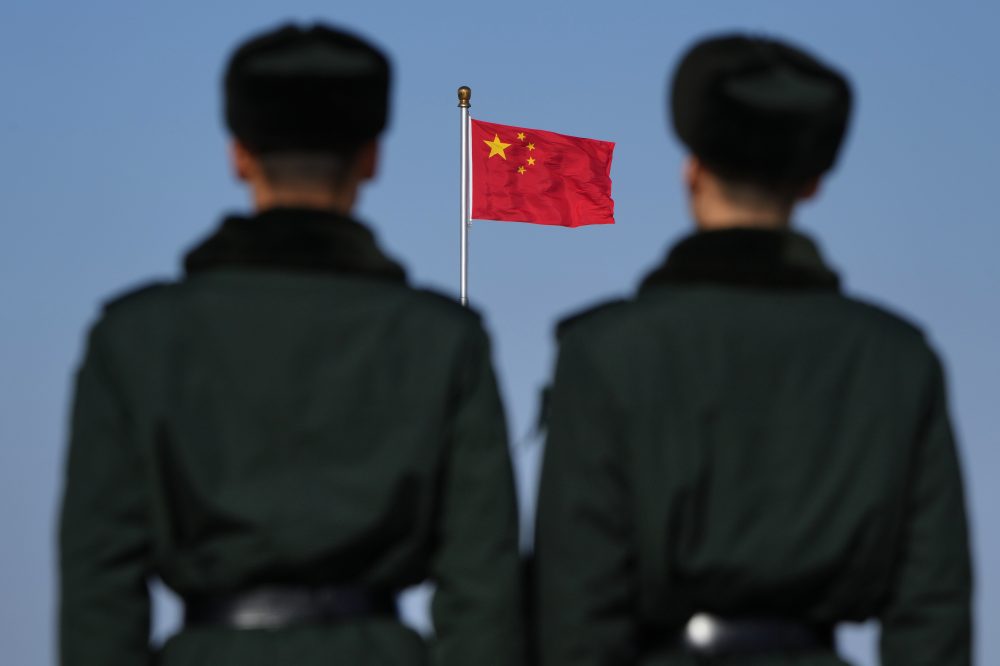
BEIJING (AP) — The day the U.S. and Israel attacked Iran, China waited several hours before taking its first official position. It said it was “highly concerned” and called for an immediate halt to military operations and the resumption of dialogue.
The next day, Foreign Minister Wang Yi condemned the strikes as unacceptable and again called for more talks.
There were no indications of direct intervention — but such an expectation wouldn’t be realistic. As in other recent conflicts, including last year’s attack on Iran, China has condemned the use of force while remaining on the sidelines, keeping in mind its long-term interests.
This time, those interests include a highly anticipated visit by U.S. President Donald Trump to Beijing, expected to take place around early April.
China’s military has grown rapidly. It has conducted military drills with Iran and established a base in Djibouti in East Africa in 2017. But its overwhelming focus is defending its interests in Asia, from Taiwan to the South China Sea.
It has waded into Middle East diplomacy where it sees an opportunity, helping to broker a rapprochement between Iran and Saudi Arabia in 2023. But it views the U.S. wars in Afghanistan and Iraq as cautionary tales to be avoided, said William Yang, an analyst with the International Crisis Group.
“China is reluctant to project military power beyond its immediate periphery and it is also unwilling to play the role of security guarantor in unstable regions like the Middle East,” he said.
Likewise, it has provided diplomatic and economic support to Russia and Venezuela, but steered away from any military action in Ukraine or Latin America.
China’s position on the sidelines shows the limits to its influence in global geopolitics, said Craig Singleton, a senior China fellow at the Foundation for Defense of Democracies, a Washington-based research institute.
“Beijing’s response has been predictably restrained, underscoring China’s limited ability to shape events once hard power is in motion,” he said. “Beijing can signal unease; however, it cannot meaningfully deter or influence U.S.-Israeli military action.”
China’s unhappiness with the strikes against Iran is unlikely to upend ties with the U.S. or plans for Trump to meet Chinese leader Xi Jinping in Beijing in about a month, analysts say.
For Chinese leaders, the relationship with the U.S. is much more crucial than with Iran on multiple fronts, from trade and the economy to Taiwan.
Beijing may have a war of words with Washington over Iran, but the downside to creating a new conflict with Trump outweighs the upside, said George Chen, a partner at The Asia Group.
“U.S.-China relations are already complicated enough for President Trump and Xi to handle,” he said. Adding Iran to the mix “won’t be something that both sides are keen to do.”
Still, it is possible that Beijing could postpone the Trump visit, he said.
China is the top importer of oil from Iran, but the government is deeply concerned with energy security and has developed alternatives. What’s most worrisome is rising prices and potentially losing access to oil and natural gas from the broader Middle East.
China imported about 1.4 million barrels a day — or 13% of China’s total seaborne oil imports — from Iran last year, according to Kpler, a data and analytics company. But the firm estimates that enough oil is already in transit to last another four to five months. That would give China’s independent refineries time to adjust and seek alternatives, with discounted Russian oil as their primary option, said Muyu Xu, a senior analyst with Kpler.
China has spent years diversifying its supplies and building up its reserves, Singleton said. “The loss of Iranian oil appears marginal, not material, at least in the short-term,” he said.
Iran’s attempts to shut down the Strait of Hormuz — the narrow mouth to the Persian Gulf — is of greater concern, as are any attacks on liquefied natural gas facilities in the Gulf states.
QatarEnergy, a major supplier, halted production of liquefied natural gas Monday after its facilities were attacked.
China is unlikely to send arms to Iran to help it fight the U.S. for several reasons, analysts say.
“Tangible military aid, if any, would be limited to existing long-term defense trade arrangements rather than rapid battlefield support, and it would be constrained by Beijing’s interest in avoiding direct confrontation with the U.S. and its allies,” said Muhammad Zulfikar Rakhmat, a researcher at the Center of Economic and Law Studies in Indonesia.
China has criticized the U.S. for supplying arms to Ukraine, saying it prolongs the fighting.
Iran’s missile program is based on Chinese technology, said James M. Dorsey, an adjunct senior fellow at Nanyang Technological University in Singapore. But he predicted that China would err on the side of caution rather than sell any missiles to the country’s military.
“What China wants is this to end,” he said.
___
Associated Press writers Kanis Leung in Hong Kong, Didi Tang in Washington, E. Eduardo Castillo in Beijing and Simina Mistreanu in Taipei, Taiwan, contributed.
Brought to you by www.srnnews.com
 Georgia school shooting suspect’s father convicted of second-degree murder, involuntary manslaughter
 Last year, small US firms faced notable tariff price pressures, Fed report finds
 2 men arrested in Cincinnati nightclub shooting that wounded 9
 The Latest: Primary voters head to the polls in Texas, North Carolina and Arkansas