
By Olivia Le Poidevin
GENEVA, Aug 11 (Reuters) – The World Health Organization on Tuesday defended the science-based process used to determine childhood immunisation schedules after U.S. President Donald Trump signed an executive order aimed at reducing the number of recommended childhood vaccinations in the United States.
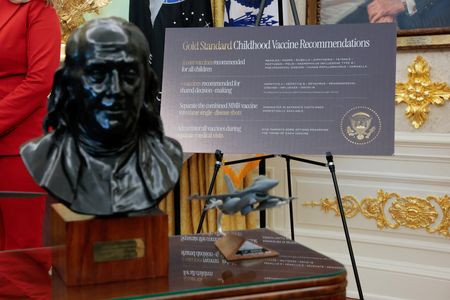
On Monday, Trump signed an executive order calling for a reduced childhood vaccination schedule of 11 immunisations. Trump said the move would provide U.S. children with “gold-standard” protection and align the United States more closely with other developed countries that recommend fewer shots.
Vaccine experts say that other developed countries that may recommend fewer shots face different disease risks and have different healthcare systems.
The order advances a long-standing objective of U.S. Health Secretary Robert F. Kennedy Jr., who has questioned vaccine safety and promoted claims linking vaccines to autism even though scientific studies and public health authorities have found no evidence of a link.
WHO spokesperson Tarik Jašarević told a press briefing in Geneva that vaccination recommendations were based on more than 60 years of research by WHO, national authorities and independent expert groups.
The timing of individual vaccines was determined through extensive scientific review of when people were most vulnerable to particular diseases and the development of the immune system, Jašarević told reporters in Geneva.
Jašarević said countries typically relied on national immunisation technical advisory groups made up of multidisciplinary experts who provided independent, evidence-based recommendations to governments and vaccination programme managers. Those groups, he said, draw on guidance from WHO’s Strategic Advisory Group of Experts on Immunization (SAGE) when establishing national schedules.
“What comes out from WHO is science-based,” Jašarević said.
“We hope that all countries will use this best scientific evidence that we have.”
SEPARATE SHOTS FOR MEASLES, MUMPS AND RUBELLA
Trump’s executive order has drawn criticism from medical associations, public health experts and vaccine manufacturers, who say there is no new scientific evidence to justify the changes and that the existing U.S. schedule reflects decades of evidence and the specific health needs of Americans, rejecting the comparison to other countries.
Physicians have warned that reducing the number of recommended vaccinations could leave more children vulnerable to preventable diseases and create confusion among parents about when children should be immunised.
The Trump order also recommends separating the combined measles, mumps and rubella (MMR) vaccine into three individual injections. Vaccine maker Merck has said there is no published scientific evidence showing a benefit from splitting the shot and warned that requiring separate visits could increase the risk of delayed or missed vaccinations.
(Reporting by Olivia Le Poidevin; Editing by Kate Mayberry)
Brought to you by www.srnnews.com
 Taylor Swift wedding-dress fever puts bridal brands on high alert
 Luigi Mangione due in court ahead of insurance CEO murder trial
 Republicans pick nominee for Alabama US House district they redrew after Supreme Court ruling
 Connecticut Democrats weigh generational change as US Rep. John Larson, 78, faces primary fight