
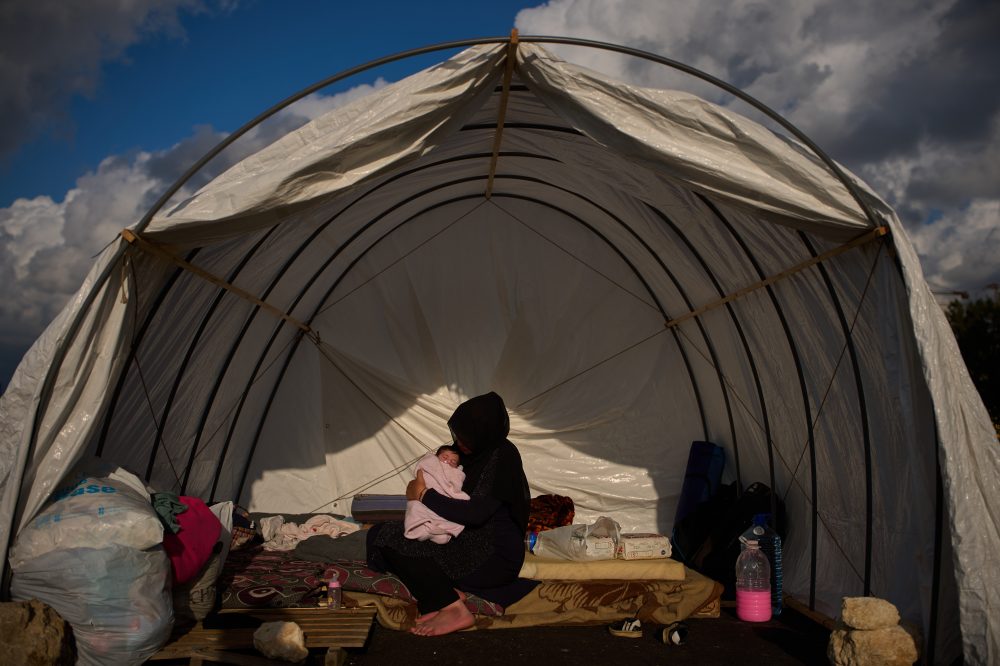
BEIRUT (AP) — All that newborn Shiman knows of the world is a flimsy tent along Beirut’s waterfront — the stench of mildewed blankets, stings of swarming insects and screams of Israeli warplanes striking the Lebanese capital.
As of Monday, she was 16 days old after being born here in the mud, said her mother, Haifa Kenjo.
Kenjo, 34, was nine months pregnant when Israeli attacks on Beirut’s southern suburbs of Dahiyeh sent her, her husband and their 2-year-old son, Khalid, running for their lives in sandals and pajamas. They had no time to bring anything as explosions shook the house, they said — not clothes, not cash.
They took refuge in a donated tent near downtown Beirut and secured the tarp with rocks as the wind threatened to rip it from the ground.
Of the more than 1 million people uprooted in Lebanon by this latest war between Israel and the Iran-backed Hezbollah, 13,500 are pregnant and more than 1,500 are expected to deliver in the next month, the United Nations’ sexual and reproductive health agency said this week, warning that many struggle to access adequate maternal care.
When life had been normal, Kenjo pictured giving birth at Beirut’s main public hospital, where she delivered Khalid. She is originally from Syria, and although she has spent almost half her life in the Lebanese capital and married a Lebanese man, she must pay to access the country’s public hospitals, where Lebanese mothers can give birth for free.
When her water broke and she went into labor on March 28, she called an ambulance and her husband scraped together the $40 admission fee. But the $500 they needed to deliver Shiman at the hospital was buried in the ruins of their home, razed the week before in an Israeli airstrike.
They returned to the tent, called a midwife and prayed.
Umm Ali, the midwife, said she did her best, but the tent was filthy. The rain seeped inside. They washed tiny Shiman with bottled water.
Kenjo had no milk in her breasts to give her child. Infant formula costs more than her husband makes in a day installing water tanks.
She knows her baby is hungry. Volunteers passing out food in the displacement camp gave her just enough formula for the next few days.
Shiman doesn’t cry like a normal infant. She coughs. Her skin is cold and clammy, pockmarked with insect bites.
“She is so precious,” Kenjo said, stroking her baby girl. “But for her we have nothing. We have less than zero.”
Brought to you by www.srnnews.com
 Nigerian ex-oil minister denies taking bribes for government contracts, during a trial in London
 Israel and Hezbollah clash in strategic Lebanese village ahead of official talks
 Happy 69th birthday to Fatou, the world’s oldest gorilla living in captivity
 People spray water to celebrate the Thai New Year during the Songkran water festival, in photos