
By Lewis Jackson, Ernest Scheyder, Vijdan Mohammad Kawoosa, Claire Fu and Melanie Burton
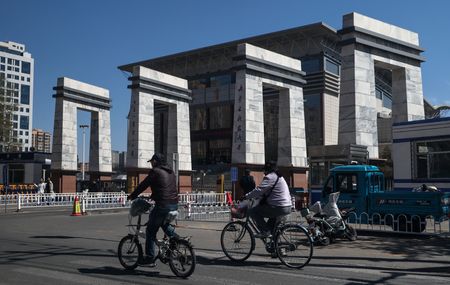
BEIJING, June 1 (Reuters) – Every year, several hundred young adults head to the steppes of northern China to learn about rare earths at schools like the Inner Mongolia University of Science and Technology.
After completing undergraduate study, they may venture a few kilometers up the six-lane Rare Earths Street in Baotou, where they can work for state-owned refiners that convert the critical minerals into magnets that power jet engines, electric vehicles and wind turbines. Or, the graduates may pursue further studies at the nearby Baotou Rare Earth Research Institute – roughly 150 km (93 miles) from the world’s largest rare earths mine.
(For a version of this story with graphics, visit )
U.S. President Donald Trump and other Western leaders have pledged billions of dollars in investments to break China’s chokehold on rare earths refining – a powerful lever Beijing has wielded in its trade war with Washington. But China still holds a significant advantage in the pipeline of talent that it has developed over decades in places like Baotou.
China has created an ecosystem of more than 40 specialist rare-earth laboratories that produce cutting-edge research, supplemented by at least 11 universities and technical colleges that collectively enroll more than 500 students annually in rare earths degree programs, a Reuters examination has found. That accumulated expertise sustains Beijing’s grip on global supplies of refined rare earths.
Several U.S. institutions have begun incorporating more of a focus on rare earths in their curriculum, though Reuters could not identify a school outside China that offers a specific undergraduate degree. The Ames National Laboratory in Iowa, whose remit goes beyond the mineral sciences, is also well regarded for its rare earths research.
The mining industry, however, has historically held little appeal for U.S. students, many of whom see it as dirty and dated, executives and professors have said. U.S. institutions awarded just over 200 generalist undergraduate mining and metallurgical engineering degrees in 2023, the latest year with nationwide figures available, according to data compiled by the Colorado-based Society for Mining, Metallurgy and Exploration.
Reuters for the first time has tallied the scale of China’s rare earths research and education system, drawing on research papers, course materials, and interviews with 11 Western mining executives and researchers who have spent extensive time in China. The examination reveals a close relationship between academia and industry that helps Chinese companies produce rare earths quickly and at low cost.
“In China, I used to hire kids right out of university and they’re immediately productive,” said Constantine Karayannopoulos, former chief executive of rare earths companies Neo Performance Materials and Molycorp. “Anywhere else I need to train them for three years.”
Beijing is now tightly guarding this expertise: It has over the years increased restrictions on exports of rare earths technology and equipment. China has also limited contact between industry professionals and foreigners, with some technicians having been ordered to surrender their passports, according to three people familiar with the matter. They did not identify the government entity that confiscated the travel documents but said the crackdown intensified after Trump’s “Liberation Day” tariffs in April 2025.
The National Development and Reform Commission, which is responsible for macroeconomic planning, and China’s industry ministry did not respond to questions about the crackdown and how the country fosters rare earth experts. None of the Chinese research institutes cited in this story responded to comment requests.
U.S. Department of Energy spokesperson Olivia Tinari said in response to questions about Washington’s rare earths rivalry with Beijing that the agency was “investing in American workers, scaling innovation, and expanding domestic production of critical materials.”
Billions of federal dollars have flowed into U.S. mining schools, research programs and other related areas since 2024 as the country seeks to rebuild mining expertise. The U.S. Congress is also considering legislation that would fund international cooperation with allies for mining education.
SCHOOLS OF ROCK
Rare earths can be difficult and costly to process. Refineries must contend with the 17 different rare earths that possess nearly identical chemical properties, a complexity which makes them difficult to isolate from each other.
Extracting neodymium and praseodymium to use in electric vehicles, for example, requires first removing the less-desirable lanthanum and cerium that are more abundant in the Earth’s crust. That separation process involves an intricate cocktail of acids, bases and other chemicals.
The West dominated rare earths refining until the late 20th century. The process can, however, be environmentally damaging, leaving byproducts that can poison soil and water unless properly stored. Excessive exposure to some types of rare earths can also harm the respiratory and nervous systems.
Chinese researchers have documented the contamination of groundwater around a major storage site in Baotou, which is located near one of China’s major rivers. The government has also acknowledged that refining had caused “severe damage” to the environment.
China’s rare earth industry benefited in the 1980s and 1990s from generous tax incentives and an abundant supply of cheap labor. The government and affiliated entities continue to fund research institutes, and state lenders have offered financing on preferential terms to firms that mine critical minerals.
By the 1990s, the processing industry was “wiped out” in the West, said Ed Richardson, chief executive of U.S. magnet producer Thomas & Skinner. “Therefore, the schools have not been educating mining students for this task.”
In contrast, researchers, universities and industry continue to collaborate closely in China. Scientists at the National Engineering Research Center for Rare Earths in Beijing developed a new technology, which state-owned Gansu Rare Earth New Materials adopted in 2023 at a refining facility that can churn out 50,000 metric tons of highly processed rare earths annually.
That is five times what Australia’s Lynas Rare Earths, the largest rare earths company outside China, produced in the 2025 fiscal year.
China produces over 90% of the world’s processed rare earths and rare earth magnets.
Gansu Rare Earth New Materials did not return a request for comment.
A spokesperson for Lynas, which has previously used Chinese consultants, said that China has “excellent facilities and research capability.” The company has since developed its own technical expertise, the spokesperson said.
Course materials published by some of the universities and reviewed by Reuters also show a heavy focus on meeting the needs of industry.
Students majoring in rare earths engineering at the Inner Mongolia University receive more than 100 hours of teaching in courses such as rare earths chemistry and material science. One of the foundational courses is done in partnership with rare-earths labs and companies, and students have the option of attending lectures at corporate facilities.
The 70 students that the Jiangxi University of Science and Technology (JXUST) told state media are set to enroll in its newly created rare earths degree will study the supply chain from processing and metallurgy to magnets. Before graduating, students will also work on research projects with companies.
David Parker, a rare earths expert at Britain’s Durham University who reviewed the Chinese institute’s course outline for Reuters, described it as “highly specialized” and reflective of the “pre-eminent position of China in rare earth science and engineering.”
The education provided at the school “ensures a supply of knowledgeable and informed young people, who are well placed to find employment,” he said.
Chinese rare earths engineering postgraduates are often more narrowly focused in their fields of research than would be the case elsewhere, said Portuguese physicist Luís Carlos, who has visited research institutes in the country for nearly 20 years.
“But if you think about people as small parts of a big machine, then this is good for the machine,” he said.
PIPELINE PROBLEM?
Some Chinese universities have explicitly acknowledged that they are training geopolitical assets.
Rare earths are “core bargaining chips” in global politics, Li Chaozhong, dean of JXUST’s rare earths program, told state broadcaster CCTV in April.
The university’s new program is designed not only for science, he said. It is “also to ensure that China continues to maintain its global leading position in the development of rare earth resources.”
There are some examples of groundbreaking work in the West. Valor Metals, for instance, is using processes developed by the University of Illinois at Urbana-Champaign that the company says are potentially 10 times cheaper and faster than those deployed in China. The technology, however, has not been tested at scale.
The Colorado School of Mines, widely regarded as one of the world’s top mining schools, is developing two new critical minerals research facilities with the Energy Department to complement existing programs. It expects the first to open in 2027.
The school’s mining-related undergraduate programs have in recent years gained more attention and enrollment.
“The U.S. minerals industry needs to be clear that we need the talent and that this is a great career path,” said Kunal Sinha, Valor’s CEO.
(Editing by Veronica Brown and Katerina Ang)
Brought to you by www.srnnews.com
 Polls open in Ethiopia’s election that is widely expected to be won by the ruling party
 Australian woman accused of joining Islamic State group has renounced jihad, her lawyer says
 Malaysia enforces ban on social media accounts for children younger than 16