
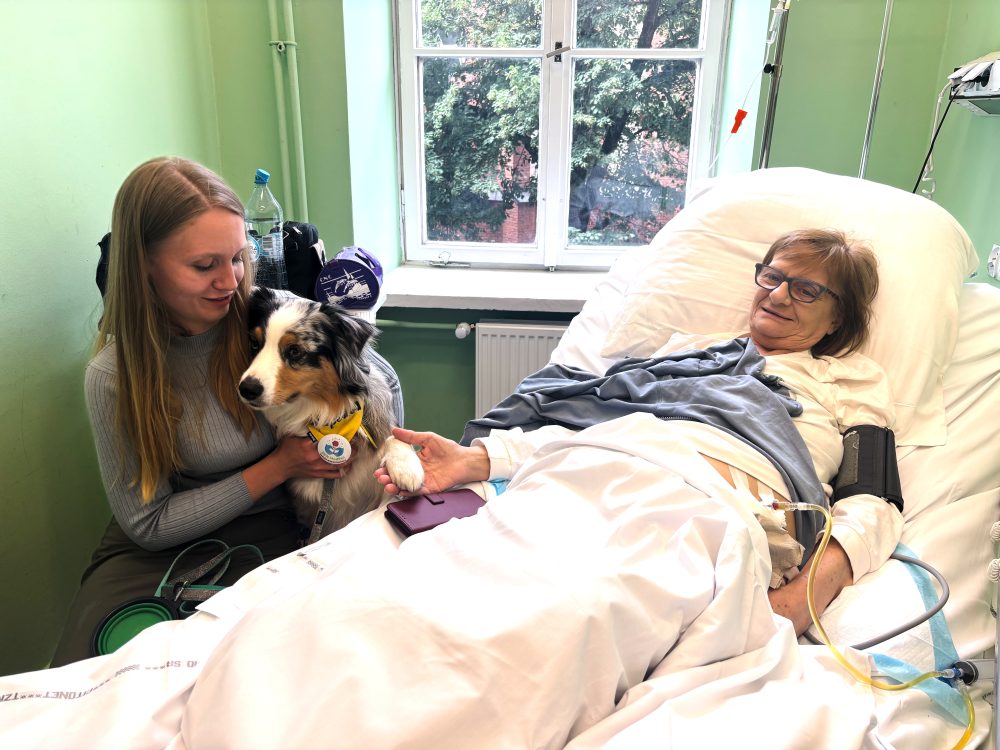
WARSAW, Poland (AP) — When Ewa Lutka-Krawczyk was diagnosed with gallbladder cancer, her first thought was for Gaja, a shelter dog she took in three years ago. She asked her doctor to assure her she would live a few more years so the deeply attached Gaja “wouldn’t be left behind.”
But the prognosis was grim, and this month the 70-year-old was admitted to the palliative ward of a Warsaw hospital. Left at home with Lutka-Krawczyk’s husband, Gaja was barely eating.
“She is waiting for me,” Lutka-Krawczyk said from her bed, where she rested with a draining tube attached to her abdomen.
Under proposed new legislation in Poland, patients like Lutka-Krawczyk soon would have the right to be visited in hospices and palliative care wards by their pets. Visits are already allowed in many clinics, but there is no universal right under the law.
Dr. Tomasz Dzierżanowski, director of the Palliative Medicine Clinic at the Medical University of Warsaw, where Lutka-Krawczyk is being treated, has led the proposal, which was introduced to parliament by a member of Prime Minister Donald Tusk’s centrist party.
Dzierżanowski said the presence of a beloved pet can ease the physical and spiritual pain of terminally ill patients at a time when society is experiencing “an epidemic of loneliness.”
“We make sure that no patient dies alone,” Dzierżanowski said in an interview with The Associated Press.
“When someone is suffering, it is important that someone is there for them. Ideally, that should be another human being,” he said. “Sometimes, however, there is no one.”
Dzierżanowski said he often sees older patients isolated because they have outlived their friends, as well as young patients feeling alone in palliative care clinics because in today’s world of screens and virtual friends, they have not built the kind of friendships that earlier generations often had.
Dzierżanowski said the catalyst for his mission was a seriously ill cancer patient named Waldemar who was not afraid for himself but for his two cats. Dzierżanowski arranged for the cats to be brought into the ward.
The man’s tears of happiness and the cats’ emotional reaction — as well as that of other patients and hospital staff who witnessed the reunion — “made me realize that this issue finally needed to be addressed,” he said.
Dzierżanowski allows pets to visit patients in his clinic when conditions allow, which means that Lukta-Krawczyk can look forward to a visit from Gaja. That pleased her when she learned of it.
“In reality, animals in hospitals are already there anyway,” said Katarzyna Piekarska, the lawmaker who introduced the legislation, which is now in parliament’s health committee. “That’s why it needs to be regulated in the law.”
Dzierżanowski also allows visits by therapy dogs. When the AP visited, Kluska, an Australian shepherd, was making the rounds with her owner, Małgorzata Brzozowska.
Kluska — whose name means “dumpling” — brought some distraction to Lutka-Krawczyk, who held the dog’s paw and smiled.
Another patient, Wojciech Zelik, a 58-year-old admitted with a tumor, propped himself up to admire the dog as Brzozowska got Kluska to perform tricks.
“She has such lovely fur to pet, so fluffy,” he said, reaching over and rubbing her head.
Brzozowska said therapy dog visits also help relieve the stress of nurses, cooks and other staff who tend to the terminally ill patients. Several made a fuss over Kluska, crouching down to pet her in the hallway — with the cook giving her slices of ham.
Brzozowska, a medical student, said the benefits are even greater when the patients are visited by their own pets. It calms them, their loved ones — and the animals, too.
“The dog isn’t as stressed,” she said. “We interpret this as meaning that he simply knows what’s happening, that he knows where the owner, who was always there before, has disappeared to.”
Brought to you by www.srnnews.com
 Kenyan police block roads around the country’s capital ahead of anti-government protest
 An oil tanker navigates the Strait of Hormuz despite threats from Iran’s Revolutionary Guard
 Canadian defence minister says he discussed GCAP fighter with Japanese counterpart
 UK’s Reeves backs Burnham for prime minister, defers on own role