
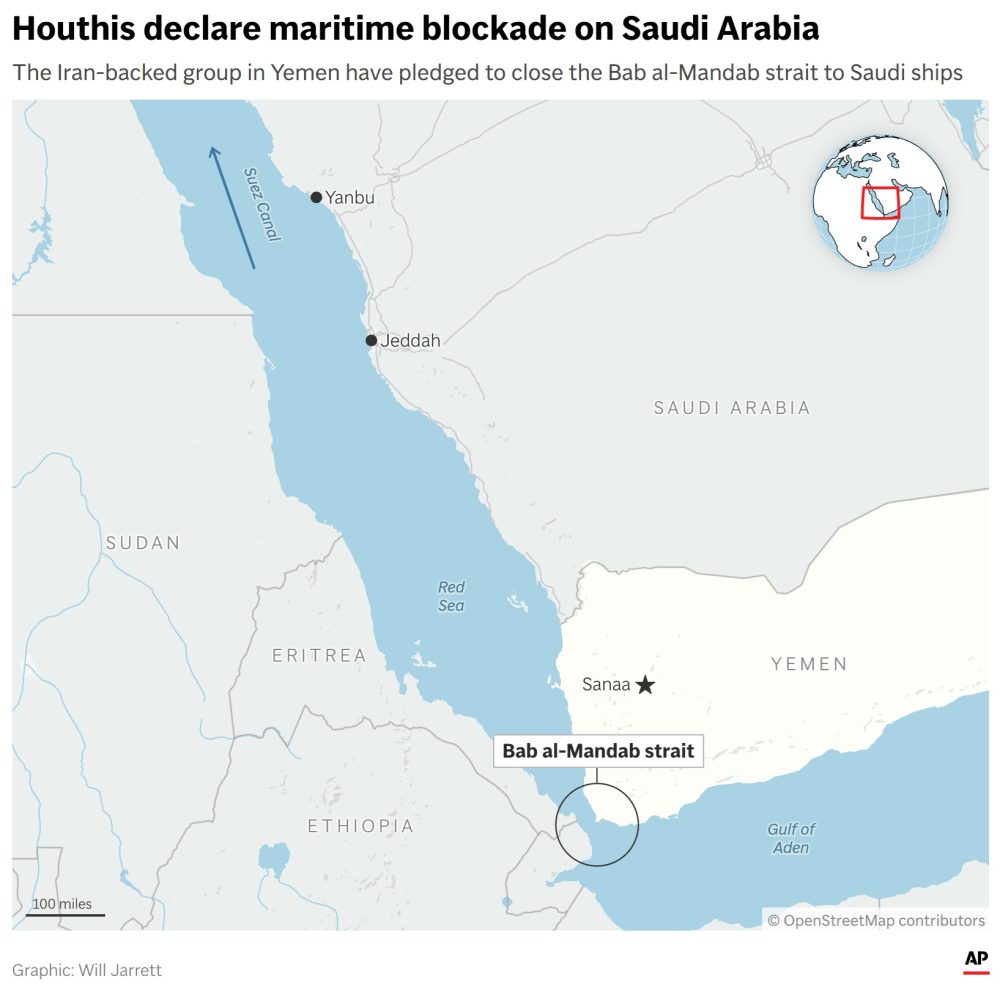
CAIRO (AP) — A declared blockade of Saudi Arabia by Yemen’s Houthi rebels has the potential to widen the Iran war and further disrupt global oil supplies and international trade.
The rebels say they have closed the Bab el-Mandeb Strait to Saudi-linked shipping in retaliation for the kingdom’s blockade on Yemen and a recent attack on the international airport in Yemen’s rebel-held capital, Sanaa. The Houthis claim to have forced six ships to reroute on Tuesday, but there was no independent confirmation.
Bab el-Mandeb, at the southern tip of the Arabian Peninsula, is a vital shipping chokepoint, connecting the Red Sea to the Gulf of Arabia. Around 12% of the world’s trade, including a fourth of global container traffic, passes through the narrows, moving between Europe and Asia via Egypt’s Suez Canal.
The strait has become even more vital for Saudi oil exports since the disruption of the Strait of Hormuz during the Iran war has severely limited shipping out of the Persian Gulf.
The Houthis say they will only stop vessels connected to Saudi Arabia or going in and out of its Red Sea ports. But during a similar blockade announced against Israel over the war in Gaza, the rebels attacked many vessels with little or no connection to that conflict.
The threat alone could keep international shippers from using the route.
The Houthis don’t control the part of Yemen’s coastline along Bab el-Mandeb — that’s in the hands of its opponents in the country’s civil war. But they hold territory less than 100 kilometers (60 miles) away.
Three Houthi officials told the AP on Tuesday that the group has planned for months how to disrupt shipping in the strait. Those plans include the use of naval mines, explosive-laden boats, drones and helicopters to allow fighters to board ships, the officials said, speaking on condition of anonymity because they were not authorized to talk to media.
They said vessels would first be warned not to cross designated boundaries in the strait. If ships ignore the warnings, the Houthis would resort to military action.
In the Strait of Hormuz, Iran has shown that even sporadic attacks on ships can be enough to effectively close a critical waterway, by driving up risks and insurance premiums.
“If Bab el-Mandeb comes under pressure at the same time as shipping in the Gulf, you have disruption around two of the world’s most important maritime routes at once,” Clionadh Raleigh, the founder of ACLED, a conflict monitoring service, said Tuesday.
More than 7 million barrels of petroleum a day transited Bab el-Mandeb in June, compared to around 4 million before the Iran war, Allison Minor, the director of the Atlantic Council’s Project for Middle East Integration, wrote in an analysis published Monday.
Saudi Arabia has been recently exporting some 4 million barrels of oil a day through its Red Sea port of Yanbu, blunting the impact of the closure of the Strait of Hormuz, which has still rattled economies around the world.
Saudi Arabia could still get crude to market without using Bab el-Mandeb, by shipping up to 2.5 million barrels a day across the Red Sea to Egypt, whose SUMED pipeline can carry it to the Mediterranean. It could also ship 1 million barrels a day through the Suez Canal.
International shippers could also reroute, as they did at the height of the war in Gaza. But that means going the long way around the Cape of Good Hope off South Africa, adding one or two weeks to voyages — and raising costs.
The Houthis attacked over 100 vessels at the height of the war in Gaza, before a punishing U.S. and Israeli air campaign put an end to the attacks in early 2025.
U.S. President Donald Trump brushed off the latest threat.
“So far, it hasn’t happened,” Trump told reporters in the Oval Office on Tuesday. “I think that if there is something like that, we’ll just have to take care of business.”
The Houthis also run the risk of reigniting the war with Saudi Arabia and its allies in Yemen, where major fighting ended with a truce in 2022. Saudi Arabia’s military says it will keep Bab el-Mandeb open.
“All Houthi threats against transiting vessels will be dealt with swiftly and firmly, as such threats are a blatant violation of international law and fall under acts of maritime piracy,” said Maj. Gen. Turki al-Malki, a Saudi military spokesperson.
Yemen’s civil war began in 2014 when the rebels seized the capital, Sanaa, and much of northern Yemen, forcing the government into exile. Saudi Arabia has led an international coalition fighting the rebels and also imposed an air and sea blockade on Houthi-held parts of Yemen, which had eased in recent years.
The Houthis say Saudi Arabia struck the airport in Sanaa earlier this month in an attempt to stop a flight carrying Houthi leaders back from Iran, where they had attended the funeral of Supreme Leader Ayatollah Ali Khamenei. The plane landed safely at another airport.
The Houthis then launched missiles and drones at Saudi Arabia’s Abha International Airport in the most significant confrontation in years.
The Houthis say closing Bab el-Mandeb to Saudi traffic aims to break the coalition’s blockade.
Ahmed Nagi, a senior Yemen analyst at the International Crisis Group, said the blockade also benefits the Houthis’ ally, Iran, at a time when the U.S. has resumed daily airstrikes.
″From Iran’s perspective, opening additional pressure points across the region gives it more leverage,” Nagi said. “The Houthis provide Tehran with influence over one of the world’s most important maritime chokepoints.”
——
Al-Haj reported from Aden, Yemen. Associated Press writer Collin Binkley in Washington contributed.
Brought to you by www.srnnews.com
 Ukraine’s Zelenskyy fires military chief after protests and names a replacement
 Two of Puerto Rico’s top government officials to step down as corruption allegations persist
 Carney says he and Trump will intensify trade negotiations after US hiked tariffs by 50%
 Lawyer in sensitive Vatican abuse case issues scathing critique of church’s secretive legal system