
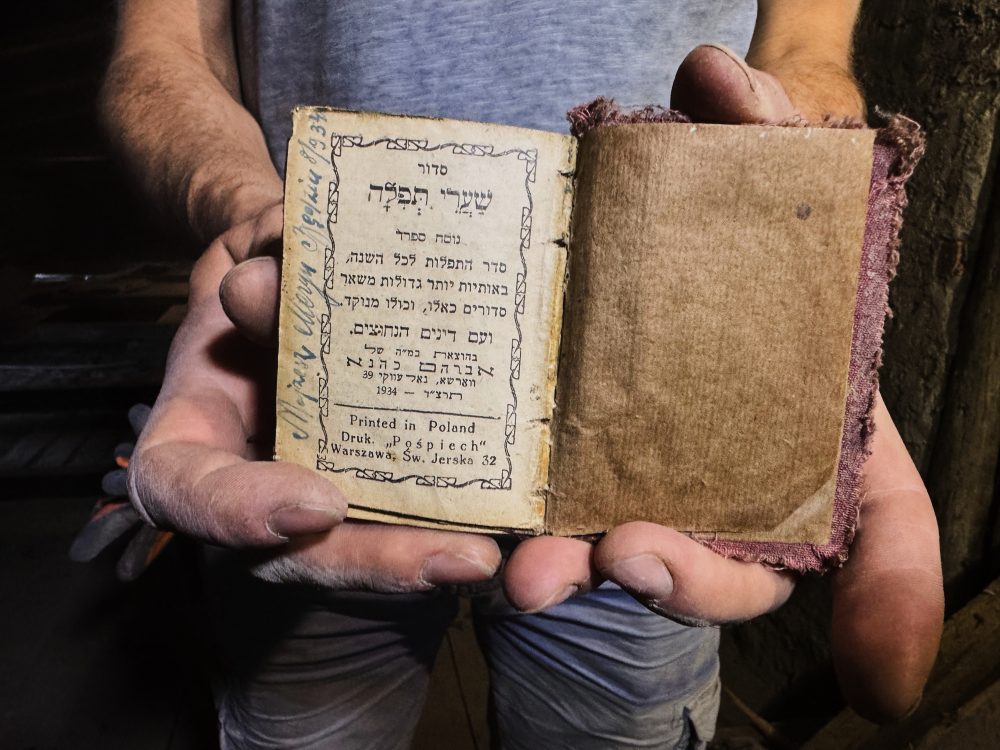
BEDZIN, Poland (AP) — A secret bunker, an underground tunnel and an armband bearing the Star of David are among the rare findings in a house in southern Poland that was used by Jews, including young members of the resistance, to hide from the Nazis.
“This armband is a witness, it’s like directly touching that evil which people created for other people,” Karolina Jakoweńko from the Cukerman’s Gate Foundation, which organized the search, told The Associated Press. Seeing it felt like a “jolt,” she said.
Jakoweńko spoke inside a two‑story redbrick house in the town of Bedzin, within the former Jewish ghetto during the World War II. The house served as the site of a “kibbutz” organized by youth from left‑wing Zionist groups — in this case, a network that relied on each other to try to ensure its members survived and resisted the Nazi occupiers.
In the days before the interview, Jakoweńko and her colleagues cleared the house attic in preparation for renovation, lifting floorboards one by one and collecting rubble in buckets, then carefully examining each handful. Among objects spanning several decades, they discovered a Jewish prayer book from 1934, and the armband bearing the Star of David.
The Cukerman’s Gate Foundation last year uncovered a bunker and an underground tunnel on the grounds of the redbrick house, relying on survivors’ memoirs and oral histories the foundation had collected. Evidence suggested there were three bunkers around the property.
“The entry to the bunker was through the kitchen oven,” Piotr Jakoweńko said, pointing to a second bunker located under the kitchen, where bricks were arranged differently. “We are not aware any of the people here survived when the Nazis discovered this place. Perhaps as many as 60 were hiding here.”
Uncovering the hideouts used by Jews to escape certain death required carefully examining the property, bit by bit, under the guidance of archaeologists.
Wojciech Mazan, one of the volunteers who helped with the search, said their work was grueling but it mirrored what the Jewish youth was doing to dig out the tunnel and bunkers. “We feel some closeness to them in this energy. The house is speaking to us.”
About 27,000 Jews lived in Bedzin before the war, representing half the town population. Others lived in nearby towns and villages in the coal-mining area neighboring Germany, forming one of the most cosmopolitan and economically developed Jewish communities in Poland. In 1942, the Nazi occupation authorities formalized the creation of ghettos for Jews.
The house Jakoweńko and her colleagues are caring for today is an important point on the map of Jewish resistance in Nazi-occupied Poland. While the best known episode is the fight of Jews against Nazis during the liquidation of the Warsaw Ghetto in 1943, many other pockets of resistance existed across the country.
The house is also likely to become a significant landmark on the European map of the Holocaust history, said Joanna Król-Komła from the POLIN Museum of the History of the Polish Jews in Warsaw.
“There are only a few authentic places in Europe where Jews hid that have been preserved,” she said. “But in those cases, the story is usually told from the perspective of the righteous — those who saved Jews.” In Bedzin, by contrast, the preserved hiding place was organized by Jews themselves.
By the time the Nazis began destroying the Bedzin ghetto in the summer of 1943, Jews hiding there had managed to smuggle in about 20 guns from outside the ghetto. They were aware that the Warsaw Ghetto, where the resistance movement was bigger and stronger, had been liquidated in May.
The Jews in Bedzin knew well they stood no chance to survive and some chose to die weapons in hand, shooting at the Nazis who found them, Król-Komła said.
Frumka Płotnicka, a female fighter and courier from the Warsaw resistance movement who was sent to Bedzin to help organize local Jews, died in a third bunker that hasn’t been found yet, according to Karolina Jakoweńko.
She said the acts of resistance in the community went beyond shooting back at the Nazis. “Whether building bunkers or trying to hide a child or an aging parent, this is all resistance. It doesn’t always have to be a fight with weapons in hand. The fact that they wanted to survive was a form of resistance.”
Before World War II, Poland was home to Europe’s largest Jewish population, counting around 3.3 million. While Nazi Germany, which occupied Poland during the war, is responsible for the Holocaust, Poland today still struggles with some episodes during which Polish neighbours were involved in local pogroms against Jews.
In Bedzin, however, the local community is actively working to revive its Jewish history. Karolina Jakoweńko, who is originally from Bedzin, said “this Jewish history, for me, gave meaning to this town.”
She also honored the Polish family who built the redbrick house in the interwar period, Maria and Józef Polak, and lived together with the Jews, kids playing together, throughout the war, as permitted by the rules of the Bedzin ghetto. According to accounts given by the family to Jakoweńko, the woman witnessed the courtyard fill up with bodies after the Nazis killed the Jews who were hiding.
After the war, the Polish family and their heirs chose not to fence off the property, allowing Jewish and other visitors. In recent years, they agreed to sell the house to the Cukerman’s Gate Foundation, which plans to turn it into a museum under the name “the Bedzin Ghetto Fighters’ House.”
Brought to you by www.srnnews.com
 Confirmed Ebola cases in Congo reach 282 as survivors describe their recoveries
 The bad news keeps coming for Keir Starmer with new trove of Mandelson files due to be published
 Hungary’s Magyar to amend the constitution to remove President Tamás Sulyok
 Colombia right wing lawyer De La Espriella, leftist senator Cepeda set for adversarial runoff