
BUENOS AIRES, Argentina (AP) — It took a World Cup to transform a remote cluster of islands that’s home to more sheep than people into a cultural juggernaut.
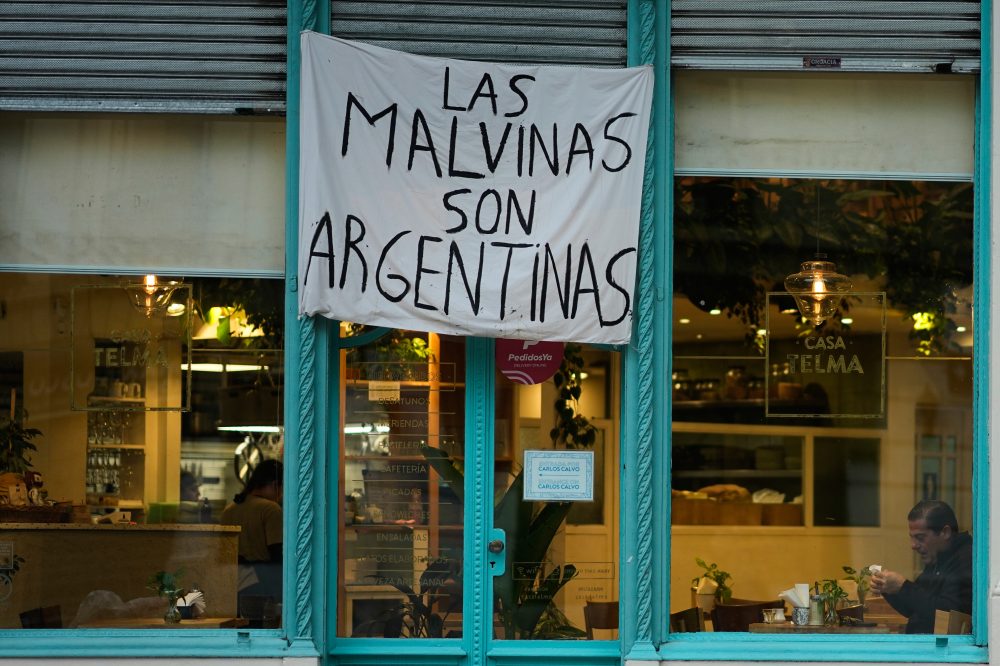
A decision by Argentina’s players to unfurl a banner about the disputed Falkland Islands after defeating England in the World Cup semifinals carried a historical cause onto the T-shirts, bedroom walls and Instagram feeds of a new generation. In the weeks since, the image that has endured from the tournament in soccer-crazed Argentina hasn’t been of Lionel Messi. It’s been the crudely painted sign reading: “The Malvinas are Argentine.”
The South Atlantic archipelago, known in Argentina as the Malvinas, is claimed by both Argentina and Britain, which fought a 10-week war over the territory in 1982.
The banner spawned a marketing bonanza in Argentina, appearing on stickers, tote bags, sneakers, artwork and soccer jerseys. It was draped over bars, painted onto subway walls and tattooed onto calves and forearms. Thousands of Argentines downloaded “Malvinas Sans,” a typeface modeled on the banner’s hand-painted lettering. Colorful murals of the islands and of war veterans popped up across the country.
“The World Cup is now over, and yet people are still talking about the Malvinas because the Malvinas somehow became part of the World Cup,” said Edgardo Esteban, an author and veteran of the war. “Kids in schools are asking me, ‘What’s this Malvinas thing?’ Now there’s a passing of the torch.”
None of Argentina’s players had been born when the country’s military dictatorship invaded the Malvinas in 1982, holding the islands for 73 days before British forces recaptured them in a war that killed 649 Argentine and 255 British troops.
But they grew up in a country haunted by the humiliation of that ill-fated invasion, widely seen as a desperate bid for popularity by the weakened junta that fell a year later. As Argentina emerged from the trauma of the brutal dictatorship, many veterans and families of conscripts killed in the war felt their sacrifices had been sidelined by a nascent democracy that sought to distance itself from the disaster.
“As veterans, we spent a long time feeling silenced, forgotten, pushed aside,” Esteban said.
It took a different World Cup to break that silence. When Argentina played England in the quarterfinals in Mexico City in 1986, Argentine soccer great Diego Maradona scored two goals — including his notorious handball known as the “Hand of God,” which he dedicated to those killed in the war and said was revenge for the Malvinas.
Over the decades, Argentina’s claim on the islands became enshrined in its constitution. The Malvinas appeared on road signs. Each year, the country’s leaders honor the war dead with wreath-laying ceremonies.
The islands, which lie 480 kilometers (300 miles) off Argentina’s coast, are home to some 3,600 people, roughly 450,000 sheep and over 1 million penguins, according to government figures.
Ahead of this year’s semifinal against England, Argentine Security Minister Alejandra Monteoliva warned fans that Malvinas-themed signs would not be allowed inside the stadium due to FIFA’s ban on political messages.
As Argentine players ran onto the field to celebrate their victory, supporters tossed what appeared to be a white bed sheet onto the pitch. Midfielder Giovani Lo Celso pulled it open to reveal the message hand-painted in bold black letters: “Las Malvinas son Argentinas,” or “The Malvinas are Argentine.” Teammates Cristian Romero and Lisandro Martínez helped spread the banner wide before TV cameras and cheering fans.
After the match, British politicians and fans took to social media to vent their anger, helping amplify a wave of online posts criticizing both Argentina and its national team, digital researchers said.
On Wednesday, FIFA charged Argentina’s soccer federation for players parading the banner.
In Argentina, the banner became a sensation, eclipsing for many both the disappointment of the team’s defeat to Spain in the final and the flood of hostile commentary.
“Despite not having won the tournament or brought home the trophy, every single player was welcomed back as a popular hero,” said Juan Rattenbach, an Argentine political expert on the Malvinas.
Iván Marcasiano, 36, owns a Buenos Aires print shop that has struggled to keep up with explosive demand for T-shirts printed with players holding the banner.
“The players had the courage to display a flag on the field that fans had been banned from bringing into the stadium. That gesture, showing that it’s up to ordinary Argentines to carry our demands forward, really resonated with young people,” Marcasiano said.
“They reached an audience that might never have participated in this kind of activism or historical remembrance before.”
When Marcasiano offered on Instagram to screen-print the image onto fans’ Argentina jerseys free of charge, 3,500 people — from teenagers to war veterans — showed up at his shop in a single day, he said.
It remains unclear if the Malvinas frenzy is a flash-in-the-pan obsession or evidence of a lasting resurgence of the political cause.
Activists have scrambled to harness the momentum. They are invoking national sovereignty to rally opposition to libertarian President Javier Milei’s free-market agenda, including legislation that would loosen restrictions on foreign land ownership in Argentina.
But experts said the real political impact may lie beyond Argentina: introducing tens of millions of viewers worldwide to a dispute over a chain of islands few could have found on a map. Global Google searches for the Malvinas jumped 2,400% after Argentina’s semifinal against England, according to Google Trends, the largest increase in search interest since the platform began tracking data.
“Britain’s strategy since 1982 has been to keep the issue of the Malvinas out of the spotlight,” Rattenbach said. “Now, no one can deny its visibility.”
Brought to you by www.srnnews.com
 Rights group says Russia-linked airstrike in Mali killed 8 civilians last month
 Hydropower plants brace for heavy rains in southern Brazil as severe El Niño looms
 Analysis-Tariff provisions could doom long-awaited Russia sanctions bill