
By Renee Hickman
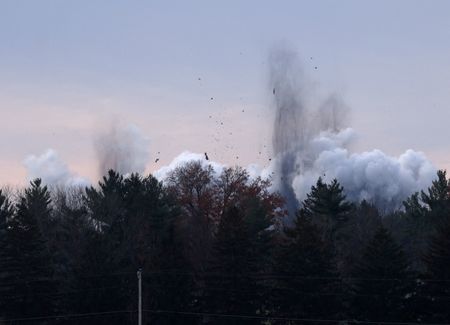
CHICAGO, Nov 28 (Reuters) – Jessica Phillips, who lives on an Iowa farm about five miles (8 km) from where the US Army detonated several tons of lead azide this week, was relieved after the blast was over. But she still wants answers from the government about why it was necessary.
The Environmental Protection Agency said after Wednesday’s blast that no airborne lead from the explosion had been detected by its monitors in the region, an assessment she trusts.
Lab results from the first soil and water samples collected after the detonation found negligible levels of contamination attributed to the blast in surrounding areas, the EPA said on Saturday.
But in a state where rising cancer rates were a major issue in this month’s midterm elections, Phillips and other area residents were keen to know who was responsible for the toxic stockpile becoming so degraded that it threatened their communities.
“I teach my kids accountability,” she told Reuters. “And there sure in hell should be some accountability over this.”
Iowa Senator-elect Josh Turek, a Democrat, has called for a full investigation of why the stockpile had deteriorated to such a state and had to be detonated in place, according to local media.
AGING CHEMICALS
Many southeast Iowa residents reacted with alarm and confusion after November 15, when the Army announced the imminent detonation of 68 barrels of the now-obsolete chemical used as an explosive in military munitions.
Legal wrangling followed as environmental groups filed suits to pause the blast, which was delayed by five days, while the Army said the chemicals were in danger of spontaneously exploding, posing a more acute danger to the public.
The risk drove some locals to flee their homes over the Thanksgiving holiday. They now face uncertainty over the safety of their air and water after the blast.
Sean Byers, a resident of Middletown, Iowa, packed up his three small children to Branson, Missouri, a six-hour drive away, where he has family.
“They’re still developing. They’re still growing,” Byers said. Staying in town was “just not a risk I’m willing to take.”
In 2009, the Army relocated the nation’s supply of lead azide to the Iowa Army Ammunition Plant in Middletown, officials said this week. At the time, they said, some of the stockpile was already more than 60 years old.
The Army said in March it had discovered dangerous crystallization in the lead azide barrels that made the stockpile unstable. Officials said they communicated the problem with residents immediately, but it was not until November 15 that they announced the date of the detonation. They also released maps showing toxic lead dust traveling up to 100 miles from the blast site.
There is no safe level of lead in the blood, according to public health experts, and it poses especially severe health risks to children, including impaired brain development.
Melanie Knedler of Burlington, Iowa, said she and her husband Nick had taped their windows shut and brought their cats inside in preparation for the detonation.
They expected to hear a loud boom, she said, but heard nothing as a plume of dust became faintly visible on a livestream they were watching.
Still, Knedler said she intends to take soil samples she gathered before and after the blast to the University of Nebraska for independent testing.
“I think they contained it well,” Knedler said about the Army. “We needed to make that big uproar in order for them to take care of it properly.”
Phillips and her husband, Aaron, raise cattle on their farm, but did not relocate them or move them indoors as the Iowa Department of Agriculture had suggested. Aaron thought it was unnecessary, although Jessica had some concerns about the animals’ safety.
“I made jokes that I was going to sneak some of my favorite cows into the basement,” she said.
(Reporting by Renee Hickman; Editing by Edmund Klamann)
Brought to you by www.srnnews.com
 Bethlehem businesses hopeful tourism will return this Christmas
 Argentina’s bid to stop UK oil activity near Falklands rejected by international court
 Indian police disperse protest outside Meta offices with water cannon