
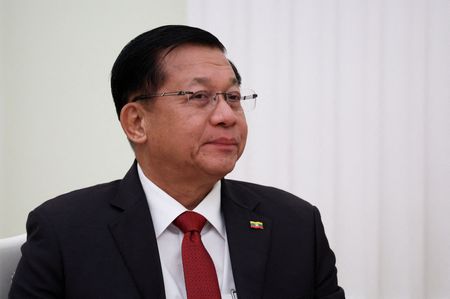
June 16 (Reuters) – Myanmar President Min Aung Hlaing’s state visit to China is set to give the former junta chief a significant diplomatic boost as he seeks to consolidate his grip on power in the war-torn country following a widely condemned election at the turn of the year.
The five-day trip at the highest level of diplomatic engagement, during which Min Aung Hlaing will meet Chinese President Xi Jinping, follows an official visit to India at the end of last month, when he held talks with Prime Minister Narendra Modi.
“An official state visit hosted by Xi Jinping is a visible signal that China is prepared to deal with Myanmar’s new administration as a full partner,” said Richard Horsey, the senior Myanmar adviser at Crisis Group.
“India gave him a warm embrace on his recent visit, but not the full honours of an official state visit.”
While the optics are a win for Min Aung Hlaing, analysts say Beijing is likely to remain focused on securing its own strategic interests, including strengthening borders and developing key resources such as rare earths.
China is Myanmar’s top trading partner and investor, anchoring its influence through major Belt and Road projects, including a cross-country oil and gas pipeline and a deep-sea port.
Beijing also serves as a vital supplier and diplomatic partner for the Myanmar military, sometimes even helping broker ceasefires along parts of its border, where ethnic armies with deep connections to China hold sway.
“China’s interests are not on federalism, but rare earths, infrastructure, mining, and securing the economic corridor to the Indian Ocean,” said David Mathieson, a Thailand-based independent analyst who closely tracks Myanmar.
“China also perceives the West in retreat from Myanmar and Beijing will assert a new suzerainty over the country.”
CHINESE INTERESTS
Myanmar has been in the throes of a devastating civil war since Min Aung Hlaing ousted the elected government led by Aung San Suu Kyi in February 2021.
Protests against the coup morphed into a nationwide armed uprising, pitting the well-armed military against a collection of newly formed pro-democracy armed groups and long-established ethnic armies.
The fighting has ravaged the impoverished Southeast Asian nation, killing more than 93,000 people and displacing more than 3.7 million.
Despite the conflict, Myanmar’s military engineered a general election last December and January that excluded any major opposition and led to an overwhelming victory for an army-backed party, paving the way for Min Aung Hlaing to become president.
The delegation accompanying Min Aung Hlaing to China includes the chief ministers of Myanmar’s Kachin and Shan states, which both border China, as well as the country’s industry minister, according to state media.
Kachin State, where fighting is raging between the military and a major armed group, has one of the world’s major heavy rare earth mining belts, while Shan State shares several trading routes with China.
The ministers’ presence suggests discussions will probably focus on border trade and the Myitsone Dam, a $3.6-billion Chinese-led project in Kachin State that was shelved in 2011, said Aung Kyaw Soe, an independent Thailand-based analyst.
“In 2025, the military’s second-in-command, General Soe Win, personally began bringing up the subject of restarting Myitsone, so I think they will discuss restarting it during Min Aung Hlaing’s current trip to China,” Aung Kyaw Soe said.
Hanging over Min Aung Hlaing’s visit is the recent arrest in China of Min Zin, a prominent American scholar of Myanmar, on suspicion of espionage.
“Min Aung Hlaing’s visit will put a greater focus on Min Zin’s arrest, because he is one of the most prominent Myanmar scholars working to improve understanding between the two countries,” the Crisis Group’s Horsey said.
(Reporting by Reuters Staff, Editing by Devjyot Ghoshal and Kate Mayberry)
Brought to you by www.srnnews.com
 6.7 magnitude earthquake shakes part of Indonesia
 Strait of Hormuz transit will take ‘weeks’ to resume, largest tanker operator tells FT
 Photos show the resurfaced remains of World War II’s ‘Death Railway’ in Thailand