
By Maayan Lubell and Rami Ayyub
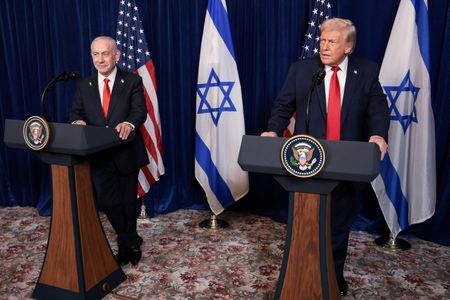
JERUSALEM, March 4, (Reuters) – Israeli Prime Minister Benjamin Netanyahu delivered on a career-long ambition to topple Iran’s leadership, but his lockstep alignment with U.S. President Donald Trump faces a test as their joint military campaign threatens to drag on, with its goals potentially shifting in the coming weeks.
At the outset of the bombing campaign on Saturday, both Trump and Netanyahu said regime change was the goal. But in remarks at the White House on Monday, two days after Israeli air strikes killed Iran’s Supreme Leader Ayatollah Ali Khamenei and much of his leadership, Trump did not mention overthrowing Iran’s government as his top priority.
The U.S. goal, he said, was to destroy Iran’s missiles and navy, and to stop it from obtaining a nuclear weapon. His Pentagon chief Pete Hegseth said at a press conference that same day that the operation was not a “so-called regime-change war.”
Netanyahu, by contrast, has called on Iran’s citizens to take to the streets and overthrow their rulers as recently as Monday night. “We’re going to create the conditions, first, for the Iranian people to get control of their destiny,” he told Fox News.
Asked about the U.S. and Israeli goals, a U.S. official familiar with the White House’s objectives told Reuters that the two countries’ military campaigns have different objectives. “Regime change is one of theirs,” said the official, who spoke on the condition of anonymity.
In the build-up to war, Netanyahu successfully convinced Trump that it was a now-or-never moment to prevent Tehran from acquiring nuclear weapons and destroy its ballistic missile capabilities. Trump has said the operation could take “four or five weeks” or “whatever it takes.”
“I don’t get bored, I never get bored,” he said at the White House on Monday in response to questions about his capacity for sustained focus.
But Israeli officials privately acknowledge that ultimately it will be Trump who decides when the war ends. Dan Shapiro, a former U.S. ambassador to Israel under the Obama administration, said that Trump may decide to seek an “early off-ramp” from the war.
“If President Trump decides that he’s reached the end of this operation before Netanyahu wants it to end, he’s still going to end it,” said Shapiro, of the Washington-based Atlantic Council think-tank.
President Trump faces domestic pressures that could affect his thinking as the war drags on and expands.
The operation is unpopular in the United States, with only one in four Americans saying they back U.S. strikes on Iran, according to Reuters/Ipsos polling. Primary votes began Tuesday in the battleground states of Texas and North Carolina that may decide who controls Congress after the fall midterm elections.
With the crisis disrupting shipping and energy production, rising gas prices could become a daily reminder of the affordability crisis facing many Americans. Gas is up 11 cents per gallon in the U.S. this week, with much higher spikes in global markets suggesting more increases for American consumers.
Inside the U.S., support for Israel has become a partisan issue, with some 59% of Americans holding an unfavourable view of Israel’s government, up from 51% a year ago, according to a Pew Research Center poll from October.
The White House and Netanyahu’s office did not respond to requests for comment.
PLANNING FOR WAR
In power for most of the last three decades, Netanyahu has often clashed with American leaders, notably publicly criticizing former Democratic President Barack Obama for negotiating a nuclear deal with Iran. Democratic President Joe Biden’s administration often clashed with Netanyahu and withheld some weapons from Israel during its military assault in Gaza.
After Trump’s return to office in 2025, Netanyahu met with the president seven times and repeatedly pushed in phone calls to focus his attention away from Israel’s war in Gaza and toward Iran’s ballistic missiles and nuclear ambitions, painting the clerical rulers in Tehran as a common enemy, a U.S. official with direct knowledge of their conversations said.
The officials and others who shared details about U.S.-Israeli planning and objectives spoke on the condition of anonymity to describe sensitive military discussions.
Even as Trump dispatched envoys to nuclear talks with Iran in Geneva and Oman, the U.S. and Israel had been at work for months planning their military operation, and timing for the attack was decided weeks ago, an Israeli official said.
Netanyahu’s last meeting with Trump was a hastily-arranged visit on February 11, 2026 which included a three-hour meeting at the White House, uncharacteristically closed to the press.
The day after that meeting, the USS Gerald Ford aircraft carrier, the world’s largest warship, departed the Caribbean where it was supporting U.S. military action in Venezuela, for the Mediterranean.
“I have tried to persuade successive American administrations to take firm action, and President Trump did,” Netanyahu told Fox News on Monday.
Trump rejected the notion that Israel might have forced his country into war, telling reporters at the White House on Tuesday: “Based on the way the negotiation was going, I think they were going to attack first, and I didn’t want that to happen. So if anything I might have forced Israel’s hand.”
A POLITICAL SURVIVOR
For the 76-year-old Netanyahu, his prosecution of a war that is supported by most Israelis represents an opportunity to seal his legacy ahead of elections, due by October, in which he faces formidable challenges.
His far-right coalition faces fissures, he’s on trial for corruption he denies and Israelis are still reeling from a multi-front war that began in 2023 and which Netanyahu has promised will transform the Middle East.
Israel’s longest-serving leader has shown remarkable political skill in the past. Despite successive polls showing that he will lose the ballot in October, Netanyahu still has a fair chance of victory if Israeli fatalities and the economic costs to Israel of the war remain low, said Udi Sommer, a political scientist at Tel Aviv University.
“If it succeeds, relatively quickly (like) in June 2025, it will work very much in his favour as Israel’s protector and the one who had woven a particularly successful relationship with the administration in Washington,” Sommer said.
Netanyahu’s security credentials were shattered on October 7, 2023, when Iran-backed Hamas militants launched a surprise attack on Israel, killing more than 1,200 people and taking 251 hostages.
It was followed by a two-year military campaign against Hamas in Gaza, where Israel’s longest war has killed at least 72,000 people, according to Palestinian health officials, left much of the enclave in ruins, and exacted the highest Israeli military fatalities in decades.
Netanyahu has rejected responsibility for the security failures of October 7 and has pointed to Israel’s subsequent gains in weakening Iran’s proxies, Hamas and Hezbollah in Lebanon. Their ally Bashar al-Assad in Syria has also been ousted.
Even if Israel achieves its military objectives in Iran, that will not wash away the outrage of many Israeli voters, including among Netanyahu’s own right-wing base, said political analyst Amotz Asa-el of the Jerusalem-based Shalom Hartman research institute.
“The past three years’ events have been so traumatic and so dramatic and so revolting to that swing vote that I don’t think any kind of salvation in Iran will offset this,” he said.
(Reporting by Maayan Lubell and Rami Ayyub in Jerusalem with additional reporting by Alexander Cornwell in Tel Aviv. Editing by Michael Learmonth)
Brought to you by www.srnnews.com
 Philippine lawmakers advance impeachment of Vice President Duterte
 South Africa’s Lekota, who led breakaway from ANC, dies at 77
 Some West African farmers turn to TikTok as part of agriculture’s changing image
 Myanmar junta to ration fuel for private vehicles, blaming Middle East shipping disruptions